https://youtu.be/yqjaG8cK8_0?si=NFTZsh9PC-f2cJT8
{source}<iframe width="560" height="315" src="https://www.youtube.com/embed/yqjaG8cK8_0?si=RjXzGbGSRwfRTqms" title="YouTube video player" frameborder="0" allow="accelerometer; autoplay; clipboard-write; encrypted-media; gyroscope; picture-in-picture; web-share" referrerpolicy="strict-origin-when-cross-origin" allowfullscreen></iframe>{/source}
{source}
<?php  require_once JPATH_SITE.'/TTcustom/TT_contentparser.php';\(parameters = array("topicname" => "biology", "modelname" => "ejss_model_transpiration");echo generateSimHTML(\)parameters, "EJSS");
?>
{/source}
Main Themes and Important Ideas/Facts:
Both sources describe the same interactive biology simulation designed to demonstrate the rate of transpiration in nine different plant species under four varying environmental conditions. The simulation allows users to observe and compare how factors like heat, wind (air movement), and light intensity affect the amount of water transpired by each plant over a one-hour virtual period.
Key Features and Functionality:
- Virtual Experiment: The core of the resource is a virtual laboratory environment where users can set up and run experiments. The second source explicitly states: "Click on Run to simulate the passing of time for 1 hour and view the amount of water transpired by each plant under different conditions."
- Variable Conditions: The simulation allows for testing the effects of four conditions: a control (none), a heater (representing increased temperature), a fan (representing wind or air movement), and a lamp (representing increased light intensity). The second source clarifies these conditions as "(none, wind or air movement temperature of air and light intensity )".
- Nine Plant Species: The experiment features a diverse selection of nine common plant species, consistently listed as: English Ivy, Weeping Fig, Dieffenbachia, Devil's Ivy, Arrowhead, Coleus, Geranium, Rubber Plant, and Zebra Plant.
- Data Recording: The simulation automatically records the data obtained during the experiment in a data table, facilitating analysis and comparison of transpiration rates. The second source notes: "Data obtained is automatically recorded in the data table to the right."
- Learning Goals: The primary learning objective is to understand how different environmental factors influence the rate of transpiration in plants. The second source outlines this clearly: "A biology simulation demonstrating the rate of transpiration of 9 different plants under 4 varying conditions (control, heater, fan, lamp)."
- Educational Application: The resource is intended for educational purposes, particularly for biology teachers and students. The "For Teachers" section in the second source provides "Activity Instructions" for an investigation using the simulation. These instructions guide students to:
- Compare transpiration rates under varying conditions.
- Investigate the effects of heat, light, and wind.
- "Describe the relationship between the environmental factor and the rate of transpiration."
- "Explain the relationship based on your understanding of transpiration and the movement of water molecules."
- Open Educational Resource: The second source explicitly identifies itself as part of "Open Educational Resources / Open Source Physics @ Singapore," indicating that the resource is likely freely available for educational use, subject to the specified Creative Commons license.
- Technical Details: The first source mentions that the simulation was "Compiled with EJS 6.02_BETA (201222)," referring to the Easy JavaScript Simulation toolkit used in its development. The second source also mentions "EasyJavaScriptSimulation" under the "About" section. It also provides an embed code, suggesting it's designed to be easily integrated into web pages.
Important Ideas and Facts:
- Transpiration: The simulation focuses on the biological process of transpiration, which is the movement of water through a plant and its evaporation from aerial parts, such as leaves, stems and flowers.
- Environmental Factors Affecting Transpiration: The simulation directly addresses how key environmental factors – wind, temperature, and light intensity – impact the rate at which plants lose water through transpiration.
- Comparative Study: By including nine different plant species, the simulation allows for a comparative study of transpiration rates across different types of plants under the same environmental conditions.
- Quantitative Data: The automatic data recording feature emphasizes the quantitative aspect of scientific investigation, allowing students to collect and analyze numerical data on water loss.
- Virtual Experimentation as a Tool: The resource highlights the value of virtual labs in providing accessible and controlled environments for scientific exploration, especially for investigating phenomena like transpiration that might be difficult to observe directly in a classroom setting.
Quotes from the Original Sources:
- (Source 2, Learning Goals): "A biology simulation demonstrating the rate of transpiration of 9 different plants under 4 varying conditions (control, heater, fan, lamp)."
- (Source 2, Activity Instructions): "In this investigation, you will compare the rates of transpiration for a selected plant species under varying environmental conditions. You will investigate the effect of heat, light, and wind on the rate of transpiration."
- (Source 2, Activity Instructions): "Describe the relationship between the environmental factor and the rate of transpiration."
- (Source 2, Activity Instructions): "Explain the relationship based on your understanding of transpiration and the movement of water molecules."
- (Source 2, About): "To-do... Add visible light (glow) to the lamp... Remove existing plant from potometer image." (This indicates ongoing development and potential future enhancements).
Conclusion:
The "Transpiration Virtual Lab with 9 Plants" is a valuable educational tool for demonstrating and exploring the process of transpiration and the influence of environmental factors on its rate. The simulation's interactive nature, the variety of plants and conditions tested, and the automatic data recording make it a useful resource for biology education, allowing students to conduct virtual experiments and develop a deeper understanding of this important biological process. The availability as an Open Educational Resource further enhances its accessibility for educators and learners.
Transpiration Virtual Lab Study Guide
Overview: This study guide is designed to help you review the concepts and procedures associated with the Transpiration Virtual Lab, which investigates the rate of water loss in nine different plant species under four environmental conditions: control, heater, fan, and lamp. The lab allows you to collect and analyze data on the effects of wind, temperature, and light intensity on transpiration.
Key Concepts to Review:
- Transpiration: Understand the definition of transpiration, the process by which water is carried through plants from roots to small pores on the underside of leaves, where it changes to vapor and is released to the atmosphere.
- Stomata: Know the role of stomata in transpiration – these are pores in the epidermis of leaves, stems, and other organs that control the exchange of gases and water vapor.
- Environmental Factors Affecting Transpiration:Temperature: How does increased temperature affect the rate of transpiration? Consider the kinetic energy of water molecules.
- Wind/Air Movement: How does air movement around a leaf affect the rate of transpiration? Think about the humidity gradient.
- Light Intensity: How does light intensity influence transpiration? Consider its effect on stomatal opening.
- Water Movement in Plants: Briefly review the concepts of osmosis and cohesion-tension theory in relation to the movement of water from the roots to the leaves.
- Experimental Design: Understand the purpose of a control group and how varying one environmental factor at a time helps isolate its effect on transpiration.
- Data Collection and Analysis: Familiarize yourself with the virtual lab interface, how to run simulations, and how the data is recorded in the table. Understand how to compare transpiration rates across different plant species and environmental conditions.
Quiz:
Answer the following questions in 2-3 sentences each.
- Define transpiration and explain its importance for plants.
- What are stomata and how do they regulate the rate of transpiration?
- Explain how an increase in temperature typically affects the rate of transpiration. Why does this occur?
- How does increased wind or air movement around a plant's leaves influence transpiration? What is the underlying reason?
- Describe the relationship between light intensity and the rate of transpiration in most plants. What mechanism is responsible for this?
- What is the purpose of having a "control" condition in the Transpiration Virtual Lab experiment?
- Name three of the nine plant species available for study in the virtual lab.
- List the four different environmental conditions that can be investigated in the Transpiration Virtual Lab.
- According to the "Learning Goals" section, what is the main aim of this biology simulation?
- How is the data on water transpired by each plant recorded during the virtual experiment?
Quiz Answer Key:
- Transpiration is the process of water movement through a plant and its evaporation from aerial parts, such as leaves, stems, and flowers. It is crucial for plants as it facilitates the transport of water and dissolved nutrients from the roots to the shoots and cools the plant through evaporation.
- Stomata are small pores on the surface of plant leaves that are surrounded by guard cells. They control the opening and closing of these pores, thereby regulating the release of water vapor during transpiration and the uptake of carbon dioxide for photosynthesis.
- An increase in temperature generally leads to a higher rate of transpiration. This is because warmer temperatures increase the kinetic energy of water molecules, causing them to evaporate more readily from the leaf surface into the surrounding air.
- Increased wind or air movement around a plant's leaves typically increases the rate of transpiration. This happens because the moving air sweeps away the humid layer of air that builds up around the leaf, thus maintaining a steeper water vapor concentration gradient between the inside of the leaf and the environment.
- Higher light intensity usually increases the rate of transpiration. Light stimulates the opening of stomata to allow carbon dioxide entry for photosynthesis, and as a consequence, more water vapor can escape from the leaf.
- The control condition in the Transpiration Virtual Lab serves as a baseline for comparison. It represents the natural or undisturbed rate of transpiration, allowing researchers to determine the specific effects of the heater, fan, and lamp by comparing the results to the control.
- Three of the nine plant species available in the virtual lab are English Ivy, Weeping Fig, and Dieffenbachia (or any other three from the provided list).
- The four different environmental conditions that can be investigated in the Transpiration Virtual Lab are none (control), with a heater, with a fan (wind or air movement), and with a lamp (light intensity).
- The main aim of this biology simulation is to demonstrate the rate of transpiration of nine different plants under four varying environmental conditions (control, heater, fan, lamp) and to allow users to observe and analyze the effects of these conditions.
- The data on the amount of water transpired by each plant under different conditions is automatically recorded in a data table displayed to the right of the simulation as time progresses during the one-hour simulation.
Essay Format Questions:
- Discuss the role of environmental factors such as temperature, wind, and light intensity in regulating the rate of transpiration in plants. Using evidence from the Transpiration Virtual Lab (hypothetically, based on how the simulation is designed), explain how each of these factors influences water loss from leaves.
- Compare and contrast the potential transpiration rates of different plant species (as listed in the virtual lab) under the same environmental conditions. What physiological adaptations might account for variations in their transpiration rates?
- Design an experiment using the Transpiration Virtual Lab to investigate the combined effects of two environmental factors (e.g., heat and light) on the rate of transpiration in a specific plant species. Describe your experimental setup, the data you would collect, and how you would analyze the results.
- Explain the interconnectedness of transpiration with other vital plant processes, such as photosynthesis and nutrient transport. How does the rate of transpiration impact these processes, and vice versa?
- Based on the principles of transpiration and the factors that influence it, discuss potential adaptations that plants in different ecological environments (e.g., deserts, rainforests) might have evolved to regulate water loss effectively.
Glossary of Key Terms:
- Transpiration: The process by which moisture is carried through plants from roots to small pores on the underside of leaves, where it changes to vapor and is released to the atmosphere. It is essentially evaporation of water from plant leaves.
- Stomata: Microscopic pores on the surface of plant leaves, stems, and other organs that are used for gas exchange (uptake of carbon dioxide and release of oxygen) and for the release of water vapor during transpiration.
- Guard Cells: Specialized plant cells in the epidermis of leaves, stems, and other organs that control the opening and closing of stomata. They respond to various environmental stimuli such as light, carbon dioxide concentration, and water availability.
- Cuticle: A waxy layer covering the epidermal cells of plants, which helps to prevent water loss from the leaves and other aerial parts.
- Xylem: Vascular tissue in plants that transports water and dissolved nutrients from the roots to the rest of the plant. The movement of water through the xylem is a continuous column, driven by the tension created by transpiration.
- Water Potential: A measure of the relative tendency of water to move from one area to another. Water moves from an area of higher water potential to an area of lower water potential. Transpiration creates a negative water potential in the leaves.
- Humidity: The amount of water vapor in the air. High humidity reduces the rate of transpiration because the concentration gradient of water vapor between the leaf and the air is smaller.
- Light Intensity: The amount of light energy striking a surface. It affects transpiration by influencing stomatal opening and leaf temperature.
- Air Movement (Wind): The movement of air around a plant. It affects transpiration by removing the layer of humid air surrounding the leaves, thus increasing the rate of evaporation.
- Temperature: The degree of heat present in the environment. Higher temperatures increase the kinetic energy of water molecules and can lead to increased transpiration rates (up to a certain point).
- Control Group: In an experiment, a group that does not receive the experimental treatment. It serves as a baseline for comparison to determine the effects of the independent variable.
Learning Goals
View the simulation here.
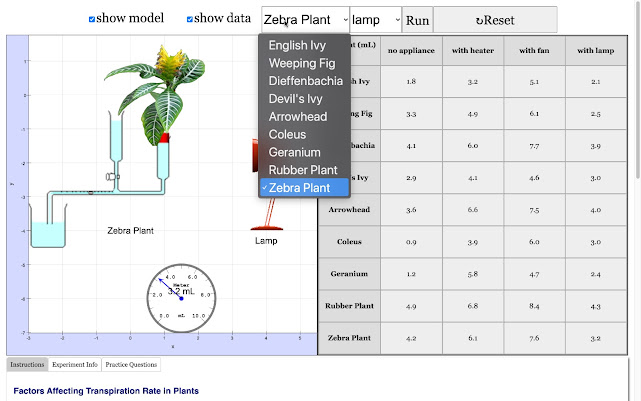
A biology simulation demonstrating the rate of transpiration of 9 different plants under 4 varying conditions (control, heater, fan, lamp). Click on Run to simulate the passing of time for 1 hour and view the amount of water transpired by each plant under different conditions. Data obtained is automatically recorded in the data table to the right.
The 9 plants are English Ivy, Weeping Fig, Dieffenbachia, Devil's Ivy, Arrowhead, Coleus, Geranium, Rubber Plant and Zebra Plant.
For Teachers
- Follow the instructions in the simulation and set up the virtual experiment to investigate the effects of:
- wind or air movement
- temperature of air
- light intensity
With reference to your virtual experimental data,
- Describe the relationship between the environmental factor and the rate of transpiration.
- Explain the relationship based on your understanding of transpiration and the movement of water molecules.
You may refer to this link for more information on the movement of water molecules
Research
[text]
Video
https://youtu.be/yqjaG8cK8_0?si=NFTZsh9PC-f2cJT8
{source}<iframe width="560" height="315" src="https://www.youtube.com/embed/H7HZMctg0Zo" title="YouTube video player" frameborder="0" allow="accelerometer; autoplay; clipboard-write; encrypted-media; gyroscope; picture-in-picture" allowfullscreen></iframe>{/source}
Version:
- https://weelookang.blogspot.com/2021/05/transpiration-virtual-lab-with-9-plants.html original simulation by kyrin
- https://vle.learning.moe.edu.sg/mrv/community-gallery/admin/lesson/view/b411241e-4236-4c4b-a175-ca3b122ef9e3/page/1649553
- Transpiration Virtual Lab for Dynamic Environments for Room, Light, Windy and Humid by jiawen
- Transpiration Virtual Lab with 9 Plants (English Ivy, Weeping Fig, Dieffenbachia, Devil's Ivy, Arrowhead, Coleus, Geranium, Rubber Plant and Zebra Plant) Under 4 Conditions (none, wind or air movement temperature ..
- Transpiration Virtual Lab Factors affecting Transpiration Virtual Lab (Control, Plastic Bag, Fan, Lamp and Heater ) in 3 hours
Other Resources
http://glencoe.mheducation.
Frequently Asked Questions: Transpiration Virtual Lab
1. What is transpiration, and why is it important to study? Transpiration is the process by which moisture is carried through plants from roots to small pores on the underside of leaves, where it changes to vapor and is released to the atmosphere. It is essentially the evaporation of water from plant leaves and stems. Studying transpiration is crucial for understanding plant physiology, water cycling in ecosystems, and the impact of environmental factors on plant health and survival. It also has implications for agriculture, water resource management, and climate modeling.
2. What are the key environmental factors that influence the rate of transpiration in plants, as explored in this virtual lab? This virtual lab focuses on the effects of four key environmental conditions on transpiration rates:
- Wind or air movement: Increased air movement around a plant can remove water vapor from the leaf surface, creating a steeper concentration gradient between the inside of the leaf and the atmosphere, thus increasing the rate of transpiration.
- Temperature of air: Higher temperatures increase the kinetic energy of water molecules, leading to faster evaporation from the leaf surface and a greater capacity of the air to hold water vapor, generally increasing transpiration rates.
- Light intensity: Light stimulates the opening of stomata (pores on the leaves) which are necessary for carbon dioxide uptake for photosynthesis. These open stomata also allow for the escape of water vapor, thus increasing transpiration.
- Control (none): This condition serves as a baseline to compare the effects of the other environmental factors on transpiration rates.
3. Which plant species are included in this virtual lab for studying transpiration? The virtual lab allows users to investigate the transpiration rates of nine different plant species: English Ivy, Weeping Fig, Dieffenbachia, Devil's Ivy, Arrowhead, Coleus, Geranium, Rubber Plant, and Zebra Plant. This variety enables comparative studies of how different plant types respond to the same environmental conditions.
4. How does the virtual lab allow users to investigate the relationship between environmental factors and transpiration rates? The virtual lab provides an interactive simulation where users can select a specific plant species and then choose one of the four environmental conditions (control, heater, fan, lamp). By running the simulation for a set duration (1 hour), users can observe and measure the amount of water transpired by the chosen plant under that specific condition. The data is automatically recorded in a table for easy comparison.
5. What kind of data can be collected from this virtual transpiration lab? The primary data collected in this virtual lab is the amount of water transpired by a selected plant species over a one-hour period under a specific environmental condition. This quantitative data allows for direct comparison of transpiration rates across different plant species and under varying environmental factors.
6. How can teachers use this virtual lab in their biology lessons? Teachers can utilize this virtual lab as an engaging and interactive tool to demonstrate the process of transpiration and the factors that affect it. They can assign activities where students:
- Compare transpiration rates of different plants under the same conditions.
- Investigate the effect of a single environmental factor on the transpiration rate of a chosen plant.
- Describe and explain the relationship between environmental factors and transpiration based on the collected virtual experimental data and their understanding of water molecule movement.
- Use the lab as a pre-lab activity before conducting physical experiments or as a substitute when physical labs are not feasible.
7. What are the learning goals associated with using this transpiration virtual lab? The main learning goals of this virtual lab are to enable students to:
- Observe and compare the rates of transpiration in different plant species.
- Investigate and analyze the effects of wind (air movement), temperature, and light intensity on the rate of transpiration.
- Describe the relationship between specific environmental factors and the rate of transpiration.
- Explain these relationships based on their understanding of the process of transpiration and the movement of water molecules.
8. Where can this virtual transpiration lab be accessed and potentially embedded in other learning platforms? The virtual lab is accessible online through a provided link (https://iwant2study.org/lookangejss/biology/ejss_model_transpiration/transpiration_Simulation.xhtml). The lab also offers an embed code (<iframe width="100%" height="100%" src="https://iwant2study.org/lookangejss/biology/ejss_model_transpiration/transpiration_Simulation.xhtml " frameborder="0"></iframe>), allowing educators to seamlessly integrate the interactive simulation into their own webpages or learning management systems.