{source}
<?php  require_once JPATH_SITE.'/TTcustom/TT_contentparser.php';\(parameters = array("topicname" => "math/Differential_Equations_Partial", "modelname" => "ejss_model_e_VibratingString_R");echo generateSimHTML(\)parameters, "EJSS");
?>
{/source}
Overview:
This document provides a briefing on the "Vibrating String JavaScript Simulation Applet HTML5" available on the Open Educational Resources / Open Source Physics @ Singapore website. This interactive simulation is designed to illustrate the principles of the one-dimensional wave equation and the behavior of vibrating strings, relevant to both mathematics and physics education. The applet utilizes an explicit difference method to solve the wave equation and offers various functionalities for users to explore different initial conditions and observe the resulting wave propagation and interference.
Main Themes and Important Ideas/Facts:
- Solving the One-Dimensional Wave Equation: The core function of the applet is to solve the "one-dimensional wave equation using an explicit difference method." This equation is described as a "second-order linear partial differential equation, obtained by considering the forces which apply to a small element of the string of length dx." This highlights the underlying mathematical and physical principles the simulation models.
- Visualizing Wave Propagation and Reflection: The simulation visually demonstrates how an initial deflection on a string fixed at both ends evolves over time. A key observation, contrary to naive expectations, is that the initial pulse does not simply deflect. Instead, "two identical pulses of half the initial amplitude propagate to both ends, are reflected and recombine in the middle to the initial pulse with opposite sign. After two reflections the original pulse is reconstructed." This illustrates the fundamental concepts of wave propagation and reflection at boundaries.
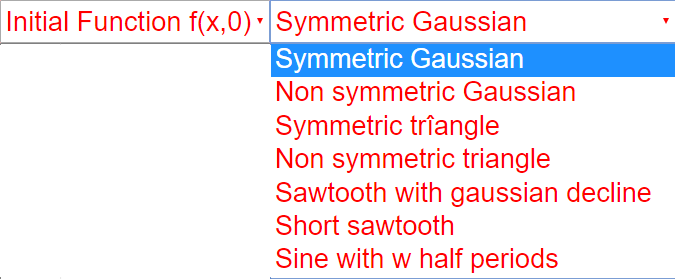
- Exploring Initial Conditions: The applet allows users to select from a variety of predefined initial deflections using a "Combobox". These include:
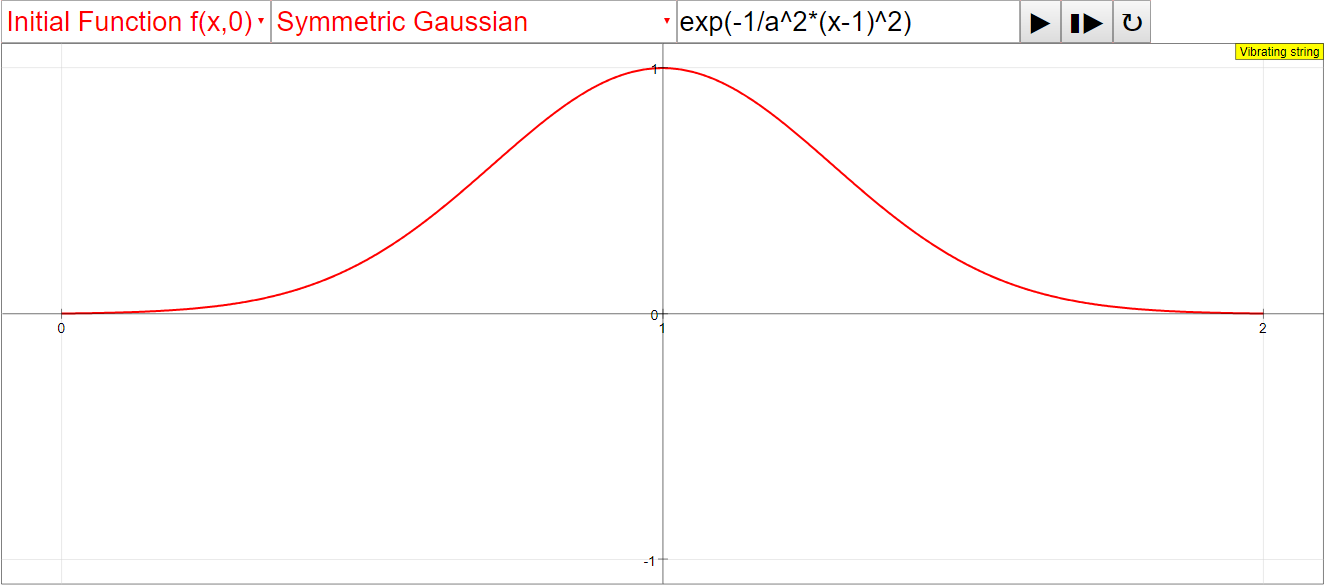
- Symmetric Gaussian of variable width
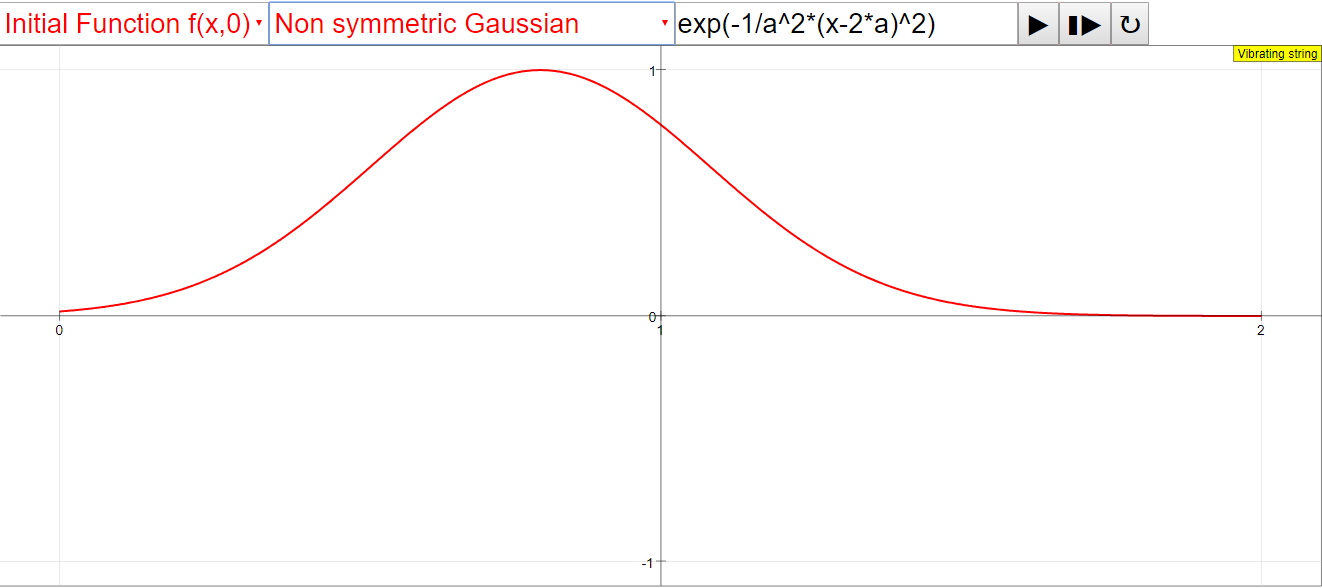
- Non symmetric Gaussian of variable width
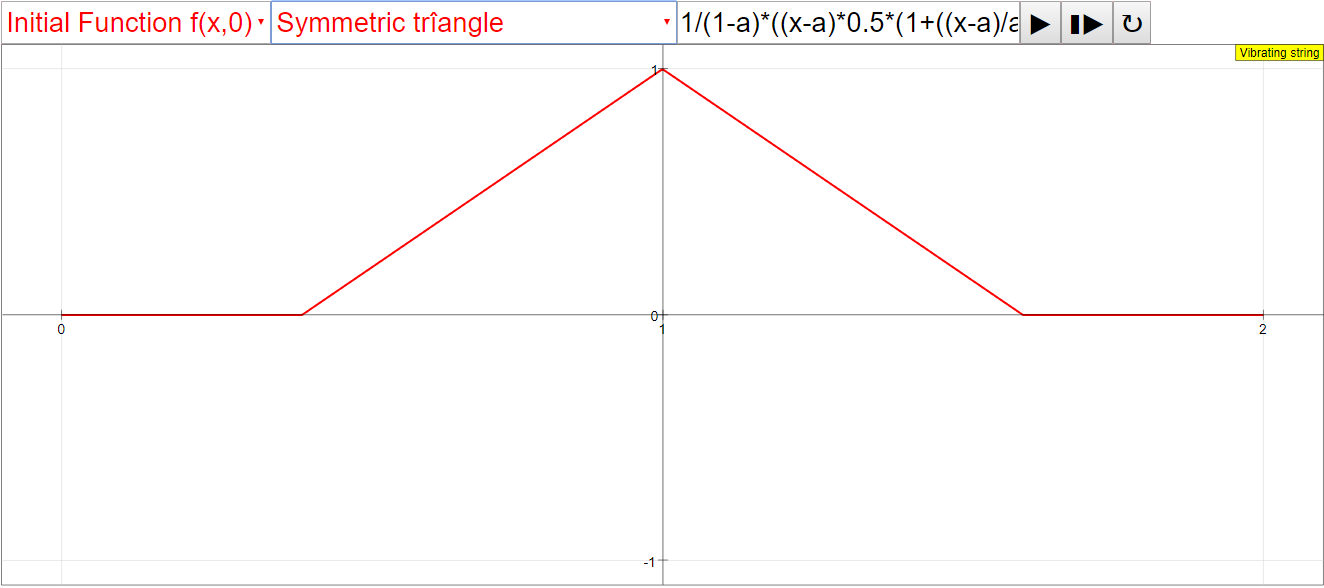
- Symmetric triangle
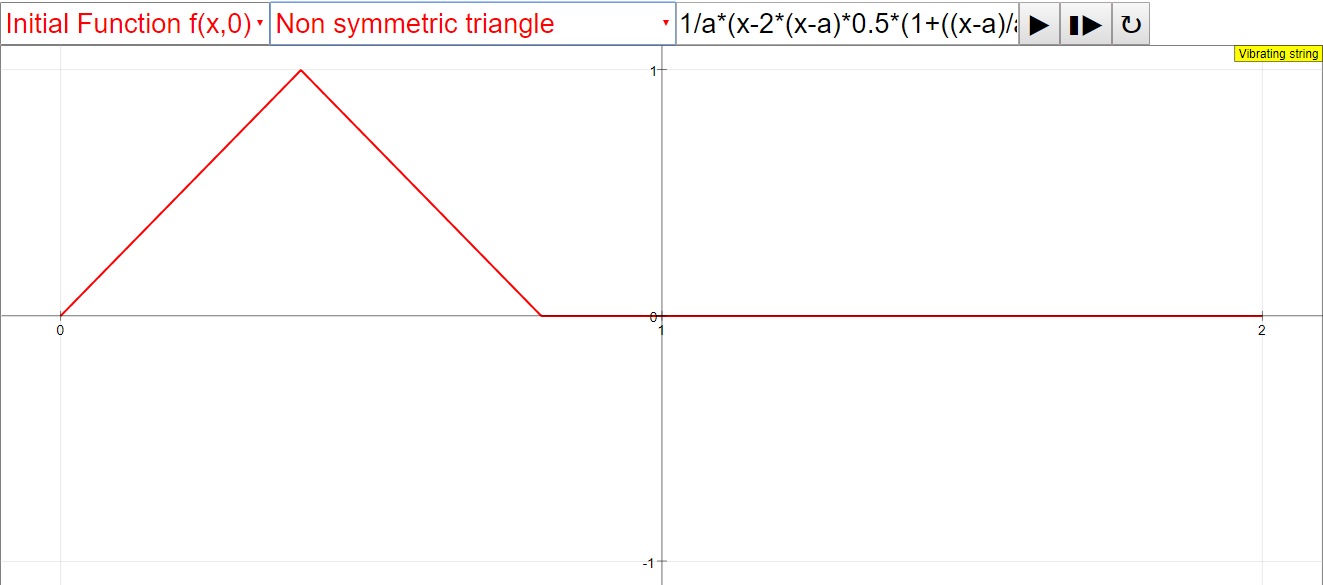
- Non symmetric triangle of variable width
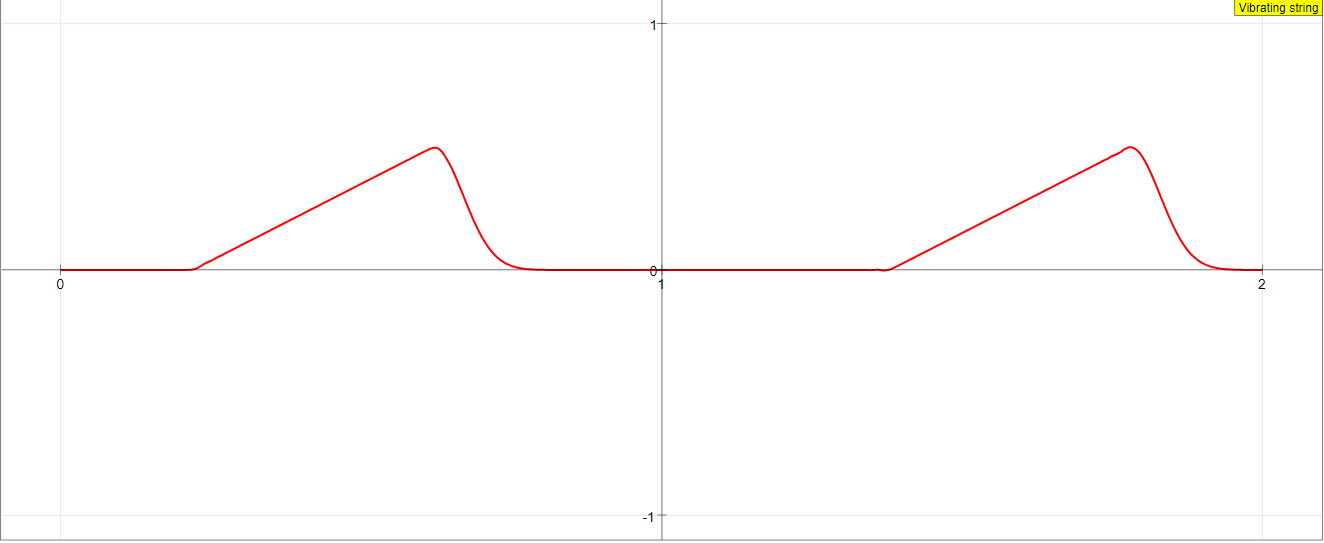
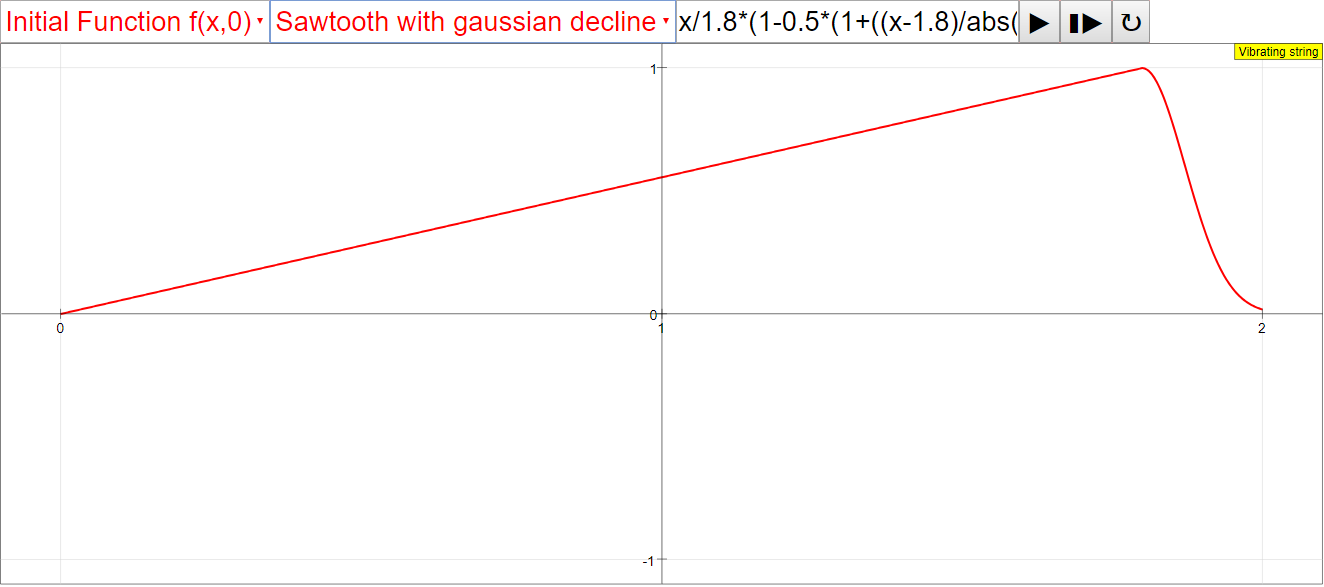
- Sawtooth with Gaussian decline
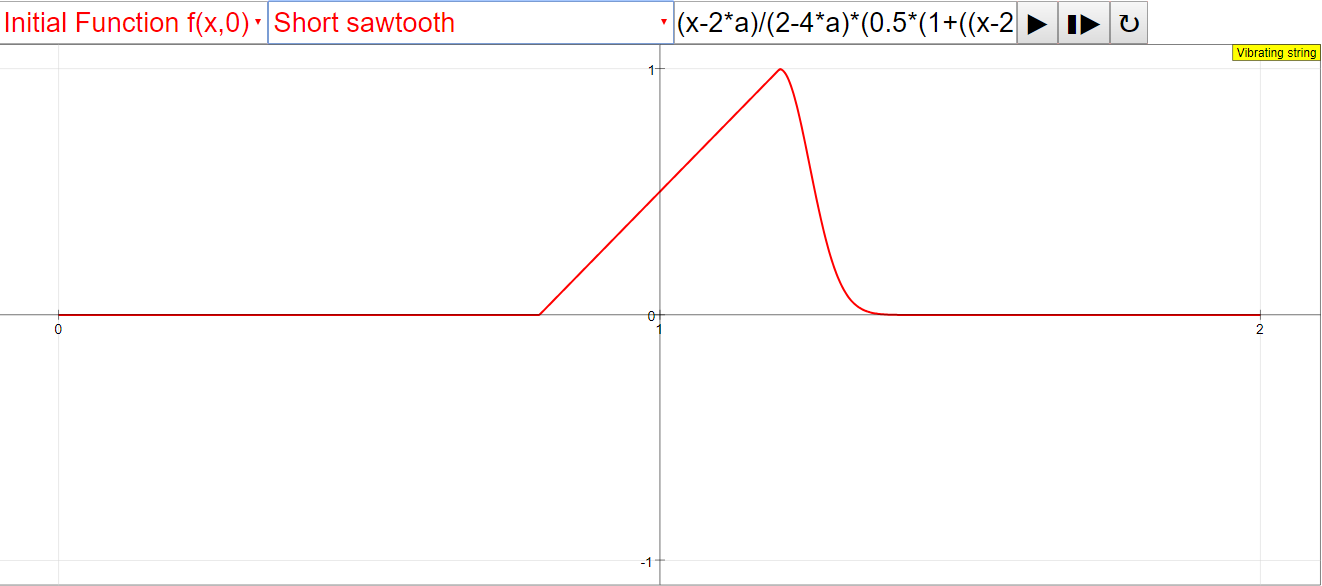
- Short sawtooth with Gaussian decline
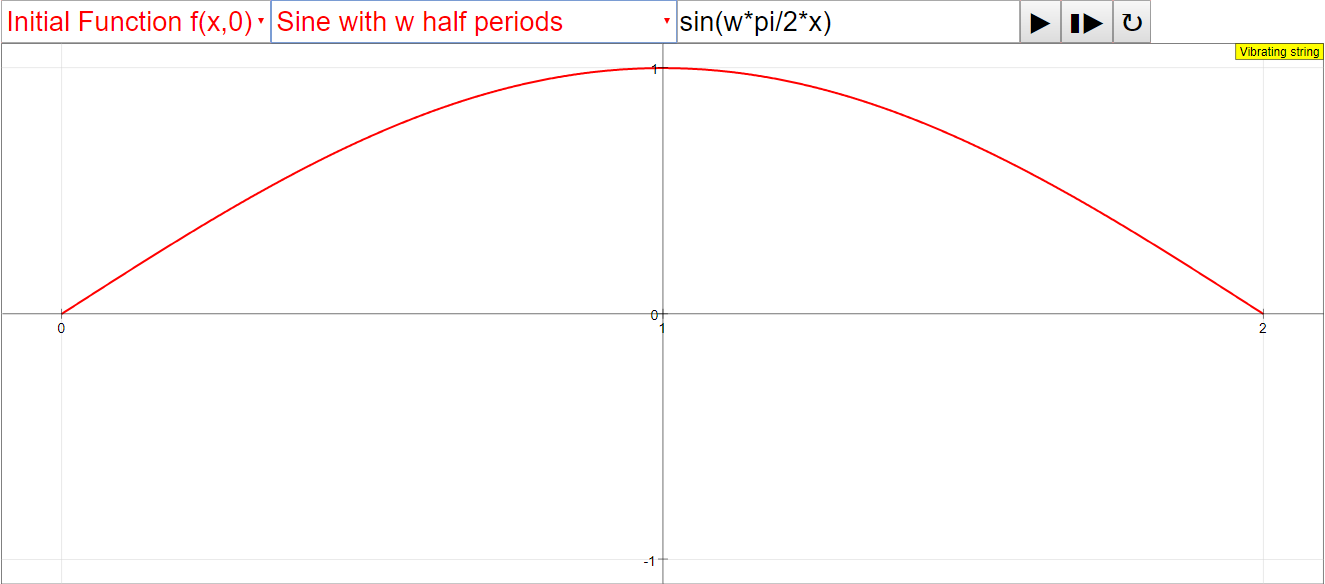
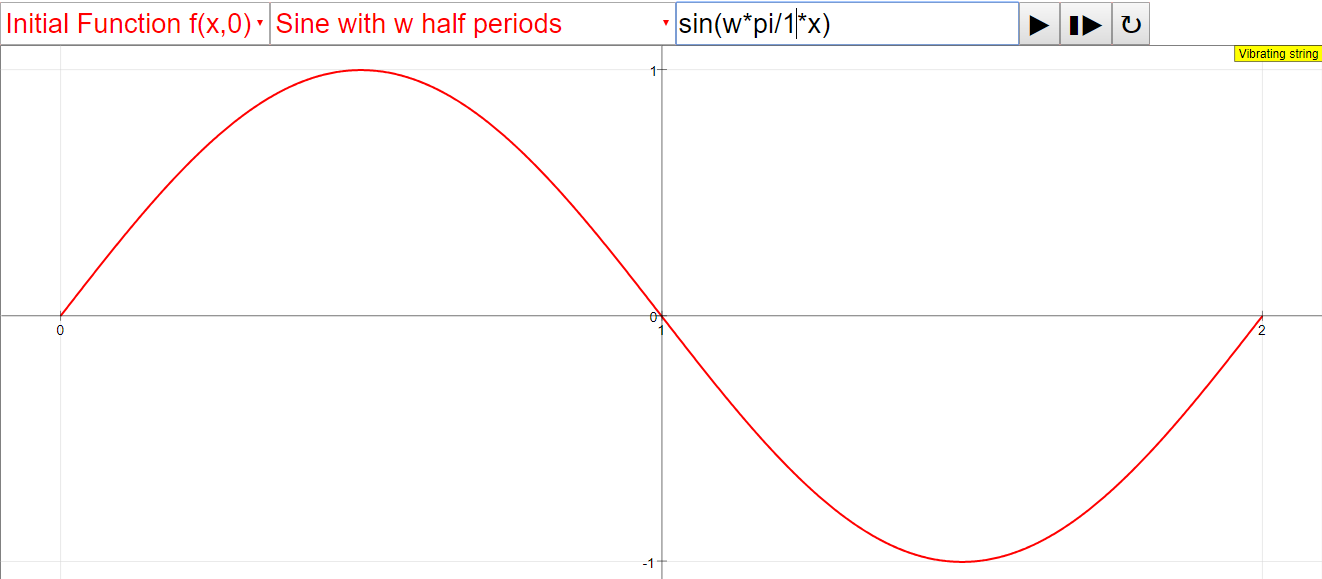
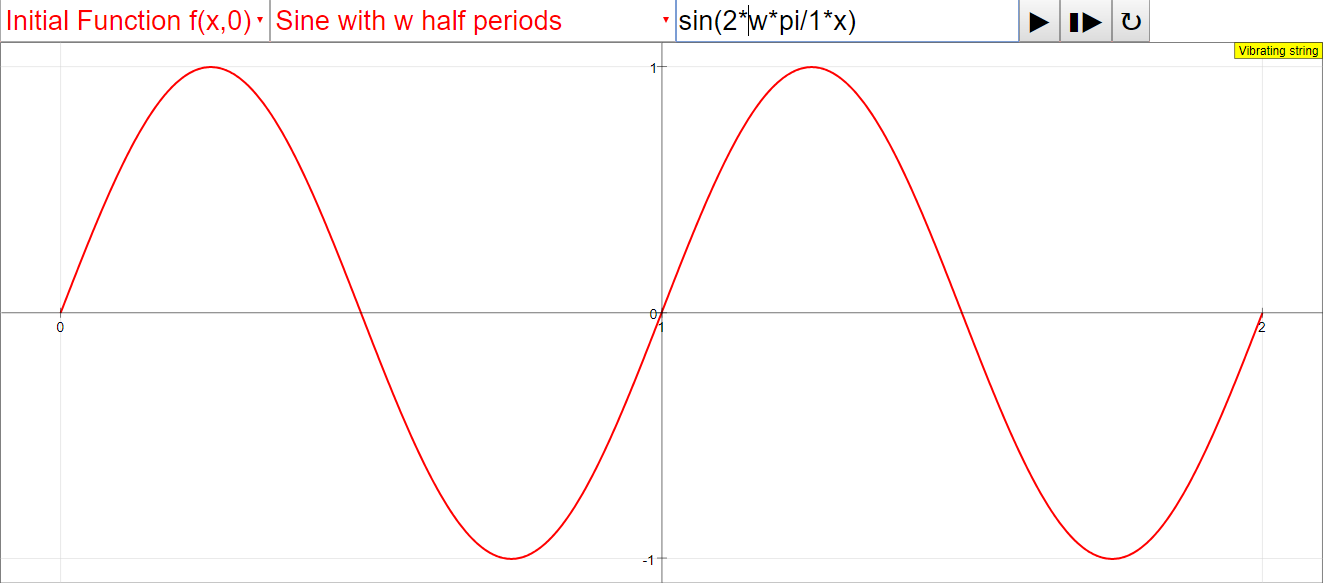
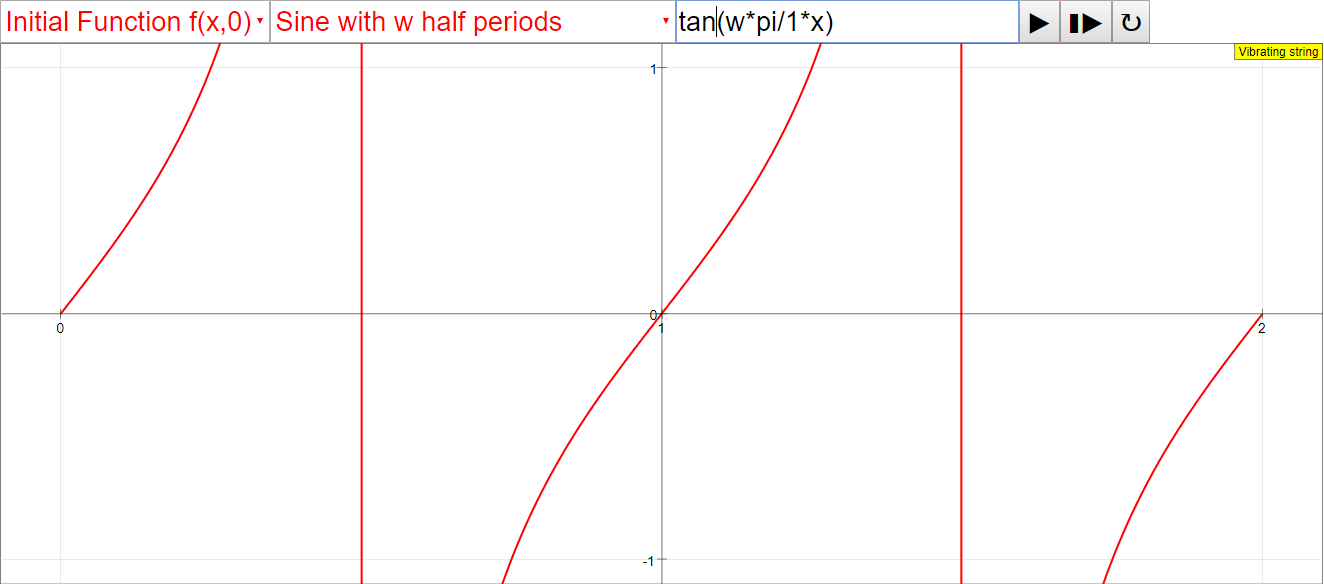
- Sine with w half periods Users can also "edit the formulas or write your own ones," enabling a deeper exploration of how different starting conditions affect wave behavior.
- Understanding Wave Interference and Standing Waves: The simulation helps visualize how standing waves, which are "base modes or eigenfunctions of the string," are formed by the "interference of two traveling waves." This is explicitly contrasted with the initial Gaussian pulse, emphasizing that what appears as a simple oscillation perpendicular to the string is actually a result of wave superposition.
- The Role of Harmonics in Sound: The applet connects the behavior of vibrating strings to the production of sound in musical instruments. It explains that the "appeal of a specific sound is determined by its mixture of harmonics." Different initial excitations, such as soft plucking in the middle versus localized plucking near the end of a guitar string, create different mixtures of harmonics, resulting in different tonal qualities.
- Simulation Parameters and Controls: The applet provides several controls for user interaction:
- Play, Stop, Step buttons: Control the progression of the simulation.
- Speed slider (s): Adjusts the time between calculation steps.
- Parameter slider and Sine Param Field Box: Affect the parameters of the selected initial function, such as the width of the Gaussian pulse (a). For example, choosing "a = 0.1 with the slider, you will observe two clearly separated short pulses traveling and reconstructing."
- Full-screen toggle: Allows for an expanded view of the simulation.
- Limitations and Real-World Considerations: The description acknowledges that the simulation is a simplified model. It notes that at "very short pulse length (a < 0.03 ) limited resolution will lead to calculation artifacts." Furthermore, it discusses real-world factors like "damping by acoustic radiation and by friction," which affect how different harmonics decay over time and contribute to the long-term tone quality.
- Complexity of Real Musical Instruments: The applet touches upon the complexity of simulating real instruments like the piano, where multiple strings, coupling effects, and damping make electronic "synthesis" practically impossible for capturing the full richness of the sound. The common approach is "sampling," which involves recording and replaying the sounds of a real instrument.
- Educational Value and Experiments: The "Experiments" section provides guided activities for users to explore different aspects of vibrating strings and wave phenomena. Examples include observing the reflection of Gaussian pulses (E1 & E2), exploring standing waves with integer values of w in the sine function (E3), and observing traveling waves with non-integer values of w (E4). These experiments encourage active learning and deeper understanding of the concepts.
- Customization and Flexibility: Users are encouraged to experiment by editing the predefined functions or creating their own, allowing for a highly customizable learning experience. The instructions explicitly state, "Do note that we can edit the function field box directly to customize our own initial function as well!"
Quotes:
- "This model solves the one-dimensional wave equation using an explicit difference method."
- "Contrary to naive expectation the string does not simply deflect perpendicular to its axis... Rather two identical pulses of half the initial amplitude propagate to both ends, are reflected and recombine in the middle to the initial pulse with opposite sign."
- "For w as an integer sine waves oscillate as standing waves. They are base modes or eigenfunctions of the string."
- "In music instruments the appeal of a specific sound is determined by its mixture of harmonics."
- "A guitar player knows that soft plucking with the fingers near the middle of the string creates a dull tone, while localized plucking with a plectrum near the end leads to pungent, wild sounds."
- "In reality a string will be damped byacoustic radiation and by friction."
- "For this reason it is practically impossible to simulate a grand piano by electronic synthesis... The common way to simulate it is to copy the sound of a real grand piano by sampling."
Conclusion:
The "Vibrating String JavaScript Simulation Applet HTML5" is a valuable interactive tool for learning and teaching about wave phenomena, the one-dimensional wave equation, and the physics of vibrating strings and musical instruments. Its user-friendly interface, customizable parameters, and guided experiments allow for a hands-on exploration of complex concepts. The applet effectively visualizes abstract mathematical and physical principles, making them more accessible and engaging for students. The discussion of real-world limitations and the complexity of musical instruments adds a layer of nuance and encourages critical thinking.
The Vibrating String Simulation Study Guide
Quiz
- What fundamental mathematical concept does the simulation primarily solve? Briefly describe the nature of this equation.
- Describe the initial state of the string when the simulation is opened. What specific shape is used for the initial deflection?
- Explain what happens to the initial deflection of the string when the simulation is started. Describe the behavior of the resulting pulses.
- What happens when the traveling pulses reach the fixed ends of the string? How does this affect the overall wave pattern?
- What does the parameter 'a' in the Gaussian function control? How does changing its value affect the observed pulses?
- What are base modes or eigenfunctions of the string, and how do they manifest in the simulation when a sine function with an integer 'w' is chosen?
- Explain why the sound produced by a musical instrument is often richer and more appealing than a pure sine wave. Relate this to the concepts illustrated by the simulation.
- Describe what happens when a non-integer value for 'w' is selected for the sine function. How does this relate to the concept of traveling waves?
- According to the text, what real-world factors can cause a vibrating string to become damped over time? How does this damping typically affect different harmonics?
- Explain the difference between "synthesis" and "sampling" in the context of simulating musical instruments like a grand piano, as mentioned in the text.
Quiz Answer Key
- The simulation solves the one-dimensional wave equation, which is a second-order linear partial differential equation. This equation describes how waves propagate through a medium as a function of both space and time.
- When the simulation opens, the string is fixed at both ends and has a symmetric initial deflection in the form of a Gaussian curve. The width of this Gaussian is such that its amplitude is near zero at the fixed ends.
- When the simulation starts, the initial Gaussian deflection splits into two identical pulses with half the initial amplitude. These pulses propagate in opposite directions towards the fixed ends of the string.
- When the traveling pulses reach the fixed ends, they are reflected. Upon reflection, the pulses travel back along the string and recombine in the middle, inverting to form the original pulse with the opposite sign after one reflection cycle.
- The parameter 'a' in the Gaussian function controls the reciprocal of the 1/e width of the initial deflection. A smaller value of 'a' results in wider pulses, while a larger value (like 0.1) leads to clearly separated short pulses.
- Base modes or eigenfunctions are standing wave patterns that occur when a sine function with an integer 'w' is chosen. In the simulation, these appear as stationary oscillations where the string deflects perpendicular to its axis, with specific points of zero displacement (nodes).
- The appeal of a specific sound in musical instruments is determined by its mixture of harmonics (overtones). Unlike a pure sine wave, instruments produce a fundamental frequency along with higher frequency components that contribute to the timbre or tonal quality, which can be influenced by localized excitations and their interference.
- When a non-integer value for 'w' is selected for the sine function, the simulation shows oppositely running waves instead of a stationary standing wave. This demonstrates that even standing wave patterns in integer 'w' cases are a result of the interference of two traveling waves.
- In reality, a vibrating string is damped by acoustic radiation (sound waves carrying energy away) and by friction within the string and at its supports. Higher harmonics are typically damped much stronger than lower ones, causing the tone to become softer and lose its brilliance over time.
- Synthesis in music simulation involves mathematically generating sound waves based on physical models of how the instrument produces sound. Sampling, on the other hand, involves recording the actual sound of an instrument and then replaying these recordings at different pitches and volumes to simulate musical performance.
Essay Format Questions
- Discuss how the Vibrating String Simulation Applet demonstrates the principle of superposition of waves. Use specific examples from the simulation's behavior with different initial conditions and function selections to support your explanation.
- Analyze the relationship between the initial conditions of the vibrating string (shape, width) and the resulting wave propagation and reflection patterns observed in the simulation. How do different initial deflections affect the tone quality if the string were part of a musical instrument?
- Explain the significance of "base modes" or "eigenfunctions" in the context of a vibrating string and musical instruments. How does the simulation illustrate the formation of these modes, and what are their characteristics?
- Compare and contrast the behavior of the vibrating string when initiated with a Gaussian pulse versus a sine wave in the simulation. How do these different initial conditions lead to different observed phenomena and what do they teach us about wave behavior?
- Evaluate the statement: "The beauty of musical sound lies in its complexity." Using the concepts illustrated by the Vibrating String Simulation and the information provided about musical instruments, discuss the role of harmonics, damping, and localized excitation in creating interesting tonal qualities.
Glossary of Key Terms
- One-dimensional wave equation: A second-order linear partial differential equation that describes the propagation of waves through a one-dimensional medium, such as a string.
- Explicit difference method: A numerical technique used to approximate the solution to a differential equation by discretizing space and time and using values at a previous time step to calculate values at the current time step.
- Gaussian: A bell-shaped curve defined by a specific mathematical formula, often used to represent an initial localized disturbance. The width of the Gaussian is related to the parameter 'a' in the simulation.
- Pulse: A single, short burst of a wave or disturbance that travels through a medium.
- Reflection: The phenomenon that occurs when a wave encounters a boundary and reverses its direction of propagation. In the simulation, this happens at the fixed ends of the string.
- Superposition: The principle that states that when two or more waves overlap, the resulting displacement at any point is the vector sum of the displacements of the individual waves.
- 1/e width: A measure of the width of a Gaussian function, specifically the distance between the two points where the function's value drops to 1/e (approximately 37%) of its peak value.
- Combobox: A graphical user interface element that allows the user to select one option from a predefined list. In the simulation, it is used to choose the initial function of the string.
- Base modes (eigenfunctions): The natural modes of vibration of a system, characterized by specific frequencies and spatial patterns. For a string fixed at both ends, these are the standing wave patterns corresponding to integer multiples of the fundamental frequency.
- Standing wave: A wave pattern created by the superposition of two waves traveling in opposite directions, resulting in fixed points of maximum and minimum displacement (antinodes and nodes, respectively).
- Interference: The phenomenon that occurs when two or more waves overlap, resulting in a combined wave with an amplitude that is either larger or smaller than the amplitudes of the individual waves, depending on their relative phase.
- Harmonics: Frequencies that are integer multiples of the fundamental frequency of a vibrating object. They contribute to the timbre or tonal quality of a sound.
- Overtone: Any resonant frequency above the fundamental frequency. In many musical contexts, "harmonics" and "overtones" are used interchangeably.
- Traveling wave: A wave that propagates through a medium, carrying energy from one location to another.
- Damping: The process by which the amplitude of an oscillation decreases over time due to energy loss, often through friction or radiation.
- Acoustic radiation: The emission of energy in the form of sound waves from a vibrating object.
- Friction: A force that opposes motion between surfaces in contact or within a medium.
- Synthesis (musical): The creation of sound electronically, often by generating waveforms based on mathematical models.
- Sampling (musical): The process of recording sounds from real instruments and then using these recordings to create music.
Sample Learning Goals
[text]
For Teachers
The Vibrating String JavaScript Simulation Applet HTML5
Instructions
Initial Function of the String
Others: Variable Sliders and Field Box

Toggling Full Screen
Play/Pause, Step and Reset Buttons

Research
[text]
Video
[text]
Version:
Other Resources
[text]
Frequently Asked Questions: Vibrating String Simulation
What is the purpose of the Vibrating String JavaScript Simulation Applet?
This applet is designed as an educational tool to visualize and understand the behavior of a vibrating string. It specifically solves the one-dimensional wave equation using an explicit difference method, allowing users to observe how initial disturbances propagate, reflect, and interfere on a string fixed at both ends.
How does the simulation model the vibrating string?
The simulation models the string as a series of 1000 calculation points connected elastically, similar to tiny springs. It begins with a symmetric Gaussian initial deflection and then calculates the subsequent motion based on the forces acting on each small element of the string, effectively solving the wave equation.
What can be observed when running the default Gaussian initial condition?
When the simulation starts with the default symmetric Gaussian deflection, you will observe two identical pulses with half the initial amplitude traveling in opposite directions towards the fixed ends of the string. Upon reaching the ends, these pulses are reflected and then travel back along the string, recombining in the middle to reconstruct the initial pulse but with an opposite sign. This process repeats after another reflection, restoring the original pulse.
What are the different predefined initial functions available in the simulation?
The simulation provides a variety of predefined initial functions that can be selected from a combobox. These include: Symmetric Gaussian of variable width, Non-symmetric Gaussian of variable width, Symmetric triangle, Non-symmetric triangle of variable width, Sawtooth with Gaussian decline, Short sawtooth with Gaussian decline, and Sine with w half periods. Users can also edit the formulas or write their own custom initial functions.
What are standing waves or base modes, and how are they related to traveling waves in the simulation?
Standing waves, also known as base modes or eigenfunctions of the string, are observed when using a sine function with an integer number of half periods (w). These appear as oscillations deflecting perpendicular to the string's axis. However, the simulation reveals that even these standing wave patterns are a result of the interference of two traveling waves moving in opposite directions along the string.
How does the initial disturbance on the string affect the resulting sound in musical instruments?
The simulation helps illustrate how the nature of the initial disturbance on a string (like plucking or striking) affects the tone produced by musical instruments. A localized, non-symmetric excitation, such as a crisp pick near the end of a string (as in a harpsichord or guitar), generates a sound rich in harmonics due to the complex interference of traveling waves. Conversely, a softer, more distributed excitation (like plucking near the middle of a guitar string) produces a duller tone with fewer high harmonics.
What factors influence the tone quality of a real vibrating string that are not fully captured in this simplified simulation?
Real strings experience damping due to acoustic radiation and friction, which causes different harmonics to decay at different rates. Typically, higher harmonics are damped more strongly, leading to a change in the tone over time, starting with a bright sound and fading to the fundamental frequency. Additionally, in instruments like the piano, multiple coupled strings and complex interactions with the instrument's body contribute significantly to the richness and complexity of the sound, making accurate electronic synthesis very challenging, often necessitating sound sampling instead.
How can the simulation be used for experimentation and learning?
The simulation allows for several experiments, such as observing the behavior of Gaussian pulses with different widths, exploring standing waves with integer and non-integer numbers of sine half-periods, and experimenting with various initial function shapes. By observing the resulting wave motion and considering how different initial conditions lead to different behaviors (including traveling pulses and standing waves), users can gain a deeper understanding of the wave equation, superposition, reflection, and the relationship between string vibrations and sound quality.