{source}
<?php  require_once JPATH_SITE.'/TTcustom/TT_contentparser.php';\(parameters = array("topicname" => "math", "modelname" => "ejss_model_gaussian");echo generateSimHTML(\)parameters, "EJSS");
?>
{/source}
1. Overview:
This document provides a briefing on the "Gaussian Distribution Simulator JavaScript Simulation Applet HTML5" available on the Open Educational Resources / Open Source Physics @ Singapore website. This interactive simulation, built using JavaScript and HTML5, is designed to visually demonstrate the emergence of a Gaussian (normal) distribution through repeated random events, specifically the flipping of 100 simulated coins. The applet is categorized under both Mathematics and Physics, highlighting its interdisciplinary relevance for learning and teaching.
2. Main Themes and Important Ideas/Facts:
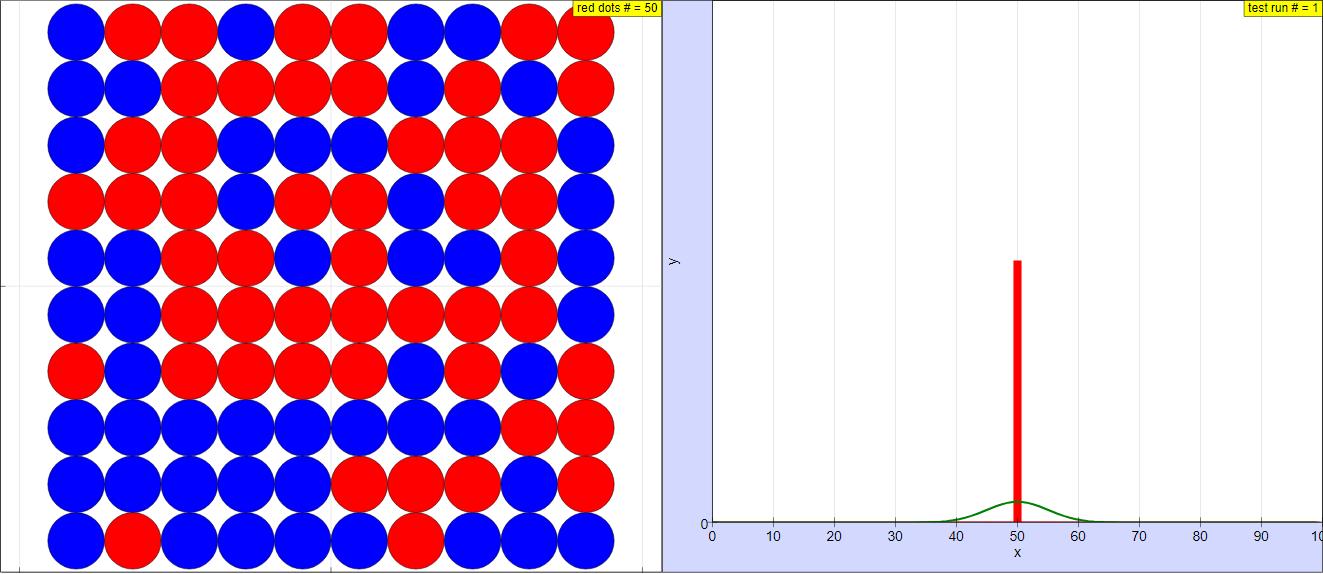
- Simulation of Random Events Leading to Gaussian Distribution: The core concept demonstrated by the applet is how a Gaussian distribution arises from a large number of independent, random trials. In this specific simulation, each trial involves "throwing" 100 virtual coins.
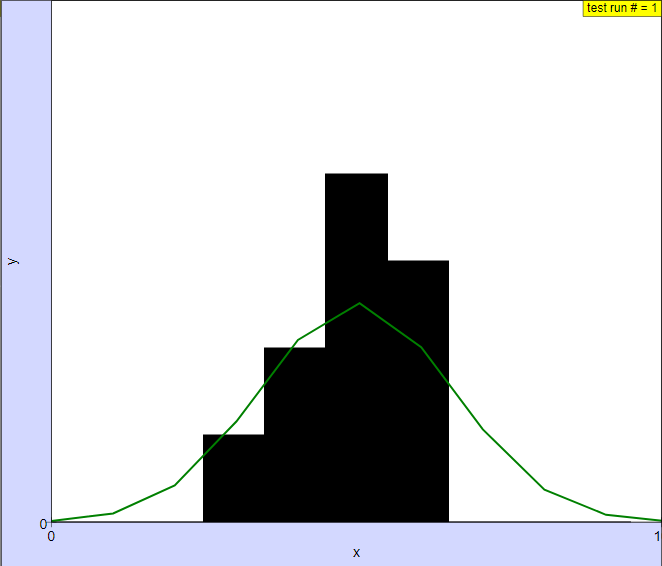
- "Each coins in the applet can be up or down (represented by red or blue dots) The applet simulate 100 coins were throwed each time and total number of coin in the up state will be added to the diagram. The distribution become gaussian distrbution as the number of run increase to large value"
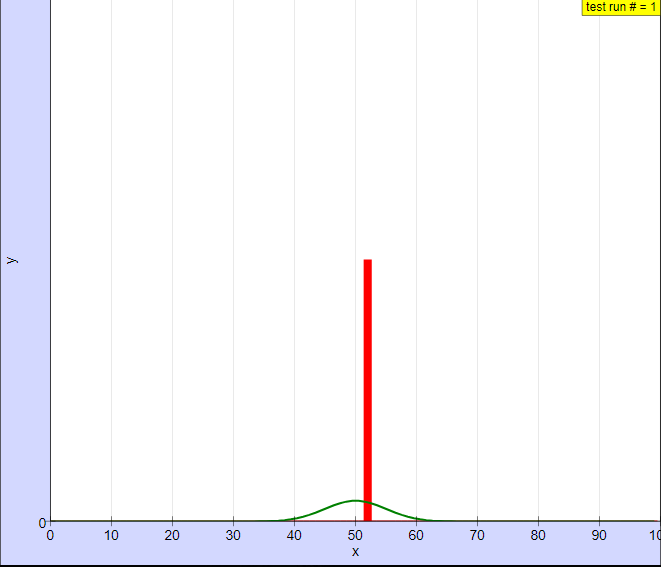
- Visual Representation of Distribution: The applet visually represents the outcome of each coin-flipping trial by plotting the total number of coins in the "up" state on a diagram. As the number of simulation runs increases, the distribution of these totals progressively approximates a bell-shaped curve, characteristic of a Gaussian distribution.
- Interactive Learning Tool: The applet offers several interactive features designed to enhance understanding:
- Single/Hundred Check Box: Allows users to control the number of simulation runs per step, enabling observation of the distribution's evolution over time.
- "Toggle this to determine the number of test runs is by single or hundreds."
- Play/Pause, Step, and Reset Buttons: Provide control over the simulation's execution, allowing for detailed observation or a fresh start.
- Full Screen Toggle: Enhances visibility for focused learning.
- "Double click anywhere on the panels to toggle full screen."
- Categorization and Context: The applet is listed under "Mathematics" and within the "Learning and Teaching Mathematics using Simulations – Plus 2000 Examples from Physics" section. It also appears under the "Magnetism" section of "Physics," suggesting potential connections or applications within that domain, although the "About" section focuses purely on the coin-flipping analogy.
- Embeddable Resource: The simulation can be easily embedded into other webpages using an provided iframe code, making it a convenient resource for educators to integrate into their online materials.
- The iframe code is provided for embedding the model.
- Credits and Licensing: The applet is credited to Fu-Kwun Hwang, Fremont Teng, and Loo Kang Wee. The content is licensed under a Creative Commons Attribution-Share Alike 4.0 Singapore License, promoting open access and sharing for educational purposes. Commercial use of the underlying EasyJavaScriptSimulations Library requires a separate license and contact with This email address is being protected from spambots. You need JavaScript enabled to view it..
- Part of a Larger Collection: This simulator is one of a vast number of interactive resources available on the Open Educational Resources / Open Source Physics @ Singapore website, covering a wide range of physics and mathematics topics. The extensive list of related simulations highlights the platform's commitment to providing diverse and engaging learning tools.
- Potential Learning Goals and Teacher Utility: While specific learning goals are not explicitly detailed in the provided excerpts, the description suggests that the applet aims to help learners understand the concept of Gaussian distribution, the role of random events in its formation, and the visual characteristics of this important statistical distribution. The instructions provided are specifically "For Teachers," indicating its intended use in educational settings.
3. Key Takeaways:
- The "Gaussian Distribution Simulator" provides a clear and interactive demonstration of how a Gaussian distribution emerges from repeated independent random events.
- Its user-friendly interface with controls for single or multiple runs, play/pause, step, and reset facilitates active learning and exploration.
- The embeddability of the applet makes it a valuable resource for online education.
- The open licensing encourages sharing and adaptation for educational purposes.
- This simulator is part of a rich collection of interactive physics and mathematics resources, highlighting the platform's commitment to open education.
4. Further Considerations:
- The "Sample Learning Goals" and "Research" sections are marked as "[text]," indicating that further information might be available on the full webpage. Accessing the live applet would provide a complete understanding of the intended learning outcomes and any associated research or theoretical background.
- The connection to "Electricity and Magnetism" and "Magnetism" in the breadcrumbs is not immediately apparent from the "About" section. Exploring the broader context on the website might reveal potential applications or related concepts within those physics domains where Gaussian distributions are relevant (e.g., error analysis in experiments).
This briefing document provides a foundational understanding of the "Gaussian Distribution Simulator" based on the provided excerpts. The applet appears to be a valuable tool for teaching and learning about a fundamental concept in mathematics and statistics through an engaging and interactive simulation.
Study Guide: Gaussian Distribution Simulator
Key Concepts
- Gaussian Distribution: A continuous probability distribution that is symmetrical around its mean, forming a bell-shaped curve. It is characterized by its mean (μ) and standard deviation (σ).
- Simulation: A computational method that uses a model to imitate the behavior of a real-world system or process over time.
- Applet: A small application, often written in Java or JavaScript, that can be embedded in an HTML page and run in a web browser.
- HTML5: The latest evolution of the standard that defines HTML, used for structuring and presenting content on the World Wide Web. It supports multimedia and interactive elements without requiring plugins.
- Randomness: The lack of predictability in events. In the context of the simulation, the outcome of each coin toss is random.
- Probability: The likelihood of a specific outcome occurring in a random event.
- Central Limit Theorem (Implied): While not explicitly stated, the simulation demonstrates the idea that the sum of a large number of independent, identically distributed random variables will tend towards a Gaussian distribution, regardless of the original distribution of the variables. In this case, each coin toss is a Bernoulli trial (up or down), and the sum of the "up" states approaches a Gaussian distribution as the number of runs increases.
Quiz
- What does the Gaussian Distribution Simulator applet simulate?
- Describe what each red or blue dot represents in the simulation.
- According to the "About" section, what happens to the distribution as the number of runs increases to a large value?
- What is the purpose of the "Single/Hundred Check Box" in the applet?
- How can a user toggle full screen in the simulation? What is one condition under which this might not work?
- Identify the functions of the "Play/Pause," "Step," and "Reset" buttons.
- Who are credited with the creation of this Gaussian Distribution Simulator JavaScript Simulation Applet HTML5?
- Under which broad subject category is this simulation listed on the website? Mention a specific subcategory as well.
- What type of license governs the content provided on the Open Educational Resources / Open Source Physics @ Singapore website?
- Besides Mathematics, under which other main subject area is this resource cataloged on the webpage?
Quiz Answer Key
- The applet simulates the throwing of 100 coins multiple times, where each coin can be either up or down. It then tracks and displays the total number of coins in the "up" state in a diagram.
- Each red or blue dot in the applet represents a single coin that has been thrown. A red dot indicates one state (e.g., "up"), and a blue dot indicates the other state (e.g., "down").
- As the number of runs (simulations of throwing 100 coins) increases to a large value, the distribution of the total number of coins in the "up" state becomes a Gaussian distribution (a bell-shaped curve).
- The "Single/Hundred Check Box" allows the user to choose whether the simulation runs once (Single) or one hundred times (Hundred) with each activation of the play or step function.
- A user can toggle full screen by double-clicking anywhere on the panels of the simulation. This function will not work if the simulation is currently playing (i.e., if the "Play" button has been activated and not paused).
- The "Play/Pause" button starts or stops the continuous running of the simulation. The "Step" button advances the simulation by one run (either a single run or one hundred runs, depending on the checkbox). The "Reset" button likely returns the simulation to its initial state, clearing the diagram and resetting any counters.
- Fu-Kwun Hwang, Fremont Teng, and Loo Kang Wee are credited with the creation of this Gaussian Distribution Simulator JavaScript Simulation Applet HTML5.
- This simulation is listed under the broad subject category of Mathematics. It is also found under the Physics subcategory, specifically within "07 Magnetism" (though this seems like a categorization error as the simulation pertains to probability and statistics).
- The content on the Open Educational Resources / Open Source Physics @ Singapore website is licensed under a Creative Commons Attribution-Share Alike 4.0 Singapore License.
- Besides Mathematics, this resource is also cataloged under Physics on the webpage, as indicated by its placement within the "Interactive Resources" section and the breadcrumbs.
Essay Format Questions
- Explain how the coin toss simulation visually demonstrates the properties of a Gaussian distribution. Discuss the role of the number of runs in shaping the resulting distribution.
- Considering the description of the applet, discuss the connection between a series of independent Bernoulli trials (like coin tosses) and the emergence of a Gaussian distribution, referencing relevant statistical concepts.
- Evaluate the educational value of this JavaScript simulation applet for teaching the concept of Gaussian distribution to students in either a mathematics or physics context.
- Based on the provided information, describe how a teacher might utilize the different features of this applet (e.g., Single/Hundred toggle, Play/Pause, Reset) in a classroom setting to facilitate student understanding of probability and distributions.
- Explore the broader context of the "Open Educational Resources / Open Source Physics @ Singapore" project, considering the purpose of providing simulations like this one and the potential benefits for learners and educators.
Glossary of Key Terms
- Gaussian Distribution: A continuous probability distribution characterized by a symmetrical bell-shaped curve around the mean. It is defined by its mean (average value) and standard deviation (measure of spread).
- Simulation: The process of creating a model of a real-world system or process and experimenting with it to understand its behavior or predict outcomes. In this context, it's a computer-based imitation.
- JavaScript Applet: A small program written in the JavaScript programming language that is designed to run within a web browser to provide interactive functionality, such as the Gaussian distribution simulator.
- HTML5: The fifth and latest major version of the Hypertext Markup Language, used to structure and present content on the web. It includes features for embedding multimedia and interactive elements.
- Random Event: An event where the outcome is unpredictable and governed by chance. Each individual coin toss in the simulation is a random event.
- Probability Distribution: A function that describes the likelihood of different outcomes in a random experiment. The Gaussian distribution is a specific type of probability distribution.
- Bernoulli Trial: A random experiment with exactly two possible outcomes, often referred to as "success" and "failure." Each coin toss (up or down) can be considered a Bernoulli trial.
- Mean (μ): The average value of a dataset or a probability distribution, representing the central tendency of the data.
- Standard Deviation (σ): A measure of the dispersion or spread of a dataset or a probability distribution around its mean. A higher standard deviation indicates a wider spread.
- Open Educational Resources (OER): Teaching, learning, and research materials that are freely available for use, adaptation, and sharing, often under specific licenses like Creative Commons.
Sample Learning Goals
[text]
For Teachers
Gaussian Distribution Simulator JavaScript Simulation Applet HTML5
Instructions
Single/Hundred Check Box
Toggling Full Screen
Play/Pause, Step and Reset Buttons

Research
[text]
Video
[text]
Version:
Other Resources
[text]
Frequently Asked Questions: Gaussian Distribution Simulator
1. What does the Gaussian Distribution Simulator demonstrate?
The simulator visually demonstrates how a Gaussian (or normal) distribution emerges from a series of random, independent events. Specifically, it simulates the repeated throwing of 100 coins, where each coin can land either heads (represented by a red dot) or tails (represented by a blue dot). The applet then tracks the total number of heads in each throw and plots the distribution of these totals. As the number of simulated throws increases, the resulting distribution approximates a bell-shaped curve, characteristic of a Gaussian distribution.
2. How does the coin flipping simulation relate to a Gaussian distribution?
The coin flipping simulation is a classic example illustrating the Central Limit Theorem. This theorem states that the sum (or average) of a large number of independent, identically distributed random variables will be approximately normally distributed, regardless of the underlying distribution of the individual variables. In this case, each coin flip is an independent Bernoulli trial (two possible outcomes), and the total number of heads in each run is the sum of these trials. As the number of runs (repeated sets of 100 coin flips) increases, the distribution of these sums converges to a Gaussian distribution.
3. What are the key features of the Gaussian Distribution Simulator applet?
The applet includes several interactive features. Users can toggle between performing single test runs or hundreds of runs at once using a checkbox. There are also Play/Pause, Step, and Reset buttons to control the simulation's progression. Additionally, users can toggle to a full-screen view by double-clicking on the panels, although this functionality is disabled while the simulation is playing.
4. What are the pedagogical applications of this simulator?
This simulator is a valuable tool for teaching concepts in mathematics and physics, particularly probability, statistics, and the Central Limit Theorem. It provides a visual and interactive way for students to understand how random events can lead to predictable distributions when aggregated over a large number of trials. It can also be used to introduce the concept of a Gaussian distribution and its prevalence in natural phenomena.
5. Who developed this Gaussian Distribution Simulator?
The simulator was developed by Fu-Kwun Hwang, Fremont Teng, and Loo Kang Wee, as credited within the applet's information.
6. Where can this simulation be embedded and accessed?
The simulation can be embedded into webpages using the provided iframe code, which links to the hosted applet at https://iwant2study.org/lookangejss/math/ejss_model_gaussian/gaussian_Simulation.xhtml. This allows educators and learners to easily integrate the interactive model into online learning resources.
7. Are there any specific learning goals associated with this simulation?
The source mentions "Sample Learning Goals" but does not provide the specific text of these goals. Typically, learning goals for such a simulation would include understanding the emergence of the normal distribution from repeated random events, grasping the basic properties of a Gaussian curve, and potentially exploring the impact of the number of trials on the shape of the distribution.
8. Are there other related resources available from Open Educational Resources / Open Source Physics @ Singapore?
Yes, the website hosts a wide variety of interactive physics and mathematics simulations, as evidenced by the extensive list of other applets provided. These cover topics ranging from mechanics and electromagnetism to waves and optics, and even mathematical concepts like fractals and calculus methods. The platform serves as a rich repository of open educational resources for STEM learning.