{source}
<?php  require_once JPATH_SITE.'/TTcustom/TT_contentparser.php';\(parameters = array("topicname" => "math", "modelname" => "ejss_model_pslemathquestion3circlefinddiameter");echo generateSimHTML(\)parameters, "EJSS");
?>
{/source}
1. Introduction:
This briefing document analyzes two sources related to a specific mathematics question from the 2019 Singapore Primary School Leaving Examination (PSLE). The question focuses on determining the diameter of a circle within a given geometric configuration. The sources provide the question's title, author information, licensing details, and crucially, offer multiple methods for solving the problem, along with a concluding principle.
2. Source Overview:
The two provided sources appear to be closely related, likely originating from the same project or initiative:
- Source 1: "2019 PSLE Question on finding Diameter"This source primarily provides the title, author and copyright information, and licensing details. It identifies the creators as This email address is being protected from spambots. You need JavaScript enabled to view it., Francisco Esquembre, and Felix J. Garcia Clemente. It also states that the work is licensed under a specific license.
- Source 2: "2019 PSLE Question on finding Diameter - Open Educational Resources / Open Source Physics @ Singapore | Open Educational Resources / Open Source Physics @ Singapore"This source is hosted on the "Open Educational Resources / Open Source Physics @ Singapore" platform. It provides context through breadcrumbs indicating its location within the website (Home > 2019 PSLE Question on finding Diameter > Circle > Mathematics > 2D Shapes).
- It offers an embeddable model of the question, translations (though none are listed in the provided excerpt), credits attributing the work to the same individuals as Source 1, and importantly, outlines the "Learning Goals" as being centered around the "2019 PSLE Question on finding Diameter."
- The core of this source presents three distinct methods for solving the problem and a concluding principle. It also includes sections for "For Teachers," "Research," "Video," "Version," and "Other Resources," although the content of these sections is marked as "[texthttps://youtu.be/JuGNaORvxvs"), and a related blog post ("Version: https://weelookang.blogspot.com/2019/10/2019-psle-question-on-finding-diameter.html"). These suggest a more comprehensive set of materials related to this question.
- Focus on Learning Goals: The explicit mention of "Learning Goals: 2019 PSLE Question on finding Diameter" in Source 2 underscores the pedagogical intent behind analyzing and presenting these solutions.
4. Implications and Potential Use:
The analysis of this PSLE question and the provision of multiple solution methods can be valuable for:
- Teachers: Understanding different approaches can inform their teaching strategies and help them cater to diverse student thinking. The identified "principle" can guide them in teaching problem-solving techniques for similar geometry questions. The linked video and blog post offer additional resources for classroom use.
- Students: Exposure to multiple solution methods can deepen their understanding of the underlying geometric principles and enhance their problem-solving flexibility.
- Curriculum Developers: Analyzing past PSLE questions and the methods used to solve them can provide insights into the curriculum's emphasis and potential areas for improvement in teaching and assessment.
- Open Education Advocates: This example showcases the creation and sharing of open educational resources for mathematics education in Singapore.
5. Further Investigation:
To gain a more complete understanding, it would be beneficial to:
- Access the actual 2019 PSLE mathematics paper to see the original presentation of the question (including any accompanying diagram).
- View the video explanation by the "Boring physics teacher" to understand the visual and logical steps of Method 1.
- Read the linked blog post for potentially further insights, discussions, or alternative perspectives on the question and its solutions.
- Explore the interactive simulation embedded in Source 2 to understand how the geometric elements can be manipulated and visualized.
6. Conclusion:
The provided sources offer a valuable insight into the analysis of a 2019 PSLE mathematics question focused on finding the diameter of a circle. The presentation of multiple solution methods and the identification of a general principle highlight the pedagogical approach of the "Open Educational Resources / Open Source Physics @ Singapore" initiative. This material serves as a useful resource for educators, students, and curriculum developers interested in understanding the nuances of problem-solving in mathematics within the Singaporean primary education context.
PSLE Mathematics: Finding Diameter of Circles
Study Guide
This study guide is designed to help you understand the methods used to solve a specific type of mathematics problem involving finding the diameter of circles, as presented in the "2019 PSLE Question on finding Diameter" resources.
Key Concepts:
- Circle: A closed two-dimensional shape where all points on the boundary are equidistant from a central point.
- Diameter: A straight line segment that passes through the center of a circle and whose endpoints lie on the circle. The diameter is twice the length of the radius.
- Symmetry: The property of being identical on both sides of a central point or line. In this context, the symmetrical arrangement of circles is crucial.
- Shifting: Mentally or visually moving geometric shapes without changing their size or orientation to simplify the problem.
- Alignment: Arranging objects in a straight line or along a common reference.
- Pattern Recognition: Identifying recurring features or relationships in a set of data or shapes.
Methods for Finding the Diameter (as presented):
- Method 1 (Boring physics teacher): This method involves shifting one of the outer circles (Circle C in the example) towards the center. By observing the resulting symmetrical arrangement around another circle (Circle B), the diameter of the central circle can be determined by adding the visible segments, considering the shift.
- Method 2 (Julie Choy): This approach involves shifting multiple circles to one side to create an alignment. The diameter of the "odd one out" (the circle whose diameter we need to find) is then calculated by taking the sum of the measurements at one edge of the aligned configuration and subtracting the sum of the measurements at the opposite edge.
- Method 3: Similar to Method 2, this method involves shifting circles to create alignment. It identifies a relationship where the sum of measurements at one edge equals the sum of measurements at the opposite edge plus the diameter of the target circle. Rearranging this relationship allows for the calculation of the diameter.
Core Principle:
The underlying principle for solving these problems, as highlighted in the conclusion, is to identify a pattern where the difference between one set of measurements and another set of measurements reveals the "odd length out," which in these cases corresponds to the diameter of the circle being sought.
Quiz: Finding Diameter
Answer the following questions in 2-3 sentences each.
- What is the definition of the diameter of a circle?
- In the context of these problems, why is the concept of symmetry important?
- Briefly describe the "shifting" technique used in Method 1 to find the diameter.
- How does Method 2 utilize the alignment of circles to determine the diameter?
- Explain the core relationship identified in Method 3 that leads to the calculation of the diameter.
- According to the conclusion, what is the key principle for solving these types of diameter problems?
- What role does pattern recognition play in applying these methods?
- In Method 2, why is one of the circles referred to as the "odd one out"?
- How does shifting a circle help in visualizing the dimensions needed to calculate the diameter?
- Can you generalize the principle mentioned in the conclusion to other types of geometry problems? Provide a brief example.
Answer Key for Quiz:
- The diameter of a circle is a straight line segment that passes through the center of the circle and has both of its endpoints on the circle's circumference. It is also the longest chord of the circle and is equal to twice the radius.
- Symmetry is important because the problems often involve symmetrically arranged circles. Recognizing this symmetry allows for deducing unknown lengths based on known lengths on the opposite, mirrored side of the arrangement.
- Method 1 involves mentally moving one of the outer circles towards the center to create a symmetrical arrangement around the circle whose diameter needs to be found. This allows for the diameter to be determined by summing the relevant visible lengths based on this symmetry.
- Method 2 aligns multiple circles by shifting them to one side. The diameter of the target circle is then found by calculating the difference between the sum of measurements at one extreme of the aligned circles and the sum of measurements at the other extreme.
- Method 3 identifies that the sum of the measurements at one edge of an aligned set of circles is equal to the sum of the measurements at the opposite edge plus the diameter of the circle being investigated. This relationship allows for the diameter to be isolated and calculated.
- The key principle is to look for a pattern in the arrangement of circles that allows you to find the difference between one set of measurements (e.g., top) and another set (e.g., bottom), where this difference represents the "odd length out," which is the diameter in these problems.
- Pattern recognition is crucial because these methods rely on identifying how the dimensions of the different circles and the spaces between them relate to each other. Recognizing a consistent pattern allows for the application of the shifting and alignment techniques to find the unknown diameter.
- In Method 2, the "odd one out" refers to the circle whose diameter we are trying to determine. By aligning the other circles, this target circle's dimensions become the key unknown that the calculation aims to isolate.
- Shifting a circle helps in visualizing how its dimensions relate to the dimensions of the other circles and the overall arrangement. This mental or visual manipulation can reveal symmetrical relationships or create alignments that simplify the process of finding the diameter.
- Yes, the principle of looking for patterns and relationships between dimensions can be generalized. For example, in problems involving finding the length of a missing side in a composite shape, you might look for patterns in the given side lengths and use addition or subtraction to deduce the unknown length.
Essay Format Questions:
- Compare and contrast the three methods presented for finding the diameter of the circle in the PSLE problem. Discuss the underlying logic and the visual or conceptual manipulations involved in each method.
- Analyze the role of spatial reasoning and visualization in solving the type of diameter problem presented in the source material. How do the different methods rely on these skills?
- Evaluate the "Conclusion" provided in the source material. To what extent does it accurately summarize the principle behind solving these diameter problems? Can you think of other similar mathematical problems where this principle might apply?
- Discuss the pedagogical implications of using problems like this in mathematics education. What skills and concepts do they help students develop? How might teachers introduce and explain these methods effectively?
- Consider potential variations or more complex versions of this type of diameter problem. How might the methods discussed need to be adapted or extended to solve these more challenging scenarios?
Glossary of Key Terms:
- Circle: A two-dimensional geometric shape consisting of all points in a plane that are at a constant distance from a center point.
- Diameter: A straight line segment that passes through the center of a circle and has its endpoints on the circle's circumference. Its length is twice the radius.
- Radius: A straight line segment from the center of a circle to any point on its circumference. Its length is half the diameter.
- Circumference: The distance around the boundary of a circle.
- Symmetry: The exact correspondence in size, shape, and position of parts that are on opposite sides of a dividing line or center.
- Alignment: The arrangement of objects in a straight line or in parallel to a common base or axis.
- Shifting: The act of moving an object from one position to another without rotating it or changing its size or shape.
- Pattern Recognition: The cognitive process of identifying regularities or similarities in data. In geometry, this involves noticing relationships between shapes, sizes, and positions.
- Spatial Reasoning: The capacity to think about objects in three dimensions and to draw conclusions about those objects from limited information. This often involves visualizing and manipulating shapes mentally.
- PSLE (Primary School Leaving Examination): A national assessment taken by students at the end of primary education in Singapore.
Learning Goals
2019 PSLE Question on finding Diameter
Method 1 by the Boring physics teacher https://youtu.be/JuGNaORvxvs
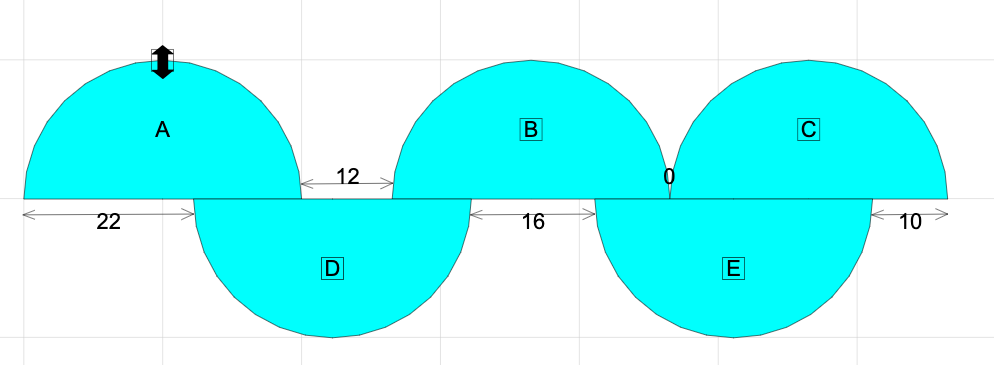
Shift circle C by 12 cm. Therefore, by symmetry looking at the circle B, the diameter is 10+16+10 where 10 is from the shifting of 22-12, the first 10 is by symmetry. The diameter is 36 cm.
Method 2 by Julie Choy
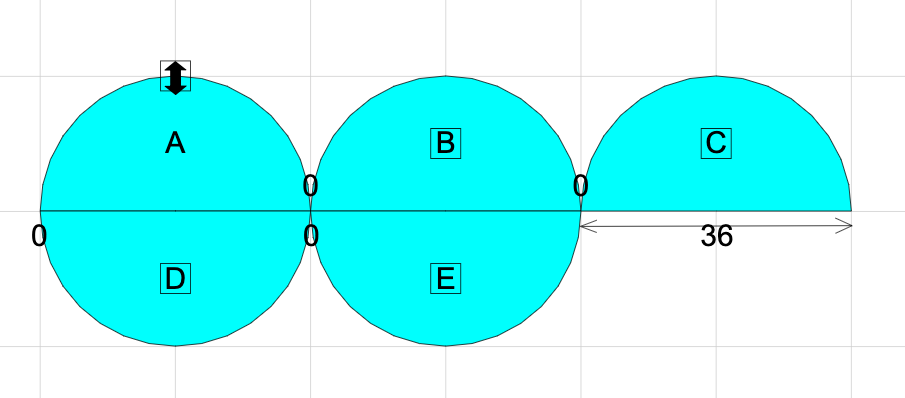
Shift circle B, C, D and E to the extreme left to align them up. So, the circle C is the odd one out. Then the diameter is sum of the bottom numbers subtract the sum of the top numbers, leading to 22+16+22 - (12+12) =36 cm.
Method 3
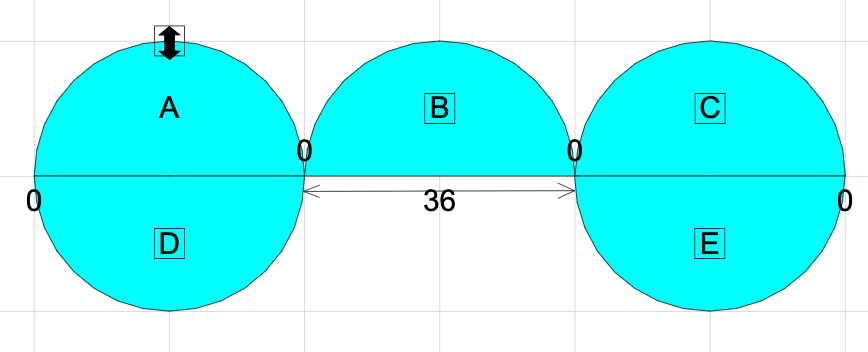
Shift circle D to the extreme left align with circle A. Shift circle E to the extreme right align with circle C. So, the bottom numbers add up is equal to the 2 top numbers plus diameter B. Therefore, the diameter is sum of the bottom numbers subtract the sum of the top numbers, leading to 22+16+22 - (12+12) =36 cm.
Conclusion
Therefore, the principle to solving this kind of problem is to look out for a pattern that leads to top set of numbers - bottom set of numbers, is the odd length out which is the diameter in this case.
For Teachers
[text]
Research
[text]
Video
[text]
Version:
Other Resources
[text]
Frequently Asked Questions: 2019 PSLE Mathematics Question on Finding Diameter
1. What was the core mathematical problem presented in the 2019 PSLE question on finding diameter?
The central problem involved determining the diameter of a specific circle (implied to be circle B based on the provided solutions) within an arrangement of multiple circles with given horizontal distances between their edges. The challenge lay in correctly interpreting the spatial relationships and devising a method to isolate the diameter of the target circle.
2. What were the different methods proposed to solve this diameter problem?
Three distinct methods were highlighted:
- Method 1 (Boring physics teacher): This method involves conceptually shifting one of the outer circles (circle C) by a certain distance (12 cm) to align it with another circle. By leveraging symmetry, the diameter of the target circle (B) is then calculated based on the adjusted distances between the circles. The calculation is presented as 10 + 16 + 10 = 36 cm, where the initial 10 cm comes from the shifted distance (22 - 12), and the subsequent 10 cm is inferred due to symmetry.
- Method 2 (Julie Choy): This approach suggests shifting multiple circles (B, C, D, and E) to one край (extreme left) to align them. It identifies circle C as the "odd one out." The diameter is then found by taking the sum of the bottom measurements and subtracting the sum of the top measurements, resulting in (22 + 16 + 22) - (12 + 12) = 36 cm.
- Method 3: Similar to Method 2 in its result, this method describes shifting circle D to align with circle A on the left and circle E to align with circle C on the right. It concludes that the sum of the bottom numbers equals the sum of the top numbers plus the diameter of circle B. Therefore, the diameter is calculated as the sum of the bottom numbers minus the sum of the top numbers: (22 + 16 + 22) - (12 + 12) = 36 cm.
3. What was the underlying principle identified as crucial for solving this type of problem?
The conclusion of the analysis suggests that the key principle is to identify a pattern where the difference between a "top set of numbers" and a "bottom set of numbers" equals the "odd length out," which in this specific case is the diameter of the circle being sought. This implies looking for relationships in the given dimensions that, through addition and subtraction, isolate the desired diameter.
4. Why were multiple solution methods presented for a single PSLE question?
Presenting multiple solution methods serves several pedagogical purposes. It demonstrates that mathematical problems can often be approached from different perspectives and solved using various logical pathways. This can cater to different learning styles and levels of understanding. Moreover, it encourages students to think flexibly and creatively about problem-solving, rather than relying on a single, rigid algorithm. It also highlights the underlying mathematical concepts from different angles, deepening comprehension.
5. What role does visual representation or shifting of circles play in the solution methods?
The concept of shifting circles, either physically or conceptually, is a key element in all the presented methods. This visualization technique helps to simplify the complex spatial arrangement of the circles. By aligning certain circles, the relationships between the given distances and the unknown diameter become clearer. This allows for the creation of equations or direct comparisons that lead to the solution. The "shifting" acts as a mental or visual tool to reframe the problem in a more manageable way.
6. What is the significance of this PSLE question being featured on an open educational resources platform?
Featuring this PSLE question on an open educational resources platform like Open Source Physics @ Singapore makes it freely accessible to a wider audience, including students, teachers, and parents. This aligns with the goals of open education, which promotes the sharing and reuse of educational materials. By providing the question, multiple solution methods, and underlying principles, the platform facilitates learning, discussion, and deeper understanding of mathematical problem-solving strategies.
7. Who were the individuals or teams credited for their contributions to this resource?
The credits mention This email address is being protected from spambots. You need JavaScript enabled to view it., Francisco Esquembre, and Felix J. Garcia Clemente as the creators of the resource. Additionally, Method 1 is attributed to a "Boring physics teacher" (likely Weelookang based on the associated YouTube link), and Method 2 is attributed to Julie Choy. This acknowledges the collaborative nature of developing and sharing educational content and recognizes the different perspectives brought to solving the problem.
8. Beyond this specific question, what broader educational initiatives or resources are associated with Open Source Physics @ Singapore?
The extensive list of "Other Resources" on the webpage indicates a wide range of educational initiatives and resources associated with Open Source Physics @ Singapore. These include interactive JavaScript simulations and applets covering various topics in mathematics and science (physics, chemistry, etc.), resources related to teacher professional development (e.g., SLS Hackathons, workshops), and initiatives promoting the use of technology in education. The platform appears to be actively involved in creating and sharing engaging, interactive tools and resources to enhance learning across different subjects and educational levels.