{source}
<?php  require_once JPATH_SITE.'/TTcustom/TT_contentparser.php';\(parameters = array("topicname" => "math", "modelname" => "ejss_model_shmmassscale");echo generateSimHTML(\)parameters, "EJSS");
?>
{/source} File name changed to shm instead of SHM capitalisation causing error in App
{source}<iframe style="border-radius:12px" src="https://open.spotify.com/embed/episode/2f7JziEwTukwlFnMlMUp9f?utm_source=generator" width="100%" height="352" frameBorder="0" allowfullscreen="" allow="autoplay; clipboard-write; encrypted-media; fullscreen; picture-in-picture" loading="lazy"></iframe>{/source}
Briefing Doc: Mass or Weighing Scale Model JavaScript Simulation
Source: Excerpts from "Mass or Weighing Scale Model JavaScript Simulation Applet HTML5 - Open Educational Resources / Open Source Physics @ Singapore | Open Educational Resources / Open Source Physics @ Singapore"
Main Themes:
- Interactive Learning: This resource emphasizes hands-on learning through a JavaScript simulation of a mass or weighing scale. This interactive approach allows students to experiment with different scales and levels of precision.
- Measurement Skills: The simulation focuses on developing students' abilities to accurately measure mass using a weighing scale, including reading measurements from a circular scale.
- Addressing Common Misconceptions: The document highlights the common misconception students have regarding decimals, especially when converting between units like grams and kilograms.
- Accessibility: The simulation applet is designed to be accessible across various platforms, including Android, iOS, Windows, MacOSX, Linux, Chromebooks, laptops, desktops, handphones, and tablets. This ensures broad accessibility for learners.
Most Important Ideas/Facts:
- Sample Learning Goal: "(g) describe how to measure a variety of masses with appropriate accuracy by means of weighing scales." This clearly defines the intended learning outcome for students using this simulation.
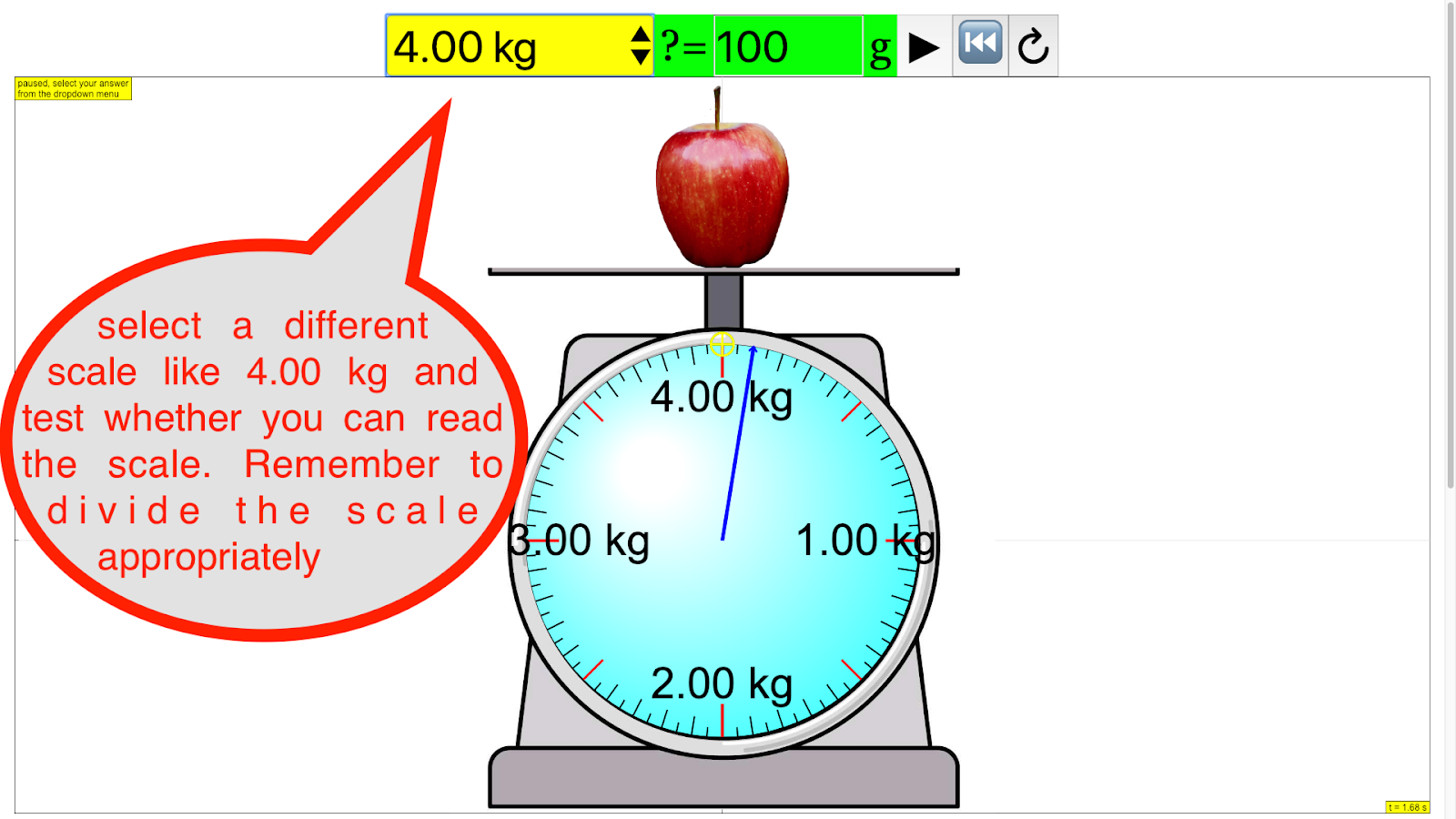
- Three Options: The simulation offers three different scale options, each with varying levels of precision (decimal places), allowing students to explore measurement accuracy based on the tool's limitations.
- Decimal Place Understanding: The simulation helps students understand the concept of decimal places, crucial for accurate mass measurement and unit conversion. The document states, "Students typically can tell masses of whole numbers such as 600 g, but to be able to type in 0.60 kg requires some understanding of decimal places."
Quotes:
- "This Mass Scale Model allows the skills of reading from a circular scale of a typical weighing scale."
- "The three options available allows for student's own testing of the different scales with different decimal places of precision appropriate in each scale's smallest division."
- "Play with the Mass Scale Model. Test what you've learned by trying the input field."
Overall: This resource provides an interactive and engaging way for students to learn about mass measurement using a weighing scale. The simulation is designed to address common misconceptions related to decimals and develop crucial skills in reading measurements from a circular scale. Its availability across various platforms ensures accessibility for a wide range of learners.
Mass or Weighing Scale Model Study Guide
Quiz
Instructions: Answer the following questions in 2-3 sentences each.
- What is the primary function of the Mass or Weighing Scale Model?
- List three devices that can be used to access the Mass or Weighing Scale Model.
- What specific skill does the model aim to develop in students?
- Describe one common misconception students may have when using the model.
- Explain the concept of decimal places in the context of measuring mass.
- What is the smallest unit of measurement available in the model?
- How does the model help students engage with the learning process?
- What are the three options available within the model and why are they included?
- How does the model prepare students for real-world applications of mass measurement?
- Identify one resource cited that provides a similar simulation experience.
Quiz Answer Key
- The Mass or Weighing Scale Model simulates the use of a weighing scale, allowing users to practice reading measurements from a circular scale.
- The model can be accessed on Android and iOS devices (including phones, tablets, and iPads), Windows/MacOSX/Linux devices (including laptops and desktops), and Chromebook laptops.
- The model aims to develop students' ability to accurately read measurements from a circular scale, focusing on the skill of using and interpreting measuring instruments.
- Students often struggle with understanding decimal places when recording mass. They might correctly identify a mass as 600 g but have difficulty expressing it as 0.60 kg.
- Decimal places indicate the precision of a measurement. For instance, a scale with markings for every 0.1 kg allows for measurements to the tenth decimal place (e.g., 1.2 kg), while a scale with markings for every 0.01 kg allows for measurements to the hundredth decimal place (e.g., 1.23 kg).
- The smallest unit of measurement varies depending on the scale option chosen, but it could be as precise as 0.01 kg (10 grams).
- The model provides an interactive and visual experience, allowing students to manipulate the scale and observe changes in the reading, promoting active learning and observation.
- The model offers three different scales with varying levels of precision. This allows students to explore the impact of scale increments on measurement accuracy and practice reading measurements with different decimal places.
- By simulating a real-world weighing scale, the model equips students with the skills necessary to confidently use similar scales in practical settings, like kitchens, laboratories, or grocery stores.
- A similar simulation experience is offered by a GeoGebra resource created by Lew w s, accessible at: https://www.geogebra.org/m/p2att6kw.
Essay Questions
- Discuss the importance of understanding decimal places in the context of measuring mass. How does the Mass or Weighing Scale Model help students develop this understanding?
- Compare and contrast the three scale options available in the model. How do these options contribute to a comprehensive understanding of mass measurement?
- Analyze the role of simulation in science education. How does the Mass or Weighing Scale Model exemplify the benefits of using simulations for learning?
- Critically evaluate the learning goals outlined in the source material. Do these goals align with the features and functionalities of the model? Provide specific examples to support your argument.
- Propose an extension activity that could be used in conjunction with the Mass or Weighing Scale Model to further enhance student understanding of mass and measurement.
Glossary of Key Terms
- Mass: A fundamental property of an object that represents the amount of matter it contains. Commonly measured in grams (g) or kilograms (kg).
- Weighing Scale: An instrument used to measure the weight or mass of an object.
- Circular Scale: A type of scale where measurements are displayed along a circular dial or arc.
- Decimal Places: The digits in a number that come after the decimal point, representing fractions of a whole unit.
- Precision: The level of detail or accuracy of a measurement, often indicated by the number of decimal places used.
- Simulation: An imitation or representation of a real-world process or system, often used for educational or training purposes.
- Applet: A small, self-contained application or program, typically designed for a specific function or task.
- HTML5: The latest version of HyperText Markup Language, used to create and structure content on the World Wide Web.
- JavaScript: A programming language commonly used to create interactive elements and dynamic content on websites.
- Open Educational Resources (OER): Freely accessible and reusable educational materials that can be used, adapted, and shared by educators and learners.
Apps
{source}
<a href='https://play.google.com/store/apps/details?id=com.ionicframework.scaleapp217336&utm_source=global_co&utm_medium=prtnr&utm_content=Mar2515&utm_campaign=PartBadge&pcampaignid=MKT-Other-global-all-co-prtnr-py-PartBadge-Mar2515-1'><img alt='Get it on Google Play' src='https://play.google.com/intl/en_us/badges/images/generic/en_badge_web_generic.png'/></a>
{/source}
<a href='https://play.google.com/store/apps/details?id=com.ionicframework.scaleapp217336&pcampaignid=MKT-Other-global-all-co-prtnr-py-PartBadge-Mar2515-1'><img alt='Get it on Google Play' src='https://play.google.com/intl/en_us/badges/images/generic/en_badge_web_generic.png'/></a>
{/source}
{source}
<iframe src="https://widgets.itunes.apple.com/widget.html?c=us&brc=FFFFFF&blc=FFFFFF&trc=FFFFFF&tlc=FFFFFF&d=&t=&m=software&e=software,iPadSoftware&w=300&h=300&ids=1189447296&wt=discovery&partnerId=&affiliate_id=&at=&ct=" frameborder=0 style="overflow-x:hidden;overflow-y:hidden;width:300px;height: 300px;border:0px"></iframe>
{/source}
https://itunes.apple.com/us/app/even-odd-multiples-factors/id1196575475?ls=1&mt=8 iOS App
Topics
- measure to obtain a reading from a suitable measuring instrument
- Skills Engaging with an event, phenomenon or problem through:
- Collecting and presenting evidence through:
- Observing This is the skill of using our senses to gather information about objects or events. This also includes the use of instruments to extend the range of our senses.
- Using apparatus and equipment This is the skill of knowing the functions and limitations of various apparatus, and developing the ability to select and handle them appropriately for various tasks.
ScreenShots
Mass or Weighing Scale Model JavaScript Simulation Applet HTML5
|
|
|
Mass or Weighing Scale Model JavaScript Simulation Applet HTML5 |
|
|
|
Mass or Weighing Scale Model JavaScript Simulation Applet HTML5 |
|
|
|
Mass or Weighing Scale Model JavaScript Simulation Applet HTML5 |
|
|
|
Mass or Weighing Scale Model JavaScript Simulation Applet HTML5 |
|
|
|
Mass or Weighing Scale Model JavaScript Simulation Applet HTML5 |
|
|
|
Mass or Weighing Scale Model JavaScript Simulation Applet HTML5 |
|
|
|
Mass or Weighing Scale Model JavaScript Simulation Applet HTML5 |
|
|
|
Mass or Weighing Scale Model JavaScript Simulation Applet HTML5 |
Description
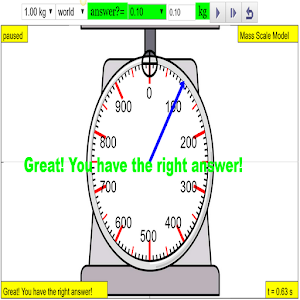
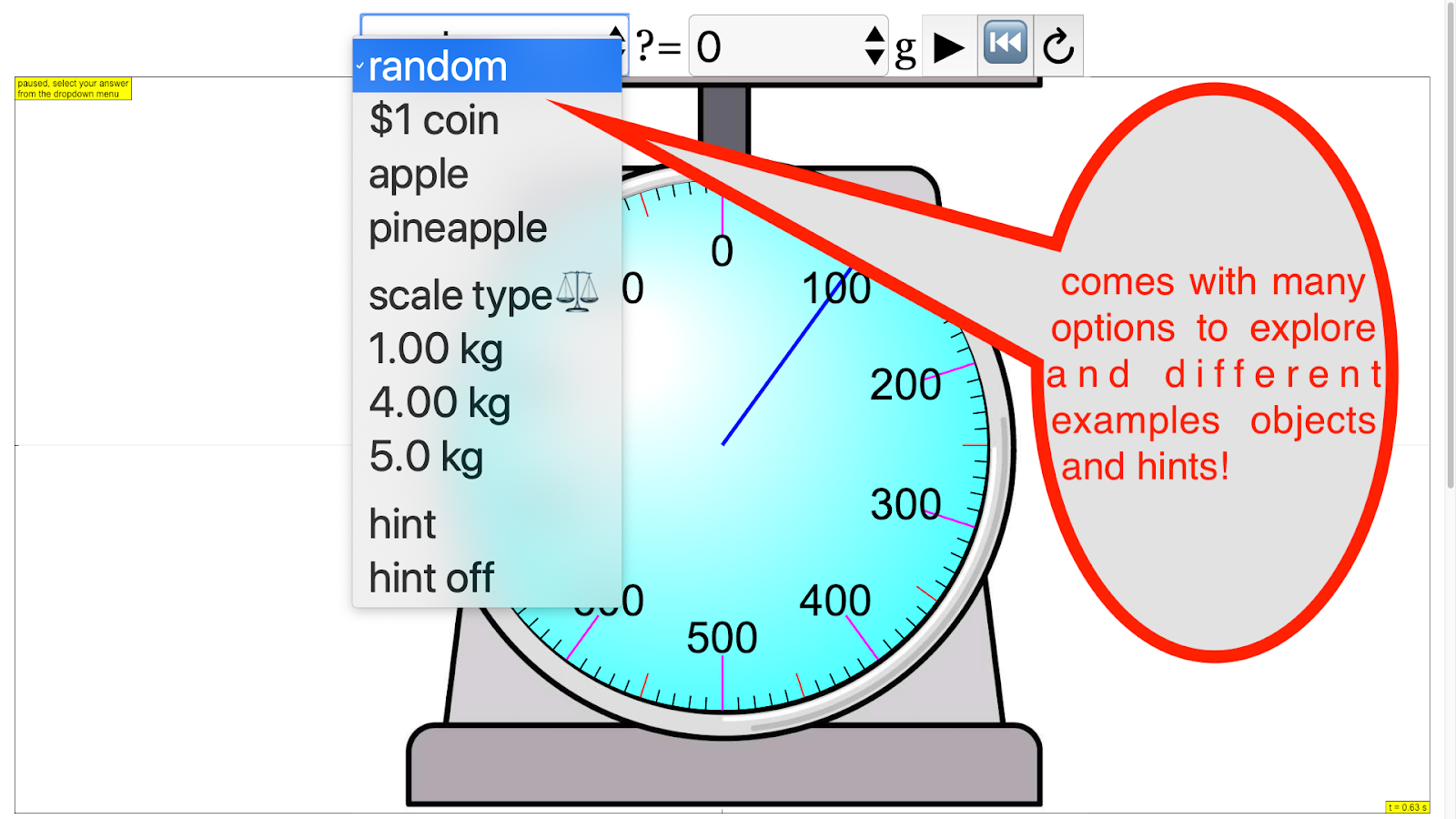
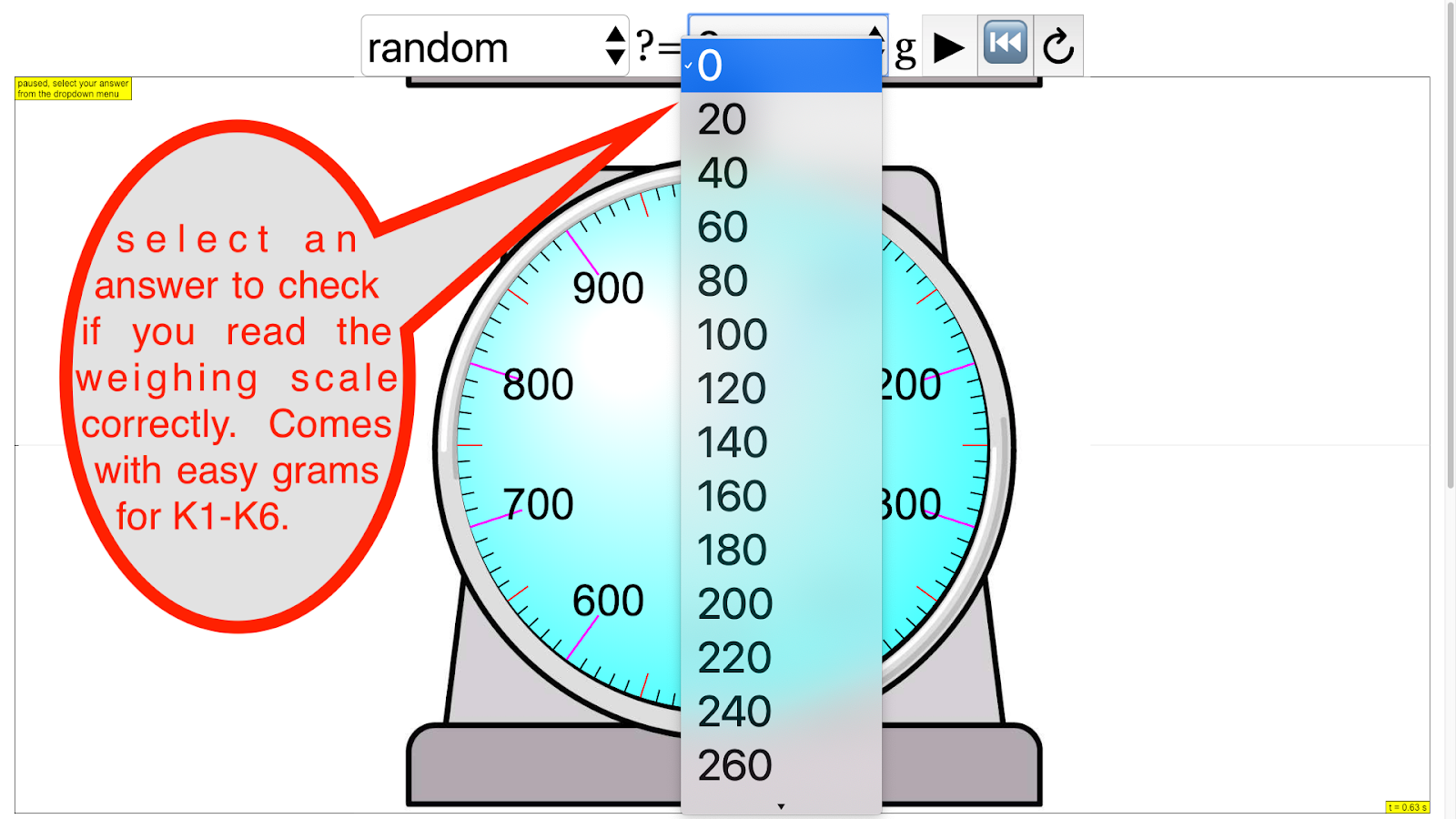
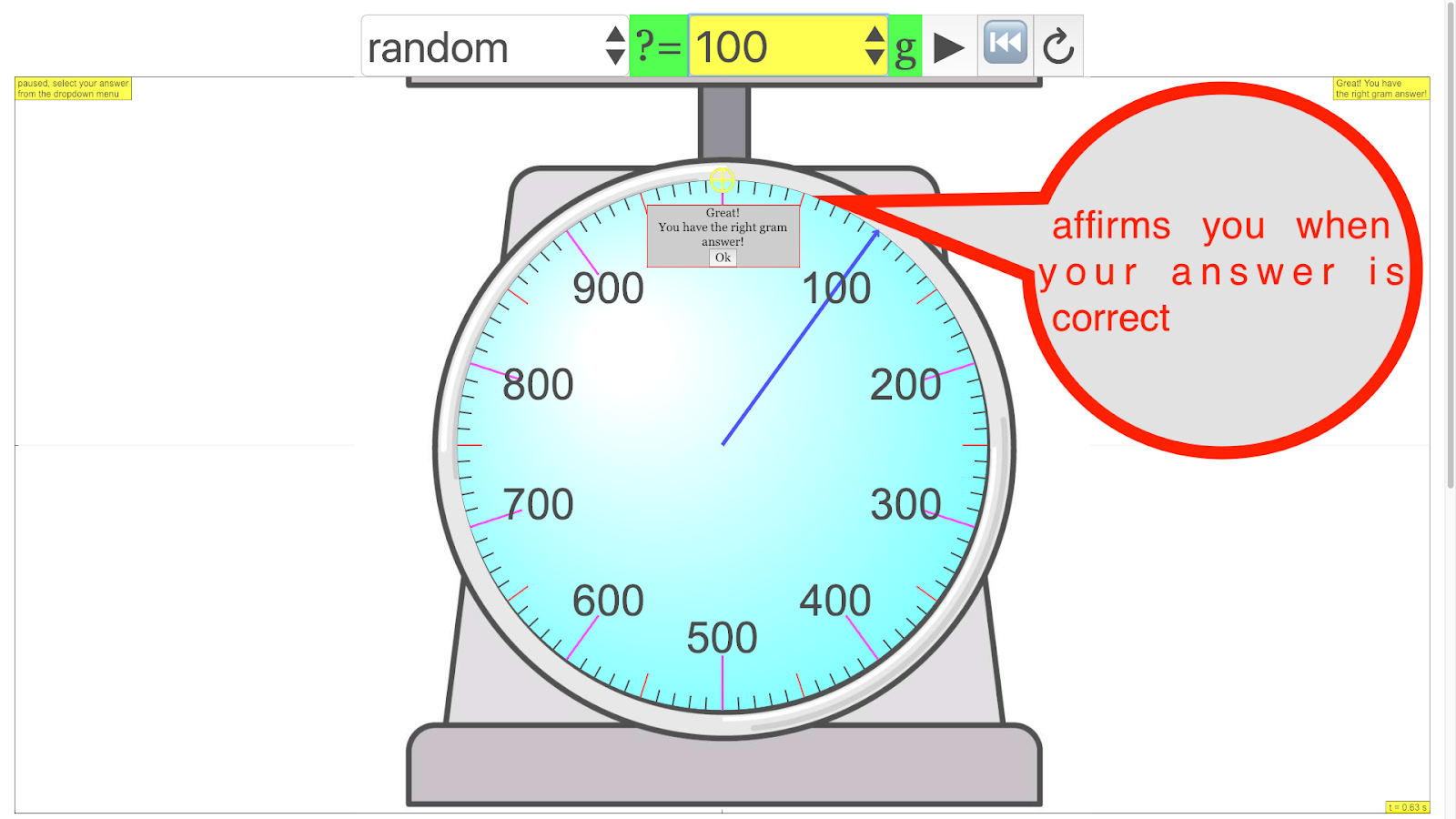
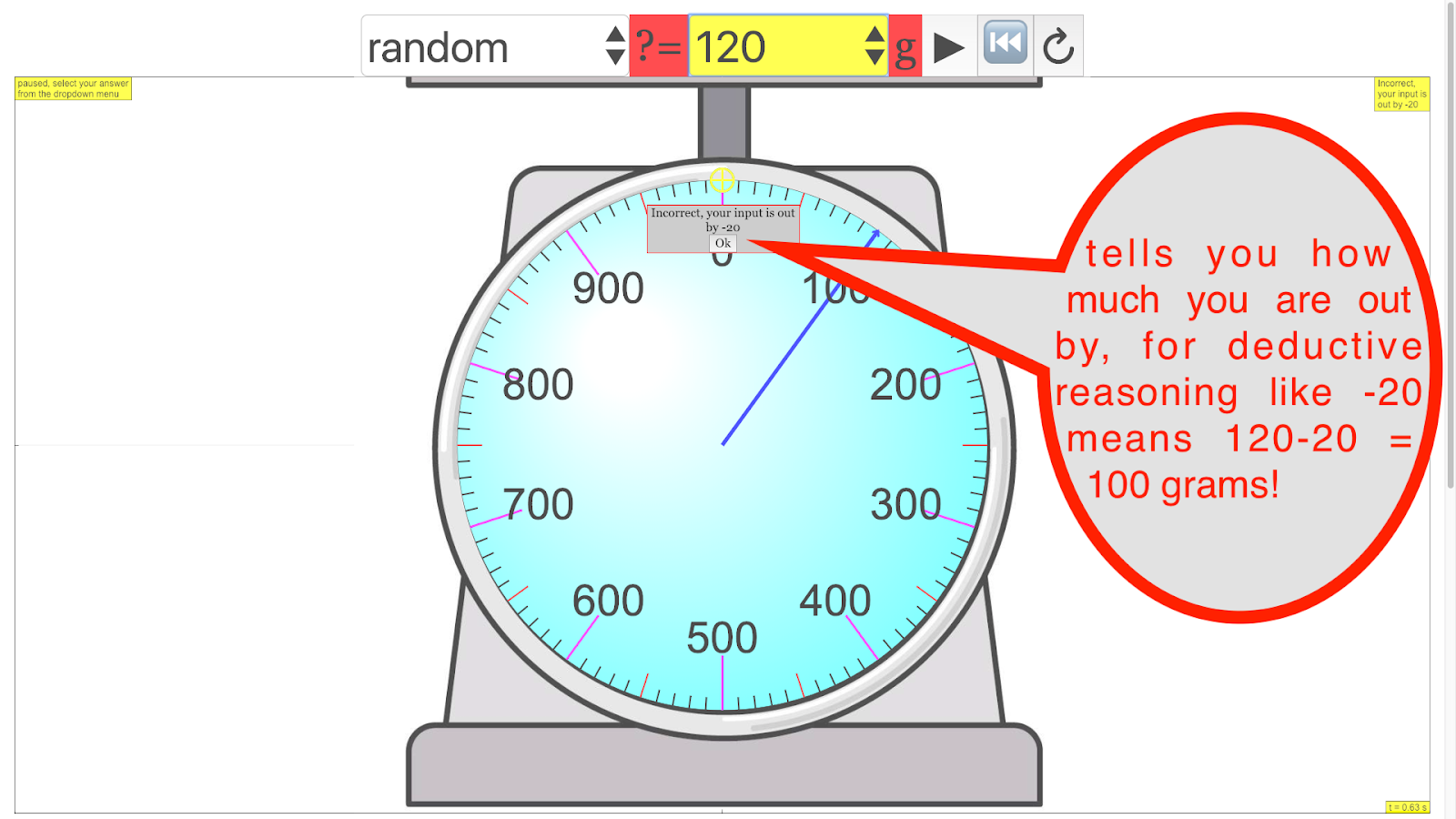
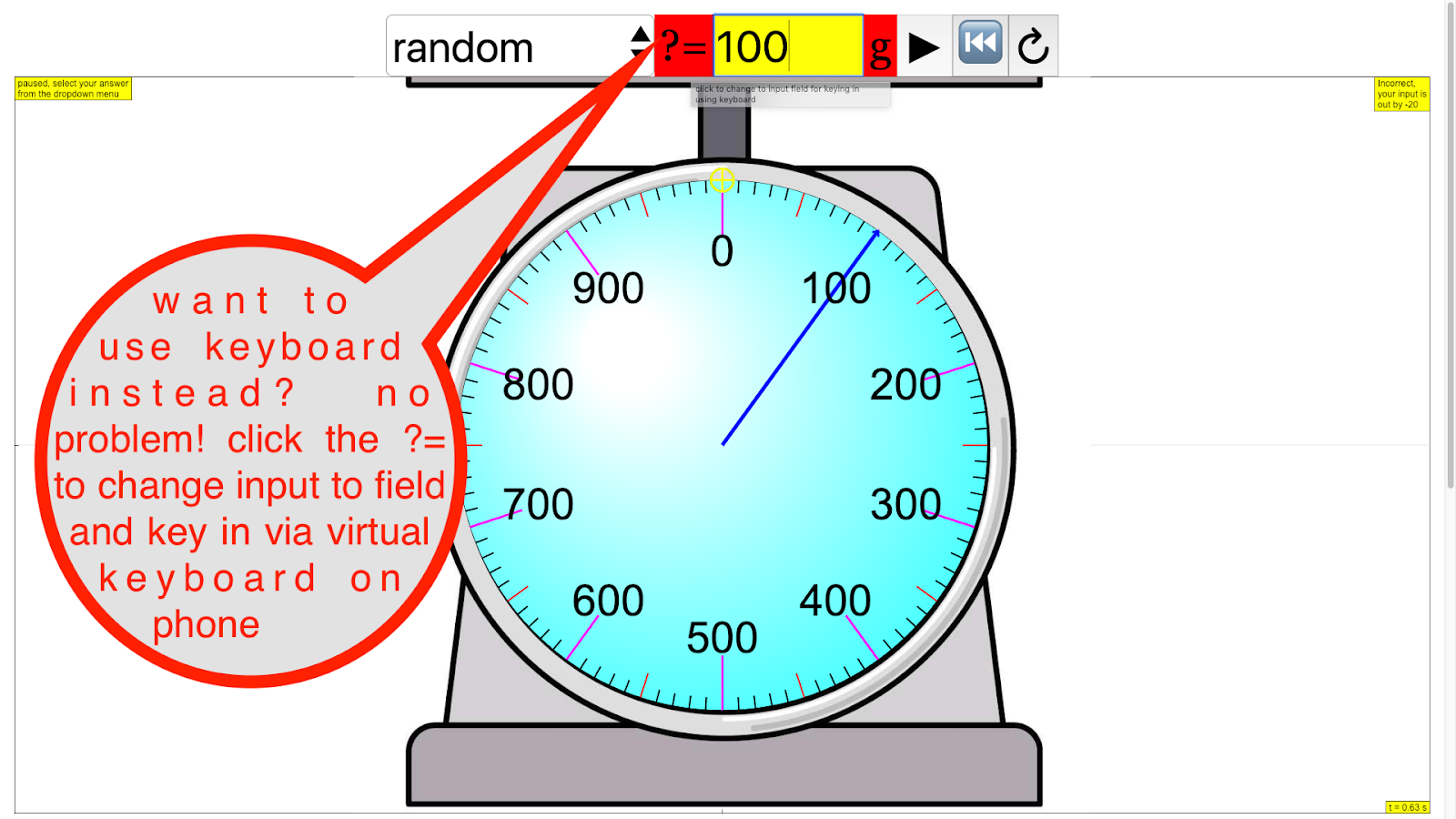
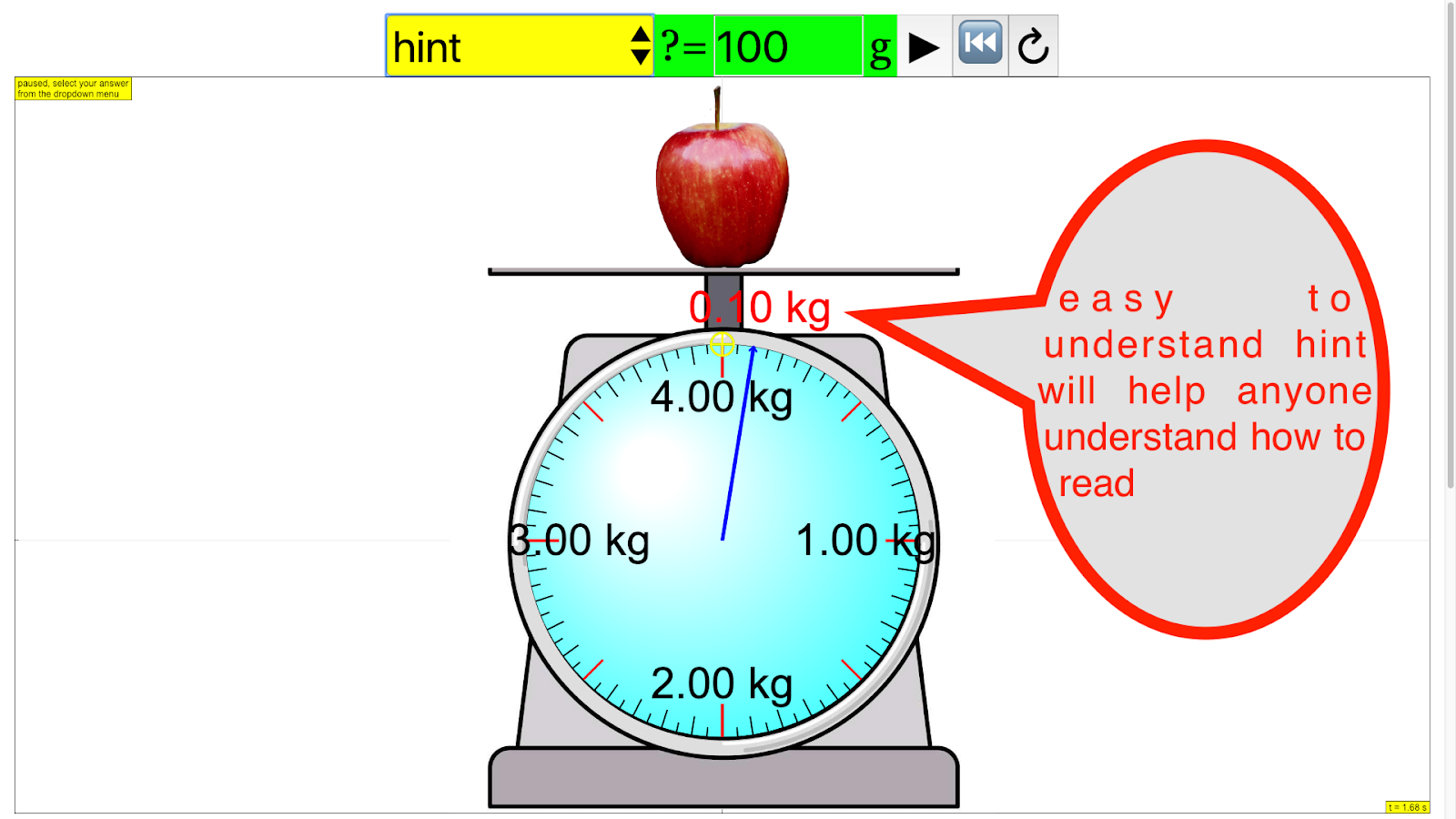
Play with the Mass Scale Model. Test what you've learned by trying the input field.
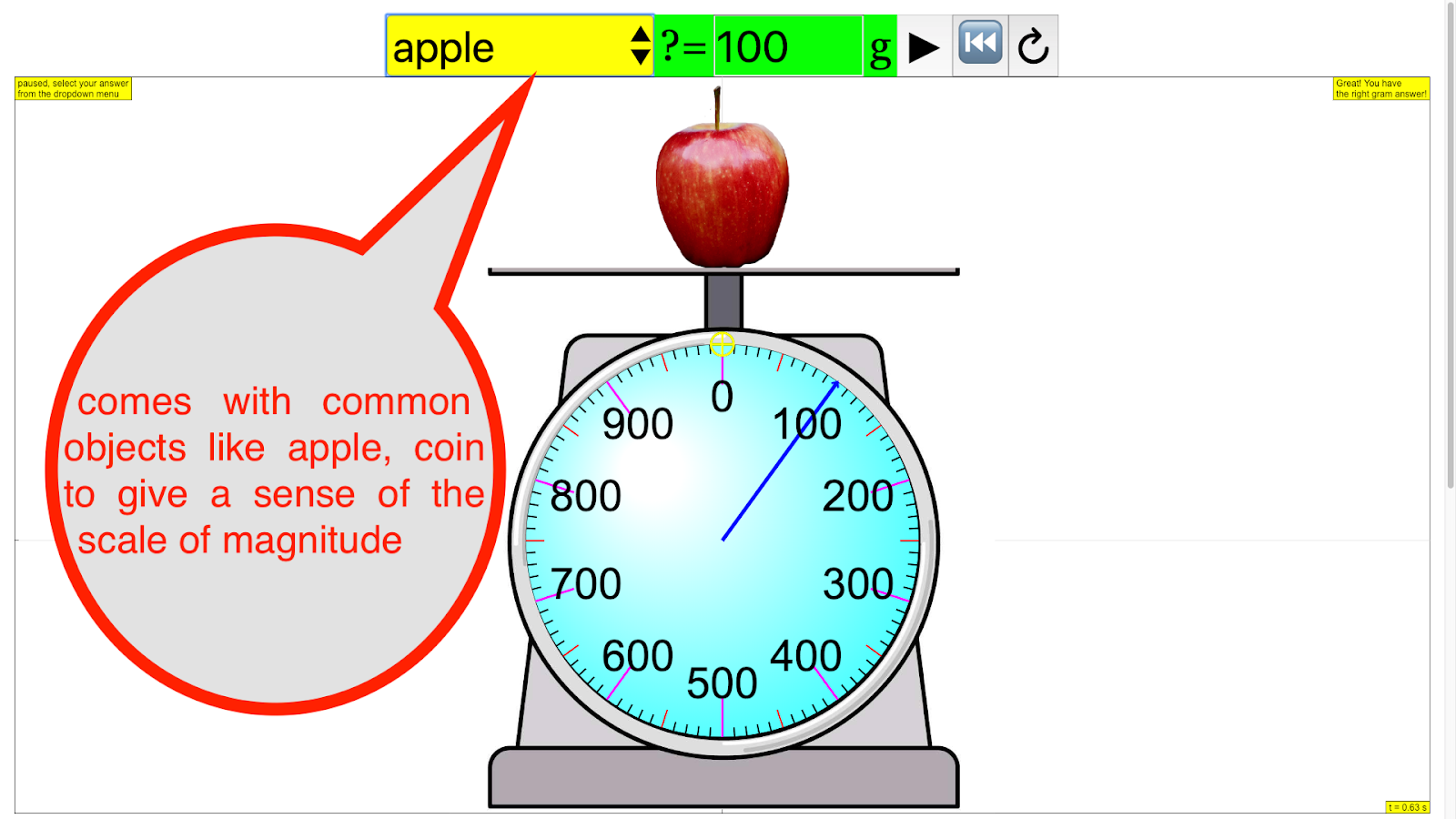
This Mass Scale Model allows the skills of reading from a circular scale of a typical weighing scale. The three options available allows for student's own testing of the different scales with different decimal places of precision appropriate in each scale's smallest division.
Common misconceptions
Students typically can tell masses of whole numbers such as 600 g, but to be able to type in 0.60 kg requires some understanding of decimal places.
Sample Learning Goals
(g) describe how to measure a variety of masses with appropriate accuracy by means of weighing scales.
Version:
Resources
https://www.geogebra.org/m/p2att6kw by Lew w s
https://www.geogebra.org/m/yphhaxky By lew
Credits
http://weelookang.blogspot.sg/2014/11/ejss-mass-scale-model.html
scale from
http://www.abcteach.com/free/k/kilogramblankscalergb.jpg
http://www.picserver.org/p/pineapple.html
https://commons.wikimedia.org/wiki/File:Single_apple.png
http://fengshuibeginner.com/singapore-1-dollar-coin/
Mass or Weighing Scale Model FAQ
1. What is the purpose of the Mass or Weighing Scale Model?
This interactive simulation allows students to practice reading measurements from a circular scale, similar to those found on typical weighing scales. It helps develop the skills needed to accurately determine mass using different scales and levels of precision.
2. What are the key features of the simulation?
- Interactive Scale: Users can manipulate the scale to change the displayed mass.
- Multiple Scales: The model offers three different scales with varying levels of precision (decimal places).
- Input Field: Students can test their understanding by entering specific mass values.
3. What topics does the simulation cover?
- Measurement: Learning to obtain readings from a measuring instrument.
- Observing: Using senses and instruments to gather information about objects and events.
- Using Apparatus and Equipment: Understanding the function and limitations of weighing scales.
- Decimals: Interpreting and using decimal places in mass measurements.
- Numbers up to 100: Reading and understanding mass values within this range.
- Length, Mass, and Volume: Connecting the concept of mass to other fundamental measurements.
4. What are some common misconceptions addressed by the simulation?
Students often struggle with understanding decimal places when measuring mass. For instance, they might easily identify a mass as 600 g but find it challenging to express it as 0.60 kg. The simulation helps clarify the relationship between different units and the importance of decimal precision.
5. What are some sample learning goals for using this model?
- Describe how to measure a variety of masses with appropriate accuracy using weighing scales.
- Convert between different units of mass (e.g., grams and kilograms).
- Explain the significance of decimal places in representing mass measurements.
6. Is the simulation available on mobile devices?
Yes, the Mass or Weighing Scale Model is available as a free and pro app for both Android and iOS devices, making it accessible on smartphones, tablets, and iPads.
7. Who created the Mass or Weighing Scale Model?
The simulation was created by lookang and is part of the Open Educational Resources / Open Source Physics @ Singapore initiative.
8. Are there other similar interactive simulations available?
Yes, the Open Educational Resources / Open Source Physics @ Singapore platform offers a wide range of interactive simulations covering various physics topics. You can explore other simulations related to measurement, motion, waves, and more on their website.