{source}
<?php  require_once JPATH_SITE.'/TTcustom/TT_contentparser.php';\(parameters = array("topicname" => "math", "modelname" => "ejss_model_addfractions");echo generateSimHTML(\)parameters, "EJSS");
?>
{/source}
{source}<iframe style="border-radius:12px" src="https://open.spotify.com/embed/episode/4MzYbLtMRKVxvau9aXx365?utm_source=generator" width="100%" height="352" frameBorder="0" allowfullscreen="" allow="autoplay; clipboard-write; encrypted-media; fullscreen; picture-in-picture" loading="lazy"></iframe>{/source}
Briefing Document: Add and Subtract Fractions JavaScript HTML5 Applet Simulation Model
1. Overview
This document provides a review of the "Add and Subtract Fractions JavaScript HTML5 Applet Simulation Model" resource, hosted on the Open Educational Resources / Open Source Physics @ Singapore platform. This resource is designed as an interactive tool for teaching and learning about fractions, targeting primary and secondary school mathematics. The applet aims to visually demonstrate fraction addition and subtraction using different representations.
2. Key Features and Themes
- Interactive Simulation: The core of this resource is a JavaScript-based HTML5 applet that allows users to manipulate and visualize fractions during addition and subtraction. This interactivity is key to its educational value.
- The applet can be embedded in a webpage via an iframe tag.
- Visual Representations: The applet utilizes several visual models to represent fractions, including:
- Circles
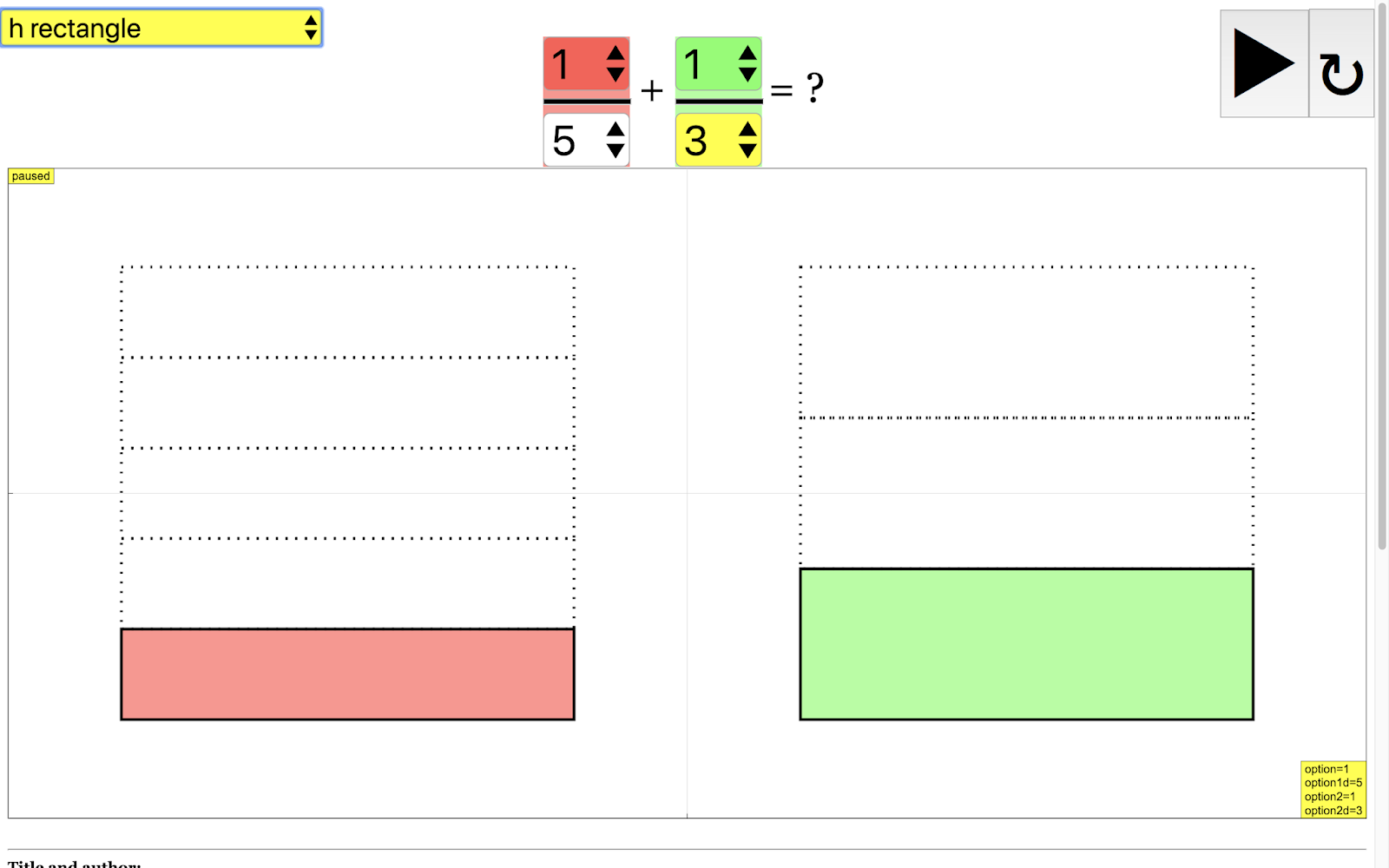
- Horizontal Rectangles
- Vertical Rectangles
- Focus on Alignment: A key aspect highlighted is how these visual models are designed so that "the pieces align for ease of adding." This is a crucial feature for helping students conceptually understand how fractions are combined. The text indicates this alignment makes adding more intuitive. For example: "visualisation in circles, notice the pieces align for ease of adding" "visualisation in horizontal rectangles, notice the fraction line up of ease of adding" "visualisation in vertical rectangles, notice the alignment"
- Target Audience: The resource is labeled for both primary and secondary school mathematics, suggesting its adaptability across different grade levels within these educational stages.
- Open Educational Resource: The resource is part of the "Open Educational Resources / Open Source Physics @ Singapore" initiative, indicating its commitment to free access and open use within educational settings.
- Multiple Language Support: The resource includes information on translations, suggesting a commitment to reaching a global audience, though specific translations aren't listed.
- Specific Fraction Concepts: The applet focuses on concepts related to fractions, as indicated by the tags and navigation elements, specifically "fractions," "Fractions of a Whole," "Fractions Equivalent," "Mixed Numbers and Improper Fractions," and "fraction of a set of Objects".
3. Learning Goals (Based on Implied Goals)
Although explicitly stated sample learning goals aren't provided in this document, the design suggests the following implicit learning goals:
- Students will be able to visually represent fractions using different models.
- Students will understand the concept of adding and subtracting fractions by visualizing how parts combine.
- Students will recognize equivalent fractions through visual comparison.
- Students will develop an understanding of fractions as parts of a whole.
- Students will be able to work with mixed numbers and improper fractions in the context of addition and subtraction.
4. Support for Teachers
- The document includes a "For Teachers" section with links that are meant to offer guidance or additional teaching resources.
- The emphasis on aligned pieces in visualisations suggests the applet is meant to facilitate a more intuitive understanding of fraction operations for teachers to leverage in instruction.
5. Technical Details and Credits
- Technology: The applet is built using JavaScript and HTML5, making it widely accessible across different devices.
- Credits: The resource credits Francisco Esquembre and Felix_J_Garcia_Clemente for its creation.
- Licensing: The resource is licensed under a Creative Commons Attribution-Share Alike 4.0 Singapore License, encouraging sharing and adaptation. Separate commercial use requires contacting This email address is being protected from spambots. You need JavaScript enabled to view it. and observing a different license.
6. Connections to Other Resources
The document provides a variety of links and references, which demonstrate how this fraction applet is situated within a larger context of interactive educational tools developed by the OER/OSP project. These include:
- Other math-related applets (e.g., "Comparing Fractions," "More than Less than Question Generator").
- Physics simulations (e.g., "Velocity Selector," "Magnetic Bar Field").
- Workshop and professional development events.
- Tools like Tracker for video analysis.
- Examples of work based on the Easy Java/JavaScript Simulations framework used to create this applet.
7. Overall Significance
The "Add and Subtract Fractions JavaScript HTML5 Applet Simulation Model" is a valuable resource for mathematics education due to its:
- Interactive and visual approach to teaching abstract concepts.
- Accessibility through web technologies.
- Open nature, promoting sharing and adaptation by educators.
- Emphasis on aligning visual representations of fractions to enhance understanding.
This applet represents an effort to use interactive digital resources to improve teaching and learning of mathematics, especially where visualisation of the material can aid understanding.
8. Areas for Further Investigation
- It would be good to know how this app is evaluated and what the impact of the tool is on student learning.
- It would be interesting to explore how teachers are using this app in the classroom.
Fractions Simulation Study Guide
Quiz
Instructions: Answer the following questions in 2-3 sentences each.
- What type of mathematical operation is the simulation model designed to explore?
- What are the three visual representations used in the simulation to help students understand fractions?
- Besides the visual models, how else does the simulation assist in understanding fractions?
- What subject area is this simulation primarily intended for?
- Name two specific fraction concepts that the simulation addresses.
- What kind of license covers the content of this resource?
- Who are the primary creators or contributors to this simulation?
- The simulation is embedded using what web element?
- What is one of the suggested uses for teachers using the simulation?
- What is the name of the tool this simulation was created with?
Quiz Answer Key
- The simulation model is designed to explore the mathematical operations of addition and subtraction of fractions. It allows users to manipulate and visualize fractional parts to solve these types of problems.
- The simulation uses three visual representations: circles, horizontal rectangles, and vertical rectangles. These different visual aids provide multiple ways for learners to see and understand fractional relationships.
- The simulation assists in understanding fractions by aligning the fractional pieces making it easy to add. The program allows users to manipulate fractions and see how the parts combine.
- This simulation is primarily intended for the subject of mathematics. It is aimed at students learning about fractions and their associated operations.
- The simulation addresses fraction concepts such as "fractions of a whole" and "equivalent fractions." It also deals with mixed numbers and improper fractions, providing a foundation for more complex topics.
- The content is licensed under the Creative Commons Attribution-Share Alike 4.0 Singapore License. This allows for sharing and adaptation, provided proper attribution is given.
- The simulation is primarily credited to Francisco Esquembre and Felix J. Garcia Clemente. They are the main developers and contributors to the model's creation.
- The simulation is embedded using an iframe. This allows the simulation to be displayed within another webpage, creating a seamless user experience.
- The simulation can be used to show how the fractional pieces align, and to help students visually comprehend addition. It encourages playing around with the model.
- The simulation was created using the Easy JavaScript Simulations tool.
Essay Questions
Instructions: Answer each of the following questions with an essay response.
- Discuss the pedagogical benefits of using visual simulations like this "Add and Subtract Fractions" model in mathematics education. How does this approach compare to traditional methods of teaching fractions?
- Analyze the design of the simulation. How do the different visual representations (circles, horizontal rectangles, vertical rectangles) cater to different learning styles and enhance comprehension of fractions?
- Explain how the simulation model could be incorporated into a lesson plan on adding and subtracting fractions. Describe a specific activity or set of activities that a teacher could use with this resource.
- Considering the broader collection of resources listed in the document, discuss the potential for integrating different types of simulations and models to enhance interdisciplinary learning. Provide specific examples of such integration.
- Reflect on the open educational resource (OER) and open-source nature of this simulation. What are the benefits and potential challenges of using open resources in education? How might the license affect its use in various educational contexts?
Glossary of Key Terms
Applet: A small application, often written in Java or JavaScript, that can be embedded in a webpage to provide interactive content.
Fractions: A numerical quantity that is not a whole number. It represents a part of a whole and is expressed as a numerator over a denominator.
Equivalent Fractions: Fractions that, despite having different numerators and denominators, represent the same proportion of a whole.
Mixed Numbers: A number that combines a whole number and a fraction.
Improper Fractions: A fraction where the numerator is greater than or equal to the denominator.
Open Educational Resources (OER): Educational materials that are freely available for use, adaptation, and redistribution, often under a creative commons license.
JavaScript: A programming language commonly used to create interactive effects within web browsers.
HTML5: The fifth and latest version of the Hypertext Markup Language, used for structuring and presenting content on the World Wide Web.
Simulation: A computer-based model that imitates real-world processes or phenomena, used for educational or training purposes.
iframe: An HTML element that embeds another HTML page within the current page.
Sample Learning Goals
[text]
For Teachers
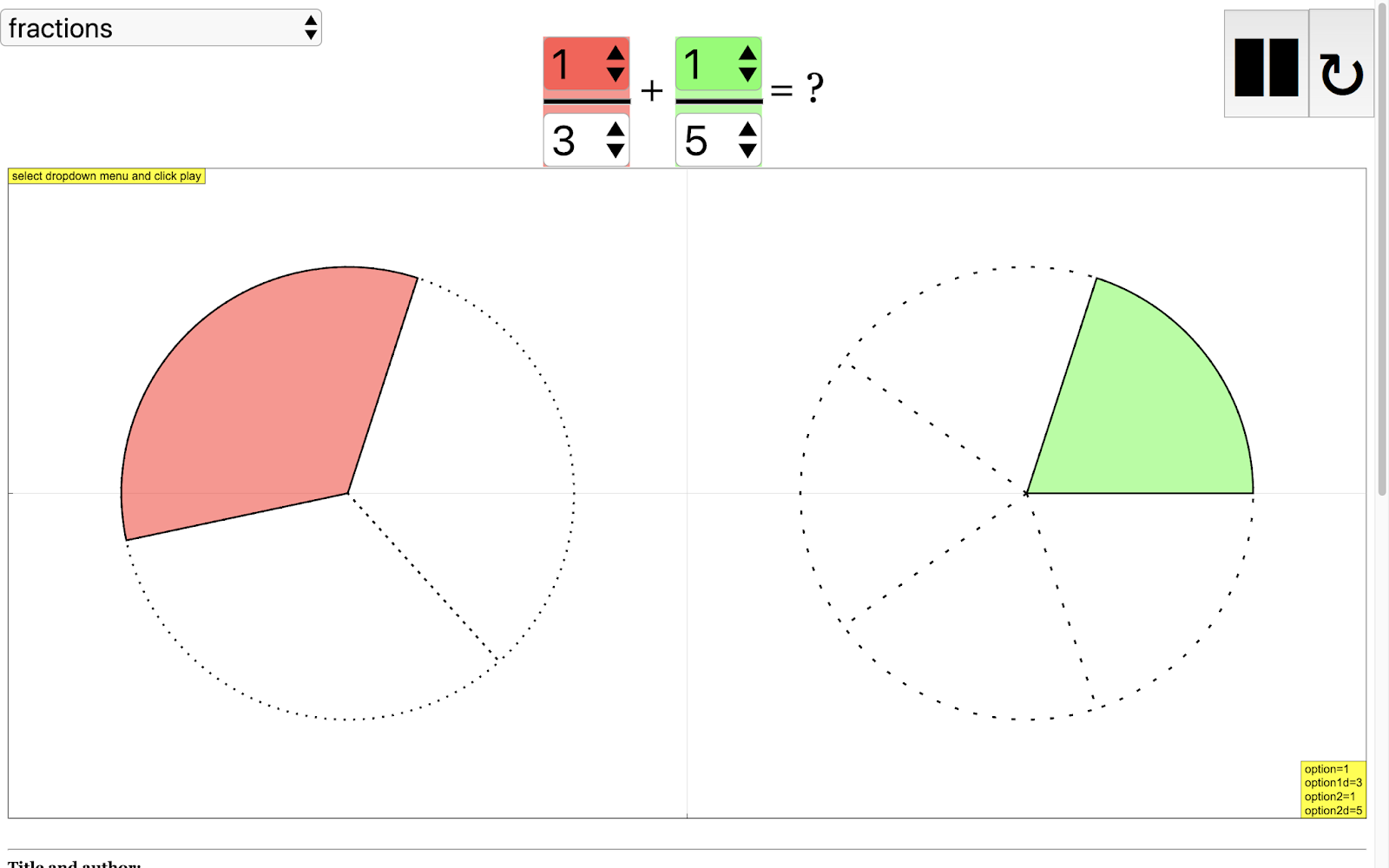 |
| https://sg.iwant2study.org/ospsgx/index.php/553 What is the addition of this fraction? Play to continue visualisation in circles |
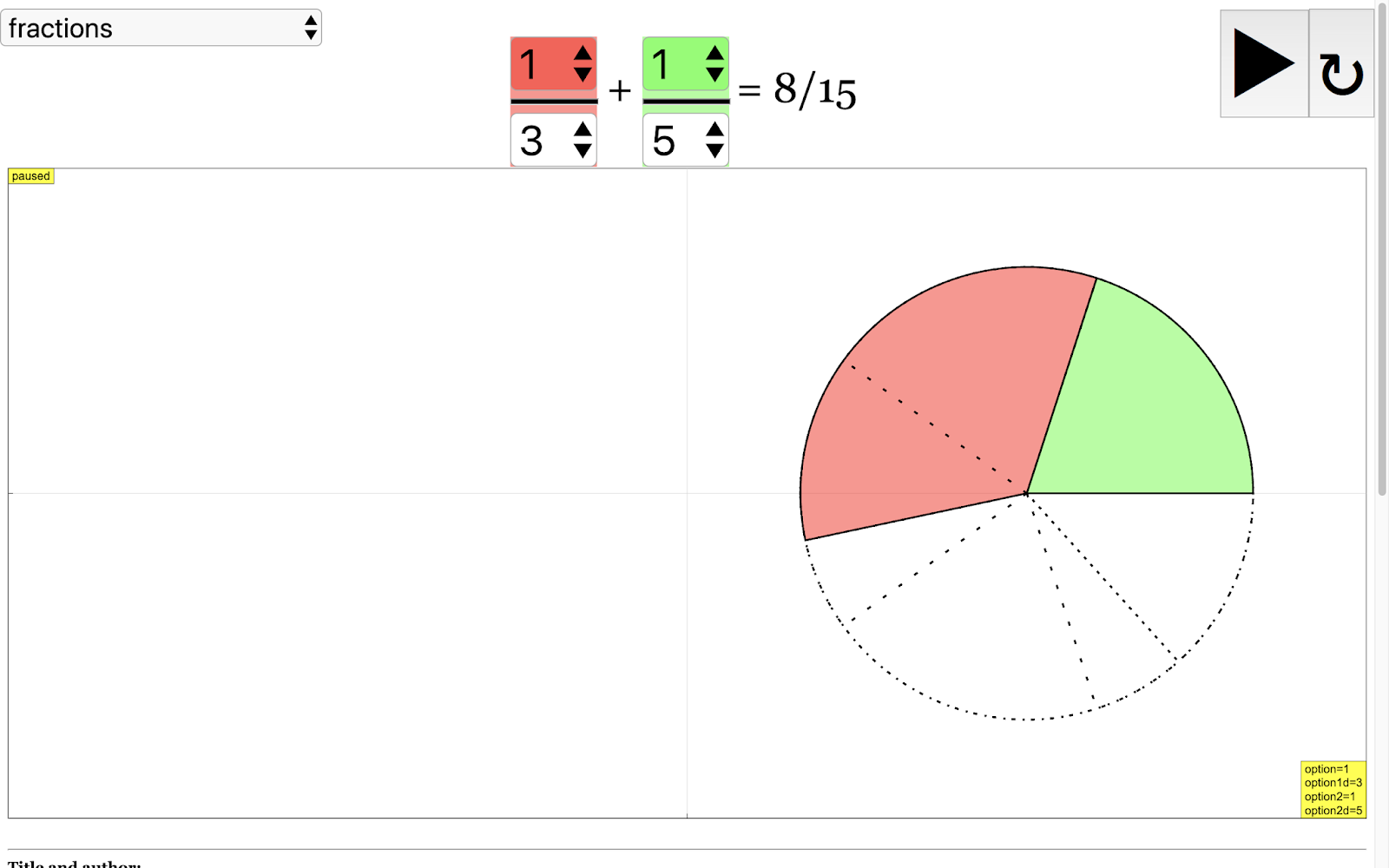 |
| https://sg.iwant2study.org/ospsgx/index.php/553 What is the addition of this fraction? visualisation in circles, notice the pieces align for ease of adding |
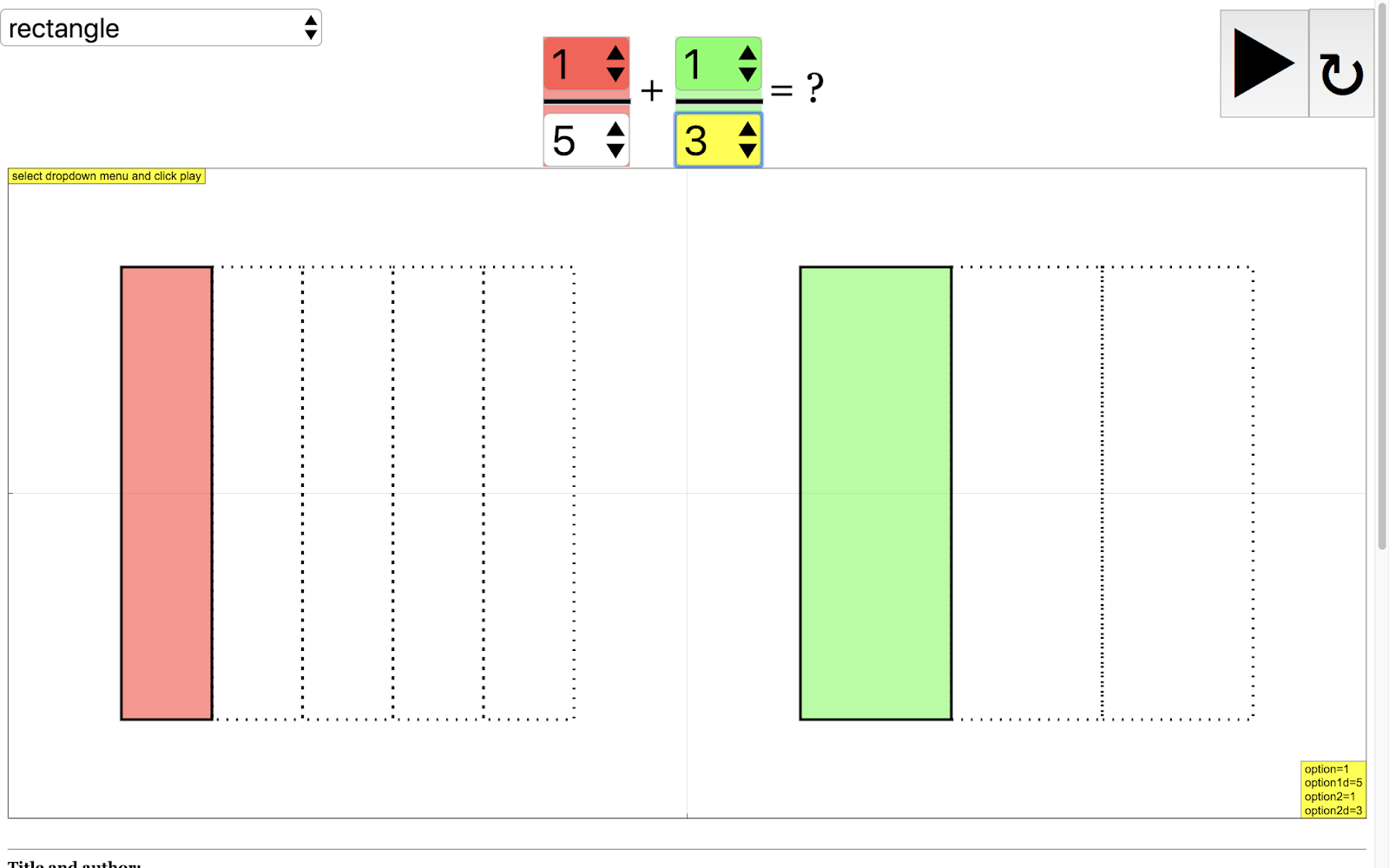 |
| https://sg.iwant2study.org/ospsgx/index.php/553 What is the addition of this fraction? Play to continue visualisation in horizontal rectangles |
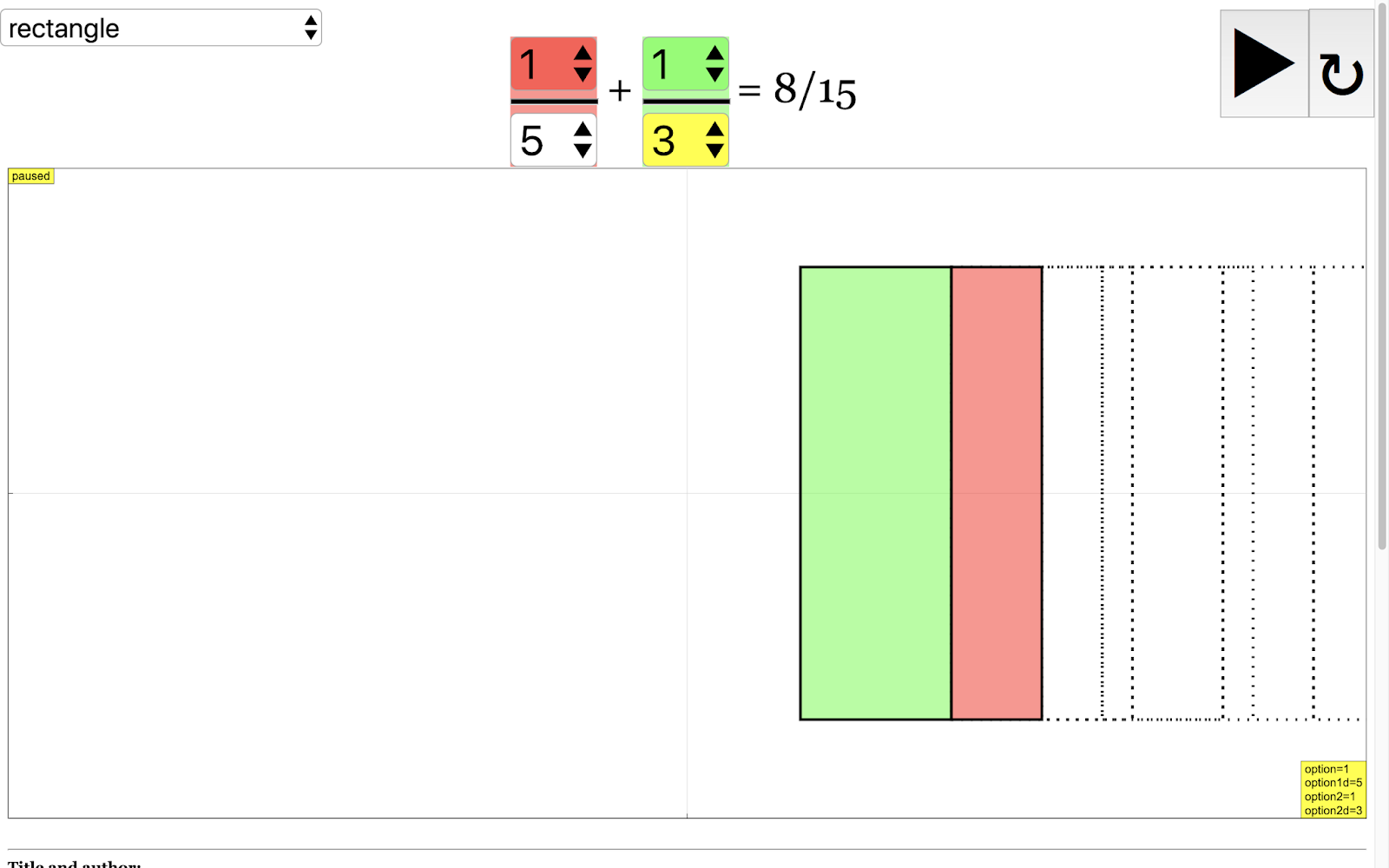 |
| https://sg.iwant2study.org/ospsgx/index.php/553 What is the addition of this fraction? visualisation in horizontal rectangles, notice the fraction line up of ease of adding |
 |
| https://sg.iwant2study.org/ospsgx/index.php/553 What is the addition of this fraction? Play to continue visualisation in vertical rectangles |
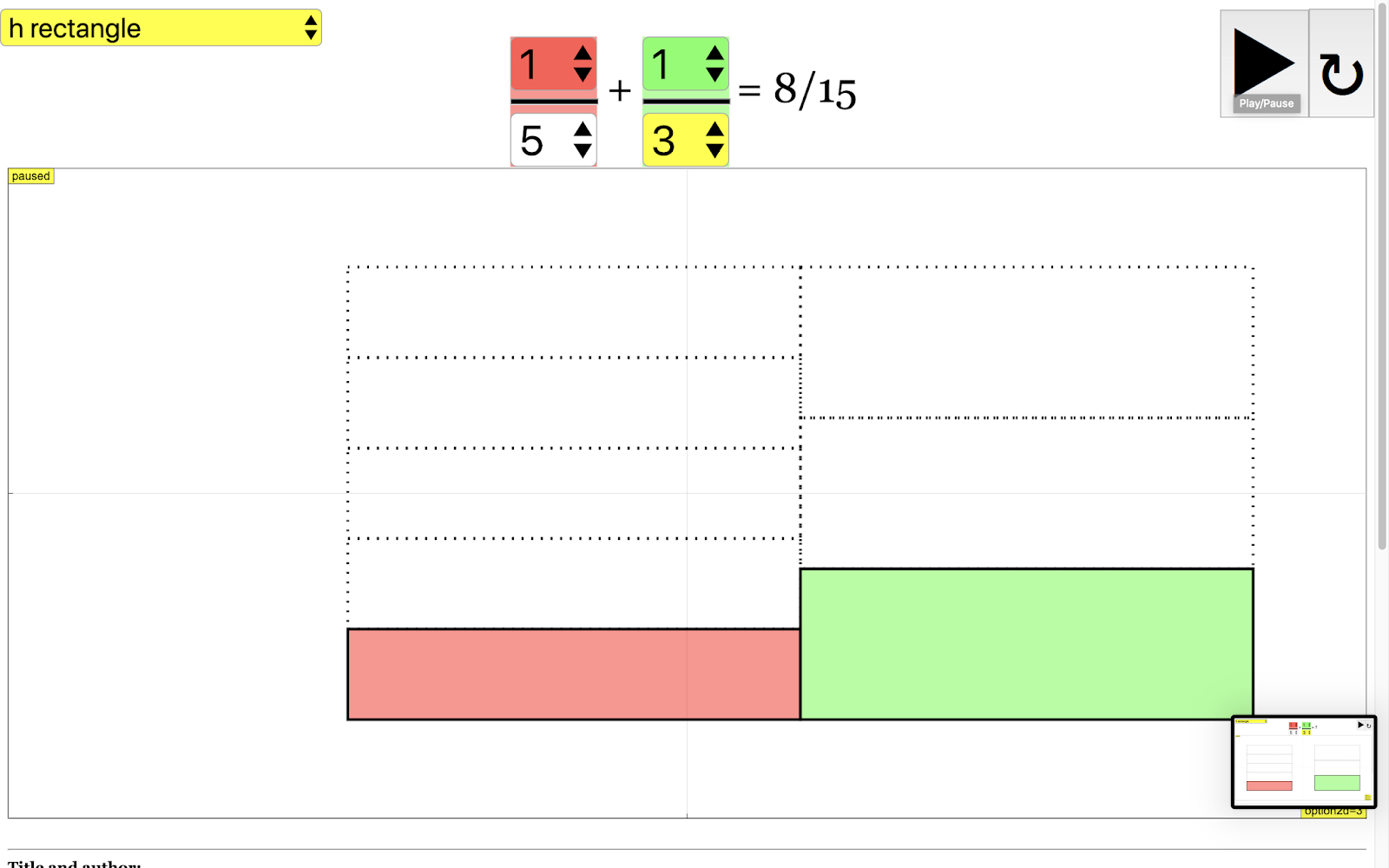 |
| https://sg.iwant2study.org/ospsgx/index.php/553 What is the addition of this fraction? visualisation in vertical rectangles, notice the alignment |
Research
[text]
Video
{source}<iframe width="560" height="315" src="https://www.youtube.com/embed/Za7FiLcBETI" title="YouTube video player" frameborder="0" allow="accelerometer; autoplay; clipboard-write; encrypted-media; gyroscope; picture-in-picture" allowfullscreen></iframe>{/source}
Version:
- http://weelookang.blogspot.sg/2017/09/add-and-subtract-fractions-javascript.html
- https://vle.learning.moe.edu.sg/lesson/view/6772fab7-bfd3-44d3-b665-e86b66bddeac#page-2 login required
- http://weelookang.blogspot.com/2020/05/add-and-subtract-fractions-javascript.html
Other Resources
FAQ
- What is the primary focus of the "Add and Subtract Fractions JavaScript HTML5 Applet Simulation Model"?
- The applet focuses on providing a visual and interactive way to understand the addition and subtraction of fractions. It aims to help learners grasp the concept of fractions of a whole, equivalent fractions, mixed numbers and improper fractions, and fractions of a set of objects using different visual models like circles and rectangles. It primarily targets primary and secondary students.
- How does the applet use visual models to aid in learning?
- The applet employs different visual representations to illustrate fraction operations. These include: * Circles: Fractions are represented as parts of a circle, which is helpful in showing the whole and its divisions. * Horizontal Rectangles: Fractions are depicted as sections of a horizontal rectangle, emphasizing alignment during addition and subtraction. * Vertical Rectangles: Similarly, fractions are illustrated as segments of a vertical rectangle, allowing for another viewpoint of alignment. The use of these diverse visual models helps reinforce the concept of fractional parts and makes the process of adding and subtracting fractions more intuitive by showing how the pieces align.
- Who are the creators and contributors to this applet?
- The applet was created by Francisco Esquembre and Felix J. Garcia Clemente. The Open Educational Resources/Open Source Physics @ Singapore project also supports the applet and is generally a project that supports interactive simulations in STEM education.
- Where can I access the simulation and its related resources?
- The simulation can be directly embedded on a webpage using the provided iframe code. Additionally, the webpage where the applet is hosted (https://sg.iwant2study.org/ospsgx/index.php/553What is the addition of this fraction?) also hosts a variety of other educational simulations and resources created by the same team. Several links to blog posts and learning platforms where the applet has been used are provided.
- What are some of the learning goals associated with using this applet?
- The provided text includes sample learning goals (although these goals are not written out). Based on the applet, it is clear the learning goals center around the ability to visualize and understand the addition and subtraction of fractions. Students should also be able to relate visual representations to numerical calculations. The goal is also to promote understanding of fractions as parts of a whole, fractions as equivalent, mixed numbers and improper fractions and fraction of a set of objects.
- What is "Open Source Physics @ Singapore" and what other resources do they provide? "Open Source Physics @ Singapore" is a project that aims to create and share free educational resources, primarily in the form of interactive simulations. They focus heavily on STEM subjects, offering models and simulations in various fields such as mathematics and physics. The resources range from basic math concepts (like fractions) to more advanced physics topics like rotational motion and electromagnetism. The variety of simulations available indicates a project dedicated to making abstract concepts more tangible through interactive and visual tools.
- What kind of learning materials and pedagogical support does this project offer? Beyond simulations, this project supports a variety of materials such as interactive applets, lesson plans, workshop presentations and research. The focus seems to be on providing resources for both student and teacher use, aiming to make STEM subjects more interactive and easier to understand. This includes both the use of their interactive resources but also a focus on pedagogy including workshops and teacher development. The project supports the use of simulations in enhancing learning experiences in various subject areas.
- Are the resources provided by Open Source Physics @ Singapore free to use?
- The website states that the contents are licensed under a Creative Commons Attribution-Share Alike 4.0 Singapore License, which typically means the resources are free to use, share, and adapt, provided you give appropriate credit and share any derived works under the same license. However, there's a separate note regarding commercial use of the EasyJavaScriptSimulations library, directing users to contact This email address is being protected from spambots. You need JavaScript enabled to view it. and read their license page, suggesting a commercial license might be required for certain uses of the base code or library. The simulation in the described page and those that use the same license are therefore free to use for non-commercial educational purposes.