{source}
<?php  require_once JPATH_SITE.'/TTcustom/TT_contentparser.php';\(parameters = array("topicname" => "physicaleducation", "modelname" => "ejss_model_projectileESSvelocityofrelease");echo generateSimHTML(\)parameters, "EJSS");
?>
{/source}
1. Introduction:
This briefing document summarizes the main themes and important ideas presented in the provided excerpts related to a "Velocity of Release Projectile Motion Model for Exercise Sports Science." The sources include introductory material, a description of a JavaScript/HTML5 applet simulation model, and accompanying information such as credits, a description of projectile motion, and potential questions for users. The overall focus is on understanding how the velocity at which a projectile is released affects its trajectory, particularly in sports contexts.
2. Main Themes and Important Ideas:
2.1. Projectile Motion Fundamentals:
- The core concept discussed is projectile motion, which is defined as "the motion of a projected object (e.g., a shot put, a javelin, a human body during pole-vaulting) acted on by forces of gravity."
- For simplification in the presented model, air resistance is considered negligible. This allows for a clearer focus on the impact of initial conditions, primarily the velocity of release.
- A key principle highlighted is that once a projectile is released, control over it is lost. This underscores the importance of understanding and optimizing the factors affecting its flight path prior to release.
2.2. Velocity at Release as a Critical Factor:
- The sources emphasize the significant role of velocity at release in determining the projectile's trajectory.
- Specifically, "The speed of projection determines the length of trajectory (range)." This implies a direct positive correlation between release velocity and horizontal distance traveled.
- The excerpts explicitly state that "A higher velocity at release will increase the maximum distance and flight time of the projectile." This establishes a causal relationship between the initial speed and key aspects of the projectile's flight.
2.3. Simulation Model and Exploratory Learning:
- A JavaScript HTML5 Applet Simulation Model is central to this educational resource. It is accessible via an embedded iframe link: <iframe width="100%" height="100%" src="https://iwant2study.org/lookangejss/physicaleducation/ejss_model_projectileESSvelocityofrelease/projectileESSvelocityofrelease_Simulation.xhtml " frameborder="0"></iframe>.
- The model is intended to allow users to explore the relationship between the velocity of release and projectile motion outcomes.
- A table is provided that illustrates this relationship with specific data points:
- | Velocity at release | Maximum distance | Flight time | | :------------------ | :--------------- | :---------- | | 5 m/s | 2.56 m | 0.72 s | | 10 m/s | 10.20 m | 1.44 s | | 15 m/s | 22.95 m | 2.16 s | | 20 m/s | 40.78 m | 2.88 s |
- The text mentions that "Graphs shows the different velocity of release, the maximum distance and flight time can be seen, similar to the table above." This suggests a visual representation of the data for enhanced understanding.
2.4. Example Inquiry-Based Questions:
The sources include "Possible Questions" designed to encourage users to interact with the simulation and think critically about the concepts:
- Question 1: "Using the default settings (angle of launch = 45 degrees and relative projection height =0) in the tool, estimate the highest velocity of release of the football when the range is the greatest." The provided answer suggests the simulation allows for a maximum slider value of 20 m/s, which corresponds to the greatest range under these default conditions within the model's constraints.
- Question 2: "Sam claimed that the velocity of release of the football does not affected maximum time of flight of the football. Do you agree? Explain." The provided answer ("disagree. From the simulation, as the velocity of release changes from 5 to 20 m/s, the maximum time of flight also increases.") directly refutes this claim based on observations from the simulation.
- Question 3: "Use the tool above, suggest whether the maximum height increase/decease/constant, as the velocity of release increases." The provided answer ("maximum height increases") indicates another direct relationship observable within the simulation.
2.5. Open Educational Resources and Credits:
- The resource is identified as part of Open Educational Resources / Open Source Physics @ Singapore.
- It is released under a Creative Commons Attribution license, indicating it can be shared and adapted with attribution.
- Credits are given to This email address is being protected from spambots. You need JavaScript enabled to view it. and Cleve Chia for their contributions.
- The use of the Easy JavaScript Simulations (EJS) toolkit is mentioned, with a link to its licensing information.
2.6. Broader Context of Open Source Physics:
- The extensive list of "Other Resources" highlights the breadth of the Open Source Physics (OSP) project and its commitment to providing interactive simulations for various science and mathematics topics. This list includes numerous applets developed for physics, mathematics, chemistry, and even language learning, demonstrating a wide range of applications for this approach to education.
- Mentions of awards like the 2020 Excellence in Physics Education Award from American Physical Society goes to Open Source Physics Team underscore the recognition and value of this initiative within the educational community.
- The inclusion of SLS Hackathon projects further indicates the integration of these open-source tools within the Singapore Student Learning Space (SLS) and their use in student-driven learning activities.
3. Key Takeaways:
- The velocity of release is a fundamental factor influencing the range, flight time, and maximum height of a projectile in motion, assuming negligible air resistance.
- The provided JavaScript/HTML5 simulation offers an interactive platform for students and educators to visually and empirically explore the relationship between release velocity and projectile trajectory in a sports science context.
- The resource is part of a larger, well-regarded Open Educational Resources initiative focused on physics and other STEM fields, utilizing the Easy JavaScript Simulations toolkit.
- The included inquiry-based questions encourage active learning and critical thinking about the principles of projectile motion.
4. Potential Applications:
- This resource can be valuable for physical education and sports science teachers to illustrate the physics behind athletic performance.
- It can be used by students to develop a deeper intuitive understanding of projectile motion and the importance of release velocity in various sports.
- The open-source nature allows for potential adaptation and integration into broader curriculum materials and learning platforms.
This briefing document provides a comprehensive overview of the key information presented in the provided sources regarding the Velocity of Release Projectile Motion Model for Exercise Sports Science. The emphasis on interactive simulation and inquiry-based learning makes this a potentially valuable tool for education in this area.
Projectile Motion in Sports Science: A Study Guide
Quiz
Answer the following questions based on the provided source material in 2-3 sentences each.
- What is projectile motion, as defined in the context of sports?
- According to the source, what is the primary force acting on a projectile after its release in sports?
- What assumption does the source material make regarding air resistance for simplicity?
- What happens to the control of a projected object once it is released into the air in sports?
- According to the text, what is a key factor that determines the length or range of a projectile's trajectory?
- How does an increase in the velocity at release generally affect the maximum distance a projectile travels?
- Based on the provided table, what happens to the flight time of a projectile when the release velocity increases? Provide an example from the table.
- According to "Possible Question 3" and its answer, how does the maximum height of a projectile change as the velocity of release increases, assuming a launch angle of 45 degrees and a relative projection height of 0?
- Based on "Possible Question 2" and its explanation, does the velocity of release affect the maximum time of flight of a football? Explain your reasoning.
- According to "Possible Question 1," what is the estimated highest velocity of release of a football for the greatest range when the launch angle is 45 degrees and the relative projection height is 0, based on the tool's default settings?
Answer Key
- Projectile motion in sports refers to the movement of an object (like a shot put or a javelin) that has been projected or thrown into the air and is subsequently acted upon by the force of gravity. Once released, the athlete or person no longer has direct control over its path.
- The primary force acting on a projectile after its release in sports, according to the source, is the force of gravity. This force is responsible for pulling the object back towards the earth, shaping its trajectory.
- For simplicity in the cases discussed, the source material assumes that air resistance is negligible. This allows for a focus on the fundamental effects of release velocity and gravity on projectile motion.
- Once a projected object is released or thrown in the air during sports, control of the object by the person who released it is no longer possible. The object's flight path is then governed by physical laws.
- A key factor that determines the length or range of a projectile's trajectory, as stated in the text, is the speed of projection or velocity at release. A higher initial velocity generally leads to a longer range.
- An increase in the velocity at release will generally increase the maximum distance that a projectile travels. This is because a greater initial speed imparts more kinetic energy to the projectile, allowing it to travel further before gravity brings it down.
- Based on the provided table, when the release velocity increases, the flight time of the projectile also increases. For example, at a release velocity of 5 m/s, the flight time is 0.72 s, while at 20 m/s, the flight time increases to 2.88 s.
- According to "Possible Question 3," the maximum height of a projectile increases as the velocity of release increases, under the specified default settings. A higher initial velocity allows the projectile to travel further upwards against gravity.
- No, "Possible Question 2" disagrees with Sam's claim. The simulation shows that as the velocity of release changes from 5 m/s to 20 m/s, the maximum time of flight also increases, indicating a direct relationship between these two factors.
- According to "Possible Question 1," the estimated highest velocity of release of a football for the greatest range under the default settings (45-degree launch angle, 0 relative projection height) is 20 m/s, which is the maximum value afforded by the simulation slider.
Essay Format Questions
Consider the following questions for essay-style responses. Each essay should incorporate information from the provided source material to support your arguments.
- Discuss the significance of release velocity in sports involving projectile motion. Explain how different release velocities impact the trajectory, range, and flight time of a projectile, providing examples from the text.
- The source material simplifies the projectile motion model by neglecting air resistance. In a real-world sporting context, how might air resistance affect the trajectory of different types of projectiles (e.g., a football vs. a shot put)? Consider factors such as the object's shape, size, and speed.
- Analyze the relationship between the velocity of release and the maximum height achieved by a projectile, based on the information provided and your understanding of projectile motion principles. How might the optimal release velocity for maximum height differ from the optimal velocity for maximum range?
- Evaluate the utility of simulation models, like the one mentioned in the source, for understanding and improving performance in sports involving projectile motion. What insights can athletes and coaches gain from manipulating variables such as release velocity?
- The source briefly mentions the importance of factors to consider "prior to its release" that affect the flight path. Based on your general knowledge of sports biomechanics and the information provided, discuss other key factors besides release velocity that influence the outcome of a projectile motion event in sports.
Glossary of Key Terms
- Projectile Motion: The motion of an object that is propelled into the air and moves under the influence of gravity.
- Velocity at Release: The speed and direction of a projectile at the exact moment it leaves the hand or apparatus of the thrower/projector.
- Trajectory: The curved path followed by a projectile in its flight.
- Range: The horizontal distance traveled by a projectile from its point of release to where it lands.
- Flight Time: The total duration that a projectile remains airborne.
- Air Resistance: The force exerted by air that opposes the motion of an object moving through it. In this source, it is considered negligible for simplicity.
- Angle of Launch: The angle at which a projectile is launched relative to the horizontal. The default setting in the tool is 45 degrees.
- Relative Projection Height: The vertical difference between the height at which a projectile is released and the height at which it lands. The default setting in the tool is 0.
Description
Projectile Motion
Projectile motion refers to the motion of a projected object (e.g., a shot put, a javelin, a human body during pole-vaulting) acted on by forces of gravity.
For simplicity, air resistance is considered negligible in the following cases.
In sports, once the projected object is released or thrown in the air, control of the object is no longer possible. Therefore, it is important to consider the following factors that affect the flight path of the projectile prior to its release:
c. Velocity at release
The speed of projection determines the length of trajectory (range). A higher velocity at release will increase the maximum distance and flight time of the projectile.
| Velocity at release | maximum distance | flight time |
|---|---|---|
| 5 m/s | 2.56 m | 0.72 s |
| 10 m/s | 10.20 m | 1.44 s |
| 15 m/s | 22.95 m | 2.16 s |
| 20 m/s | 40.78 m | 2.88 s |
More details can be explored on the simulation above
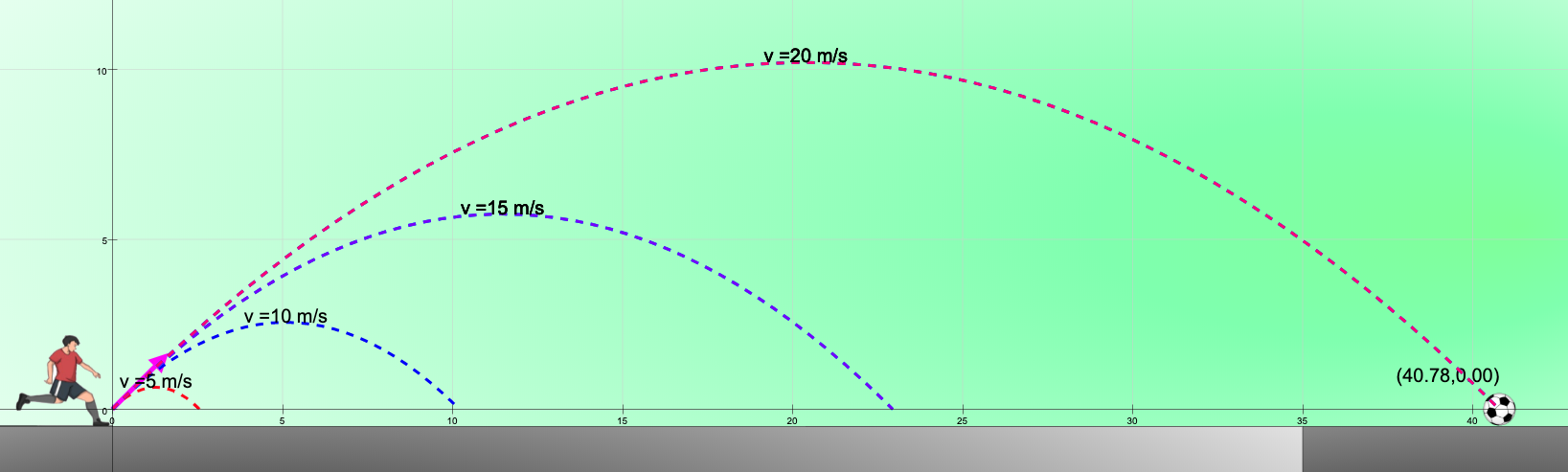
Graphs shows the different velocity of release, the maximum distance and flight time can be seen, similar to the table above.
Possible Question 1. Using the default settings (angle of launch = 45 degrees and relative projection height =0) in the tool, estimate the highest velocity of release of the football when the range is the greatest.
acceptable is 20 m/s afforded by the slider maximum value
Possible Question 2. Sam claimed that the velocity of release of the football does not affected maximum time of flight of the football. Do you agree? Explain.
disagree. From the simulation, as the velocity of release changes from 5 to 20 m/s, the maximum time of flight also increases.
Possible Question 3. Use the tool above, suggest whether the maximum height increase/decease/constant, as the velocity of release increases.
maximum height increases
Video
[text]
Version
Other Resources
[text]
Frequently Asked Questions: Projectile Motion in Exercise Sports Science
1. What is projectile motion in the context of exercise and sports science?
Projectile motion in exercise and sports science refers to the movement of an object (which could be a physical object like a ball or javelin, or even a human body during activities like jumping) after it has been launched or released into the air and is primarily influenced by the force of gravity. Once the object is released, the athlete no longer has direct control over its trajectory.
2. What is the significance of the velocity at release in projectile motion for sports?
The velocity at the moment an object is released is a critical factor determining its subsequent flight path. Specifically, the speed of projection directly impacts the range (horizontal distance traveled), maximum height reached, and the total flight time of the projectile. A greater initial velocity generally leads to a longer trajectory and increased flight time.
3. According to the provided simulation tool, what happens to the maximum range of a projectile when the velocity of release is increased, assuming a 45-degree launch angle and zero relative projection height?
Based on the example provided from the simulation tool, a higher velocity of release results in a greater maximum range. For instance, the table shows that as the velocity of release increases from 5 m/s to 20 m/s, the maximum distance achieved increases significantly from 2.56 m to 40.78 m. The simulation tool further allows exploration to estimate the highest velocity for the greatest range, suggesting around 20 m/s with the default settings.
4. Does the velocity of release affect the maximum time of flight of a projectile? Explain based on the provided information.
Yes, the velocity of release does affect the maximum time of flight. The simulation data explicitly shows that as the velocity of release increases, the maximum time of flight also increases. For example, when the velocity changes from 5 m/s to 20 m/s, the maximum time of flight increases from 0.72 s to 2.88 s. Therefore, Sam's claim that the velocity of release does not affect the maximum time of flight is incorrect according to this model.
5. Using the simulation tool, what is the relationship between the velocity of release and the maximum height reached by a projectile?
The simulation tool suggests that as the velocity of release increases, the maximum height reached by the projectile also increases. This is a logical consequence because a greater initial upward velocity component (influenced by the release velocity) will propel the object to a higher peak against the force of gravity.
6. Are there any simplifying assumptions made in this projectile motion model for exercise sports science?
Yes, for simplicity, this model considers air resistance to be negligible. This means that the calculations and simulations primarily focus on the influence of gravity on the projectile's motion, without accounting for the drag or lift forces that air might exert.
7. What type of resource is the "Velocity of release projectile motion model for exercise sports science JavaScript HTML5 Applet Simulation Model"?
This resource is an open educational resource (OER) and open-source physics simulation model. It is a JavaScript HTML5 applet designed for physical and sports education, allowing users to interact with and visualize the principles of projectile motion. It is freely available for use and can even be embedded in other webpages.
8. Who created this projectile motion model and where can more information or the simulation itself be found?
This model was created by This email address is being protected from spambots. You need JavaScript enabled to view it. and Cleve Chia. It is part of the Open Educational Resources / Open Source Physics @ Singapore project. The simulation can be accessed and explored through the provided embed link: <iframe width="100%" height="100%" src="https://iwant2study.org/lookangejss/physicaleducation/ejss_model_projectileESSvelocityofrelease/projectileESSvelocityofrelease_Simulation.xhtml " frameborder="0"></iframe>. Further details and potentially the code might be available through the Open Source Physics @ Singapore website.