{source}
<?php  require_once JPATH_SITE.'/TTcustom/TT_contentparser.php';\(parameters = array("topicname" => "02_newtonianmechanics_6pressure", "modelname" => "ejss_model_liquidlevels");echo generateSimHTML(\)parameters, "EJSS");
?>
{/source}
1. Overview
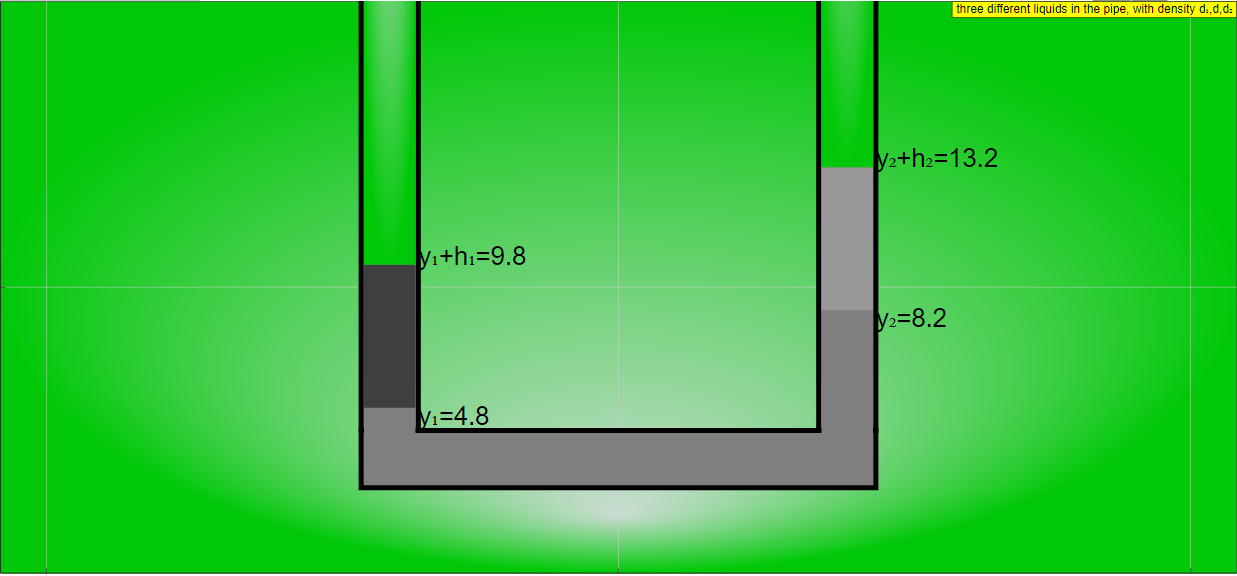
This document analyzes a JavaScript simulation applet designed to demonstrate the concept of pressure equilibrium in a pipe containing three different liquids. The simulation allows users to explore how the levels of the liquids adjust based on their densities to achieve equal pressure at the bottom of the pipe. It is part of a larger collection of interactive physics resources.
{source}<iframe style="border-radius:12px" src="https://open.spotify.com/embed/episode/0y6mMnfLEauzWpqWAU6ylu?utm_source=generator" width="100%" height="352" frameBorder="0" allowfullscreen="" allow="autoplay; clipboard-write; encrypted-media; fullscreen; picture-in-picture" loading="lazy"></iframe>{/source}
2. Main Themes and Key Ideas
- Pressure Equilibrium: The central concept is the establishment of pressure equilibrium. The simulation illustrates how liquids of different densities will settle at different heights in a connected pipe system until the pressure at the bottom of the pipe is equal on both sides. As stated in the About section, "It will reach equilibrium when the pressure are equal at the buttom."
- Density and Liquid Levels: The resource emphasizes the relationship between the density of a liquid and its height in the pipe. The simulation likely allows users to manipulate the densities and observe the resulting changes in liquid levels. The description states: "There are three different liquids in the pipe, with density d1,d,d2. The level will be adjusted due to different in pressure in two sides of the pipe."
- Interactive Learning: The applet is designed as an interactive learning tool. Users can "Play/Pause and Reset" the simulation and presumably adjust parameters via "Height and Density Tabs" to explore the concepts at their own pace. The inclusion of "Sample Learning Goals" (though the text is missing in the source), and sections "For Teachers" implies an educational focus.
- Accessibility and Embedding: The resource is designed to be easily embedded in webpages. The "Embed this model in a webpage" section provides an iframe code snippet. This facilitates integration into online courses and educational materials.
- HTML5 and JavaScript: The simulation is built using HTML5 and JavaScript, making it accessible on modern web browsers without the need for plugins. This ensures broad compatibility and ease of use.
3. Important Details and Functionality
- Simulation Controls: The simulation includes standard controls like "Play/Pause and Reset Buttons". A "Height and Density Tabs" feature indicates users can adjust these parameters, which are key to understanding the underlying physics.
- Full Screen Toggle: A "Toggling Full Screen" option is available, providing an improved viewing experience, especially for detailed observations, though it only works when the simulation is paused.
- Credits: The simulation is credited to "Fu-Kwun Hwang - Dept. of Physics, National Taiwan Normal Univ.; Fremont Teng; Loo Kang Wee", indicating the expertise behind its development.
- Extensive Resource Collection: The document highlights a vast collection of other physics simulations and interactive resources available on the Open Educational Resources / Open Source Physics @ Singapore platform. The long list of titles suggests a comprehensive library covering a wide range of physics topics, from mechanics and electromagnetism to optics and modern physics. Many are noted as being created using AI tools like Claude, GPT4o, and GPTo1-preview.
4. Potential Applications
- Classroom Demonstrations: The simulation can be used by teachers to visually demonstrate the principles of pressure and density to students.
- Interactive Homework Assignments: Students can use the simulation to explore the concepts independently and complete assignments.
- Online Learning Modules: The embeddable nature of the simulation makes it ideal for integration into online courses and tutorials.
- Self-Paced Learning: Students can use the simulation to reinforce their understanding of pressure and density at their own pace.
5. Potential Improvements/Further Information
- The resource mentions "Sample Learning Goals" and "Research" and "Video" sections, but these are marked as "[text]" indicating missing content. Adding this content would significantly enhance the resource's educational value.
- More detailed documentation on the underlying physics principles and how the simulation models them would be beneficial.
- Examples of specific learning activities or lesson plans that utilize the simulation would be valuable for educators.
6. Conclusion
The "Three Different Liquids in Pipe JavaScript Simulation Applet HTML5" appears to be a valuable tool for teaching and learning about pressure and density. Its interactive nature, accessibility, and embeddability make it a practical resource for educators and students. The simulation is part of a much larger and rich collection of openly available resources. Adding more detailed documentation and learning materials would further enhance its impact.
Physics of Fluid Pressure: A Study Guide
Quiz
Answer the following questions in 2-3 sentences each.
- What physical quantity is the simulation primarily focused on?
- What is the condition for equilibrium in the context of the simulation?
- Briefly describe the purpose of the "Height and Density Tabs" within the simulation.
- Name two other simulations that relate to physics on the site.
- Who are some of the individuals credited with the creation of the simulation?
- What does the simulation allow you to adjust in the fluids?
- What does the simulation explain about the three fluids in the pipe?
- In the context of this simulation, how does density affect pressure?
- How does the site license its contents?
- What must you do to toggle full screen?
Quiz Answer Key
- The simulation primarily focuses on the concept of pressure within fluids. It demonstrates how the height and density of different liquids in a pipe affect the pressure at the bottom.
- Equilibrium is reached when the pressure at the bottom of the pipe is equal on both sides, despite the different liquids having varying densities and heights. The liquid levels will adjust until this condition is met.
- The "Height and Density Tabs" allow users to independently control and adjust the height or density of the different liquids in the pipe. This enables users to observe how these parameters impact the overall pressure and equilibrium.
- Two simulations relating to physics on the site are: Buoyancy Force on Mass JavaScript Simulation Applet HTML5 and Push a Block JavaScript Simulation Applet HTML5.
- The simulation credits Fu-Kwun Hwang, Fremont Teng, and Loo Kang Wee as key contributors.
- The simulation allows users to adjust the height and density of each fluid.
- The simulation explains that the three fluids have different densities (d1, d, and d2) which impacts the overall pressure within the pipe.
- Generally, greater density leads to greater pressure at a given depth. This is because denser fluids exert more force due to their weight.
- The site licenses its contents under the Creative Commons Attribution-Share Alike 4.0 Singapore License.
- To toggle to full screen, double click anywhere in the panel when the simulation is paused.
Essay Questions
- Discuss the relationship between density, height, and pressure in fluids, using the simulation as a reference point. How can this simulation be used to teach these concepts effectively?
- Explain how the "Three Different Liquids in Pipe" simulation can be used to illustrate the concept of hydrostatic equilibrium. Include the relevant variables and conditions for equilibrium in your explanation.
- Describe how simulations like the "Three Different Liquids in Pipe" applet can be integrated into a physics curriculum to enhance student understanding and engagement, compared to traditional teaching methods.
- Analyze the benefits and limitations of using interactive simulations, like the "Three Different Liquids in Pipe" applet, for teaching abstract physics concepts. Consider factors such as accessibility, accuracy, and student interaction.
- Compare and contrast the "Three Different Liquids in Pipe" simulation with another physics simulation available on the Open Educational Resources / Open Source Physics @ Singapore website. How do they differ in their approach, complexity, and educational value?
Glossary of Key Terms
- Pressure (P): The force exerted per unit area. In fluids, pressure is often related to the weight of the fluid above a certain point. Measured in Pascals (Pa).
- Density (ρ): A measure of mass per unit volume. It indicates how much "stuff" is packed into a given space. Measured in kilograms per cubic meter (kg/m³).
- Equilibrium: A state of balance where opposing forces or influences are equal. In this simulation, it refers to the point where the pressure at the bottom of the pipe is the same on both sides.
- Hydrostatic Pressure: The pressure exerted by a fluid at rest due to the weight of the fluid above. It increases with depth.
- Simulation: A computer-based model of a real-world system or process. It allows users to explore and interact with the system to gain a better understanding of its behavior.
- Applet: A small application designed to run within another application, typically a web browser. The simulation is a JavaScript Applet HTML5.
- HTML5: The latest evolution of the standard that defines HTML.
- JavaScript: A programming language commonly used for web development.
- Open Educational Resources (OER): Teaching, learning, and research materials that are freely available for anyone to use, adapt, and share.
- Fluid: A substance that can flow easily. Liquids and gases are fluids because they take the shape of their container.
Sample Learning Goals
[text]
For Teachers
Three Different Liquids in Pipe JavaScript Simulation Applet HTML5
Instructions
Height and Density Tabs



Toggling Full Screen
Play/Pause and Reset Buttons

Research
[text]
Video
[text]
Version:
Other Resources
[text]
Physics Simulations and Learning Resources
Here are some frequently asked questions about the available physics simulations and open educational resources.
Frequently Asked Questions
- What is the "Three Different Liquids in Pipe" simulation about?
- The "Three Different Liquids in Pipe" simulation allows users to explore fluid statics by observing how liquids with varying densities arrange themselves in a connected pipe. The simulation demonstrates that liquids settle into layers based on density, and that equilibrium is reached when the pressure at the bottom of the pipe is equal on both sides, regardless of the arrangement above.
- How can I embed the "Three Different Liquids in Pipe" simulation into my webpage?
- You can embed the simulation by using the provided <iframe> HTML code snippet. The snippet includes a source URL pointing to the interactive simulation. The code also specifies the width and height, and a 'frameborder' attribute.
- Where are these physics simulations coming from?
- These simulations are primarily open educational resources (OER) developed by the Open Source Physics @ Singapore initiative. The simulations are built by educators like Fu-Kwun Hwang, Fremont Teng and Loo Kang Wee, often using Easy JavaScript Simulations (EJS).
- Are these simulations only for physics?
- While many simulations focus on physics topics like Newtonian mechanics, dynamics, electromagnetism, optics, and thermodynamics, the collection spans various science and mathematics domains. There are simulations covering topics like chemistry (e.g., acid-base solutions), biology (e.g., factors affecting photosynthesis, transpiration), and mathematics (e.g., graphs of quadratic functions, geometry).
- What are some examples of other simulations available beyond the "Three Different Liquids in Pipe"?
- The OER site features a large variety of simulations. Examples are "Floating Block Stability Simulator", simulations on collisions, optics, projectile motion, wave phenomena, electric circuits, and more. The simulations cover a broad range of physics concepts, and often include interactive elements like games, graph editors, and data loggers.
- Can these simulations be used for educational purposes beyond self-learning?
- Yes, many simulations are designed to be integrated into formal educational settings. Teachers can use them to demonstrate concepts, provide interactive learning experiences, and facilitate student exploration. Some resources even include sample learning goals and instructions specifically for teachers.
- Is the content on the Open Source Physics @ Singapore site freely available?
- The contents are licensed under the Creative Commons Attribution-Share Alike 4.0 Singapore License, making them freely available for educational purposes. However, commercial use of the underlying EasyJavaScriptSimulations library requires a separate license obtained directly from the library developers.
- Are there simulations that incorporate assessment or gamification?
- Yes, the resources include simulations with quiz elements ("Student Learning Space quiz") and games that are designed to reinforce learning. For example, "Math Battle: Add or Multiply?" is an interactive math game enhanced with AI. There are also interactive simulations that enhance literacy via simulations.