{source}
<?php  require_once JPATH_SITE.'/TTcustom/TT_contentparser.php';\(parameters = array("topicname" => "02_newtonianmechanics_7gravity", "modelname" => "ejss_model_gravity02");echo generateSimHTML(\)parameters, "EJSS");
?>
{/source}
{source}<iframe style="border-radius:12px" src="https://open.spotify.com/embed/episode/7kOkM78MSwOYL7iQGC2TFQ?utm_source=generator" width="100%" height="352" frameBorder="0" allowfullscreen="" allow="autoplay; clipboard-write; encrypted-media; fullscreen; picture-in-picture" loading="lazy"></iframe>{/source}
Briefing Document: Binary Stars JavaScript HTML5 Applet Simulation Model
1. Overview
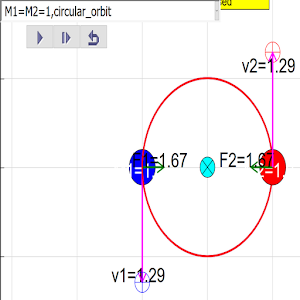
This document reviews a specific educational resource: a JavaScript HTML5 applet simulating binary star systems. This applet is part of a larger collection of Open Educational Resources (OER) developed by Open Source Physics @ Singapore. The focus of this particular resource is to visualize and interact with the gravitational forces and orbital mechanics of binary stars.
2. Main Themes and Key Ideas
- Interactive Simulation: The core theme is the provision of an interactive, web-based simulation for learning about binary star systems. This allows users to manipulate variables and observe their effects on the system's behavior.
- Gravitational Interaction: The simulation is built around the principles of Newtonian gravity, showcasing how the gravitational attraction between two celestial bodies leads to their orbital paths.
- Accessibility: The applet is designed to be highly accessible, working on a variety of platforms: "Android/iOS including handphones/Tablets/iPads," "Windows/MacOSX/Linux including Laptops/Desktops," and "ChromeBook Laptops." This broad compatibility enhances its usability in diverse learning environments.
- Open Educational Resource: The resource is freely available and licensed under Creative Commons Attribution-Share Alike 4.0 Singapore License, promoting its use, adaptation, and distribution within the educational community.
- Part of a Broader Collection: The applet is one of many interactive simulations created by the Open Source Physics @ Singapore, covering topics in mathematics, physics, and other sciences. This context reveals the effort put into creating this and other interactive learning aids.
3. Key Facts and Details
- Title: The applet is titled "7.1.4 (N84/P2/Q7) Binary Stars JavaScript HTML5 Applet Simulation Model." This title suggests it might align with a specific curriculum or examination context, possibly referencing a question (Q7) from a past paper (N84/P2).
- Technical Details:It is developed using JavaScript and HTML5, making it compatible with modern web browsers without requiring plugins.
- The simulation is embedded within a webpage using an iframe, indicating ease of integration into educational platforms.
- Credits:The simulation was developed by Fu-Kwun Hwang, Loo Kang Wee, and Wolfgang Christian, suggesting collaboration across multiple institutions and expertise.
- The link to the project on http://iwant2study.org/lookangejss/02_newtonianmechanics_7gravity/ejss_model_gravity02/gravity02_Simulation.xhtml is provided.
- App Version:A dedicated app version is available on the Google Play Store.
- Related Resources:The document also provides links to supplementary material such as a blog post about the model http://weelookang.blogspot.sg/2016/07/binary-stars-javascript-model-by-fu.html, a Phet interactive simulation for exploring solar systems https://phet.colorado.edu/sims/my-solar-system/my-solar-system_en.html and another double star simulation https://cosci.tw/run/?name=3nPTax1495777740581&fbclid=IwAR0gLAoux_EdW16f86kkGu3brJnH4AvHG_1Jw4utgN-eORt3MJLAlm2rVlA
- Navigation: The webpage this excerpt was taken from included breadcrumb navigation to this page, which includes links to general topics, like "Mathematics", "Numbers and Algebra", "Whole Numbers" and "Primary School Numbers". This is surprising as the resource itself seems most likely suitable for a Junior College, based on it's physics theme and location under a 'Gravity' section.
- Additional Resources List: The document provided many links to related and diverse simulation resources, indicating the volume of work within Open Educational Resources / Open Source Physics @ Singapore project. It references applets related to;
- Physics (gravity, forces, motion, simple harmonic motion, waves, optics, thermodynamics)
- Mathematics
- Chemistry
- Other miscellaneous items such as game development
- Usage Statistics: The document notes that there are "356 guests and no members online" with 1170 articles that have received 9646610 views.
- Licensing: The resource is licensed under Creative Commons Attribution-Share Alike 4.0 Singapore License. It includes a disclaimer about commercial use of the underlying EasyJavaScriptSimulations Library.
4. Quotes
- "Embed this model in a webpage: " - Shows the readily available method for embedding the resource for use.
- "Android/iOS including handphones/Tablets/iPads Windows/MacOSX/Linux including Laptops/Desktops ChromeBook Laptops" - Highlights the accessibility of the application.
- "Contents are licensed Creative Commons Attribution-Share Alike 4.0 Singapore License" - Indicates the open nature of the resource.
5. Significance
This binary star simulation is a valuable resource for educators and students seeking a dynamic way to understand gravitational interactions. Its accessibility, interactivity, and open-source nature make it a potentially powerful educational tool. The wealth of other resources listed alongside it highlights the scope and breadth of the Open Educational Resources / Open Source Physics @ Singapore project. The specific naming of the resource in conjunction with the breadcrumb navigation seems to indicate a possible link to specific curriculum, but the resource may also be generally useful.
6. Potential Uses
- Classroom instruction on Newtonian gravity and celestial mechanics.
- Student projects exploring the effects of various parameters on binary star systems.
- Supplement for textbooks and other learning materials.
- Self-directed learning and exploration of physics concepts.
This briefing document should give a good overview of the Binary Stars applet and its significance within the larger context of open educational resources.
Binary Star Simulation Study Guide
Quiz
Instructions: Answer the following questions in 2-3 sentences each.
- What is the primary subject of the 7.1.4 (N84/P2/Q7) simulation model?
- What kind of devices can run the Binary Star Simulation Model?
- Who are the listed developers credited for creating the model?
- What programming language is used to develop this simulation?
- What is the primary force that is demonstrated in this simulation?
- Besides the binary star simulation, what other physics-related models are listed on the page? Name at least two.
- Besides physics, what other subject matter is mentioned in the "breadcrumbs" section at the very top of this document?
- What is the name of the resource provided that allows for the creation of computational examples?
- What do the terms "Open Educational Resource" and "Open Source Physics" mean in the context of this webpage?
- What type of license covers the contents of this website?
Quiz Answer Key
- The 7.1.4 (N84/P2/Q7) simulation model primarily focuses on demonstrating the interactions and movements of binary star systems, utilizing the principles of gravity and Newtonian mechanics to show the orbital behavior of two celestial bodies.
- The Binary Star Simulation Model is designed to run on a variety of devices, including Android and iOS devices like phones and tablets, as well as Windows, MacOSX, and Linux computers like laptops and desktops, and Chromebooks.
- The developers credited for creating the model are Fu-Kwun Hwang from the Department of Physics at National Taiwan Normal University, Loo Kang Wee, and Wolfgang Christian.
- The simulation is developed using JavaScript, employing HTML5 for rendering, making it a web-based applet that is compatible across many platforms.
- The primary force demonstrated in the simulation is gravity, as it is the fundamental interaction that causes the two stars in the binary system to orbit each other.
- Other physics-related models listed include a Gravity Model Example, Gravity Force Model, Charge Particle Field Lines, Hookes Law Model, Atwood Machine, and a Projectile Frog Game among many others.
- Besides physics, the "breadcrumbs" section mentions "Mathematics," specifically "Numbers and Algebra," indicating the simulation may also be used to illustrate math concepts.
- The resource that allows for the creation of computational examples is called "Tracker Analysis and Modeling circular motion."
- "Open Educational Resource" means the materials on the webpage are freely available for educational use. "Open Source Physics" means that the underlying physics simulations and tools are freely accessible to users, often meaning they can be modified, remixed and redistributed under the terms of their license.
- The contents of the website are covered under the Creative Commons Attribution-Share Alike 4.0 Singapore License.
Essay Questions
Instructions: Answer each question with an essay that demonstrates a comprehensive understanding of the source material.
- Discuss the pedagogical value of using interactive simulations like the Binary Stars JavaScript HTML5 Applet in teaching physics concepts. How does this approach compare to traditional teaching methods?
- Explain the role of gravity in the binary star simulation and how this concept can be extrapolated to understand other astrophysical phenomena.
- Compare and contrast the Binary Star simulation with other models on the website, analyzing how different physics concepts are visualized and interacted with.
- Analyze the accessibility of the Binary Star Simulation model, discussing its suitability for a variety of users including students, educators, and members of the public interested in science.
- Explain how the various "Tracker" models mentioned on the webpage, such as those of projectile motion, SHM, and circular motion, can be used in combination with the provided simulation tools to support an inquiry-based learning method.
Glossary of Key Terms
Applet: A small application, often written in Java or JavaScript, designed to run within another application (like a web browser).
Binary Star: A star system consisting of two stars orbiting around their common center of mass.
Breadcrumbs: A navigational aid that shows the user's current location on a website, usually in a hierarchical structure.
Computational Example: A tool for users to create examples using simulation tools that may demonstrate word problems or physics-based exercises.
Gravity: The force that attracts a body toward the center of the earth, or toward any other physical body having mass.
HTML5: The fifth major revision of the HTML standard used for structuring and presenting content on the World Wide Web. It includes elements for interactive content.
JavaScript: A programming language commonly used to create interactive effects within web browsers.
Kinematics: The branch of mechanics concerned with the motion of objects without reference to the forces that cause the motion.
Newtonian Mechanics: The principles of mechanics based on Newton's laws of motion and the law of universal gravitation.
Open Educational Resource (OER): Educational materials that are freely available for use, adaptation, and distribution, typically with a Creative Commons license.
Open Source Physics: A movement promoting the use and sharing of freely available educational resources related to physics.
Simulation: A digital model that mimics a real-world system or process to allow for experimentation and learning.
App
YouTube
{source}
<iframe width="560" height="315" src="https://www.youtube.com/embed/v9R00eMrF-M" frameborder="0" allowfullscreen></iframe>
{/source}
Versions
Other resources
- https://phet.colorado.edu/sims/my-solar-system/my-solar-system_en.html
- https://cosci.tw/run/?name=3nPTax1495777740581&fbclid=IwAR0gLAoux_EdW16f86kkGu3brJnH4AvHG_1Jw4utgN-eORt3MJLAlm2rVlA Quality and isokinetic circumference movement - double star:
Frequently Asked Questions About the Binary Star Simulation and Related Resources
- What is the "Binary Stars JavaScript HTML5 Applet Simulation Model" and what can it be used for? This is an interactive simulation, accessible via web browsers and mobile devices, that demonstrates the physics of binary star systems. It allows users to explore how gravity affects the motion of two stars orbiting each other. This tool is useful for educational purposes, particularly for teaching concepts related to gravity and orbital mechanics at the Junior College level and beyond.
- Where can I access this Binary Star Simulation and what platforms are supported? The simulation can be accessed through a web browser via a provided embed link. Additionally, there's a link to an Android app version available on the Google Play Store. It is compatible with various devices including Android/iOS phones and tablets, as well as Windows, MacOSX and Linux laptops and desktops. This makes the resource highly accessible across different platforms.
- Who developed the Binary Star Simulation and where can I find more details? The simulation was developed by Fu-Kwun Hwang, Loo Kang Wee, and Wolfgang Christian. More information about its creation and other resources related to it can be found at the provided links including the blogpost and the associated app store page.
- Besides the Binary Stars simulation, what other types of interactive models and simulations are available from this source? The website offers a wide array of physics-related simulations covering diverse topics. These include gravity models, electromagnetic field simulations, simple harmonic motion, wave phenomena (diffraction, interference), mechanics (projectile motion, collisions, friction), thermodynamics, and even simple math models, such as geometry and fractions, to name a few. These simulations are mostly implemented as JavaScript HTML5 applets which enables their use on many platforms.
- What kinds of educational tools does this platform offer? This platform provides a plethora of interactive educational resources. It is particularly rich in physics simulations, but also encompasses related fields like mathematics and science in general. The simulations can be integrated into lesson plans and serve as interactive learning tools for students from primary school all the way to Junior College. Also included in the many items listed are video analysis tools, ebooks, and various applets to support educational activities.
- What software do these simulations use? The vast majority of the simulations are built using Easy JavaScript Simulations (EJS), a tool designed to allow for the creation of interactive simulations that can be easily embedded in webpages. The library associated with this tool is not open source and carries specific licensing requirements. Many simulations also utilize HTML5 and JavaScript for broad compatibility.
- How can these simulations be integrated into teaching and learning? These interactive models can be used in several ways including interactive demonstrations for lectures, individual exploration activities for students, or a visual aid in understanding complex science concepts. They can also be used with other tools like the "Nearpod Student Response System" to ensure students actively engage with the material. Further, some tools are also designed to support different learning pedagogies.
- Are there any licensing or usage restrictions for these resources? The educational content, except for commercial use of the Easy JavaScript Simulations (EJS) library, is licensed under a Creative Commons Attribution-Share Alike 4.0 Singapore License. This means that the content can be shared and adapted, provided that credit is given and derivative works are also released under a similar license. Commercial use of the EJS library requires contacting the developers directly to obtain a license.