{source}
<?php  require_once JPATH_SITE.'/TTcustom/TT_contentparser.php';\(parameters = array("topicname" => "02_newtonianmechanics_7gravity", "modelname" => "ejss_model_gravity08_1");echo generateSimHTML(\)parameters, "EJSS");
?>
{/source}
{source}<iframe style="border-radius:12px" src="https://open.spotify.com/embed/episode/3dcTc0kgFo94XSMu7S3AQQ?utm_source=generator" width="100%" height="352" frameBorder="0" allowfullscreen="" allow="autoplay; clipboard-write; encrypted-media; fullscreen; picture-in-picture" loading="lazy"></iframe>{/source}
Briefing Document: 🛰️Satellite Energy in Circular Orbit Simulation
Subject: Analysis of "7.4.3 Energy of a Satellite in circular orbit in terms of distance from Earth, r JavaScript HTML5 Applet Simulation Model" from Open Educational Resources / Open Source Physics @ Singapore.
Date: October 26, 2023
1. Overview:
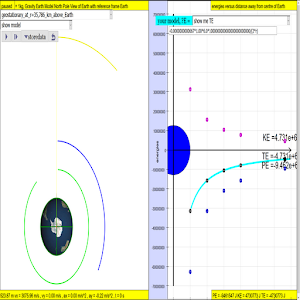
This document analyzes an online interactive simulation model focusing on the energy of a satellite in circular orbit around Earth. The simulation, built using Easy JavaScript Simulation (EJS), allows users to explore the relationship between a satellite's kinetic energy (KE), potential energy (PE), total energy (TE), and its distance from the Earth. The model is designed to be accessible on various platforms, including desktops, laptops, tablets, and smartphones.
2. Main Themes and Key Ideas:
- Energy Components of a Satellite: A satellite in orbit possesses both kinetic energy (due to its motion) and gravitational potential energy (due to its position in the Earth's gravitational field). The simulation aims to illustrate how these energies change with orbital distance.
- Quote: "A satellite in orbit possesses kinetic energy, KE, (by virtue of its speed motion) and gravitational potential energy, PE, (by virtue of its position within the Earth’s gravitational field)."
- Total Energy (TE): The total energy of the satellite is the sum of its kinetic and potential energies. The simulation demonstrates that the total energy is negative and remains constant for a stable circular orbit.
- Quote: "Hence, total energy of a satellite, TE = PE + KE"
- Gravitational Force and Centripetal Force: For a satellite in a circular orbit, the gravitational force acting on the satellite acts as the centripetal force, keeping it in its circular path. This is a crucial aspect linking forces and energy in orbital mechanics.
- Quote: "Recall that for a satellite in circular orbit, its gravitational force F = G M1 M2 / r2 acts as the centripetal force:"
- Mathematical Relationships: The source provides the following mathematical models used in the simulation, illustrating how to calculate the potential energy (PE), kinetic energy (KE) and the total energy (TE) of the satellite:
- Potential Energy (PE): PE = -GMm/r
- Where G = Gravitational Constant, M = Mass of Earth, m = Mass of the satellite, and r is the radius of orbit.
- Kinetic Energy (KE): KE = GMm/2r
- Total Energy (TE): TE = -GMm/2r
- The KE is positive and exactly half the magnitude of the PE, while TE is negative and is exactly half of PE.
- Simulation Model: The simulation is an interactive tool that allows users to visualize how these energy components change with distance (r) from the Earth. Specifically the model is designed to visually represent:
- PE is a negative quantity and inversely proportional to the orbital radius.
- KE is a positive quantity and inversely proportional to the orbital radius.
- TE is a negative quantity, inversely proportional to the orbital radius, and has half the magnitude of the PE.
- Graph of Energy vs. Distance: A typical graph shows how potential energy, kinetic energy, and total energy vary with the distance from the center of the Earth. This graphical representation is a key learning tool within the simulation.
- Simplified Model: The provided models used a mass of 1 kg for the satellite, a mass of 6.0x10^24 kg for the earth and a G value of 6.67x10^-11 N m^2 kg^-2
- Resulting formulas: The equations simplify to PE = (-4 x 10^14)/r, KE = (4 x 10^14)/(2r), and TE = (-4 x 10^14)/(2r)
- Educational Use: This resource is part of a larger collection of open educational resources from Singapore, demonstrating the commitment to sharing simulation and learning tools.
3. Key Facts & Equations:
- Relationship between KE and PE: "G m M / 2 r = 1 / 2 m v 2 = K E" The Kinetic Energy is half the magnitude of the gravitational potential energy, and has an opposite sign.
- Total Energy Equation: "T E = (m) (- G M / r) + G m M / 2 r = - G m M / 2 r" This equation reveals that the total energy is negative for a bound satellite, and equals half of the Potential Energy of the satellite.
- Sample values and equations for the interactive model: "The potential energy PE = P E = - G m M / r = 6.67 x 10^-11 (1) (6.0 x 10^24 ) / r = - 4 x 10^14 / r" " K E = G m M / 2 r = 6.67 x 10^-11 (1) (6.0 x 10^24 ) / 2 r = 4 x 10^14 / 2 * r" and "T E = - G m M / 2 r = - 6.67 x 10^-11 (1) (6.0 x 10^24 ) / 2 r = - 4 x 10^14 / 2 * r"
4. Target Audience:
The target audience for this simulation appears to be students learning about:
- Orbital mechanics
- Gravitational potential and kinetic energy
- The relationship between gravitational force and centripetal force
- Newtonian mechanics in the context of satellite motion
5. Accessibility:
- The model is accessible through a web browser.
- It is compatible with various operating systems.
- The simulation is also available as an app on the Google Play Store.
6. Additional Resources:
- The provided links direct to other simulations and resources related to gravity, including those developed by Todd Timberlake and others, showcasing a community approach to open educational resources.
- Additional models such as "Newton's Mountain" simulation are provided, further enhancing understanding of satellite motion.
7. Credits and Licensing:
- The simulation is credited to Todd Timberlake, with a remixed version by lookang and Fu-Kwun Hwang.
- The content is licensed under a Creative Commons Attribution-Share Alike 4.0 Singapore License.
8. Conclusion:
The "7.4.3 Energy of a Satellite" simulation is a valuable educational tool that allows students to interactively explore the concepts of energy in satellite motion. It provides a clear visual representation of the interplay between kinetic and potential energies and the significance of total energy in maintaining a stable orbit. The accessibility of the model across various platforms further enhances its potential for widespread educational use. The resource demonstrates a strong commitment to open educational resources and collaborative learning.
Satellite Orbital Mechanics Study Guide
Quiz
Instructions: Answer the following questions in 2-3 sentences each.
- What two forms of energy does a satellite in orbit possess?
- In the context of a satellite's circular orbit, what force acts as the centripetal force?
- What is the relationship between a satellite's kinetic energy (KE) and its gravitational potential energy (PE) in a circular orbit?
- How does the total energy (TE) of a satellite change as its distance from the Earth increases in a circular orbit?
- What is the formula for gravitational potential energy (PE) of a satellite in terms of the universal gravitational constant, masses of the Earth and satellite, and orbital radius?
- What is the formula for kinetic energy (KE) of a satellite in terms of the universal gravitational constant, masses of the Earth and satellite, and orbital radius?
- What does the provided simulation model show regarding the relationship between a satellite's distance from Earth and its potential, kinetic, and total energy?
- What are the simplifying assumptions made in the simulation model?
- What happens to a satellite’s total energy if its orbital radius were to increase and why?
- How do changes in orbital radius impact the speed and kinetic energy of a satellite?
Quiz Answer Key
- A satellite in orbit possesses kinetic energy (KE) due to its motion and gravitational potential energy (PE) due to its position within Earth's gravitational field. These two energies contribute to the satellite’s total energy.
- For a satellite in circular orbit, the gravitational force between the Earth and the satellite acts as the centripetal force, which is necessary for the satellite's circular motion.
- In a circular orbit, a satellite's kinetic energy (KE) is equal to half the magnitude of its negative potential energy (PE). KE is positive, and PE is negative, and when added together yield the total energy.
- As the distance from the Earth increases, the total energy (TE) of a satellite in a circular orbit becomes less negative. This means that the satellite's total energy increases as the satellite gains potential energy at the cost of kinetic energy.
- The gravitational potential energy (PE) of a satellite is given by the formula PE = -GMm/r, where G is the gravitational constant, M is the mass of Earth, m is the mass of the satellite, and r is the orbital radius.
- The kinetic energy (KE) of a satellite in circular orbit is given by the formula KE = GMm/2r, where G is the gravitational constant, M is the mass of Earth, m is the mass of the satellite, and r is the orbital radius.
- The simulation model demonstrates that as a satellite's distance from Earth increases, its potential energy becomes less negative, kinetic energy decreases, and its total energy becomes less negative.
- The simulation model simplifies by assuming the satellite is in a perfectly circular orbit and that the satellite's mass is 1kg and the Earth’s mass is 6.0x10^24 kg.
- If the orbital radius were to increase, the satellite's total energy would increase (become less negative) because the total energy is inversely proportional to the orbital radius.
- An increase in orbital radius causes the satellite’s speed and kinetic energy to decrease.
Essay Questions
Instructions: Answer the following essay questions using evidence and concepts from the source material.
- Explain the relationship between gravitational force, centripetal force, and orbital speed for a satellite in a circular orbit. How do the provided formulas for potential and kinetic energy help to illustrate these relationships?
- Analyze the graph of potential energy, kinetic energy, and total energy of a satellite with respect to its orbital radius. What do the shapes of these curves tell us about the changes in energy as the satellite's distance from Earth varies?
- Discuss how the concepts of energy conservation and the transformation between potential and kinetic energy are relevant to the motion of a satellite in orbit. How can this model help to explain the stability of satellite orbits?
- Compare and contrast the potential, kinetic, and total energy of a satellite in a circular orbit. Describe how each type of energy relates to the physical characteristics of the satellite's motion.
- Using the equations and model in the text as a guide, explain how you would calculate the total energy required to place a satellite in a specific orbit around the Earth. Include the assumptions made in your explanation.
Glossary of Key Terms
- Kinetic Energy (KE): The energy an object possesses due to its motion. In the case of a satellite, it’s related to its orbital speed.
- Gravitational Potential Energy (PE): The energy an object possesses due to its position in a gravitational field. For a satellite, it depends on its distance from the Earth.
- Total Energy (TE): The sum of an object's kinetic and potential energies, which is conserved in a closed system.
- Centripetal Force: The force that makes an object move in a circular path. For a satellite in orbit, this is provided by gravity.
- Universal Gravitational Constant (G): A fundamental physical constant used in calculating gravitational forces between objects, approximately 6.67 x 10^-11 N m²/kg².
- Orbital Radius (r): The distance from the center of the Earth to the center of the satellite's orbit.
- Circular Orbit: An orbit in which a satellite travels at a constant speed along a circular path around a celestial body.
- Simulation Model: A computational representation that uses equations and parameters to mimic a real-world system, in this case, a satellite's orbit.
App
Versions
- http://physics.weber.edu/schroeder/software/NewtonsCannon.html
- http://iwant2study.org/lookangejss/02_newtonianmechanics_7gravity/ejs/ejs_model_NewtonsMountainwee06.jar
Other Resources
- http://physics.weber.edu/schroeder/software/NewtonsCannon.html
- https://scratch.mit.edu/projects/898903/ Launch Simulator by Sushiboy6
Frequently Asked Questions about Satellite Energy in Circular Orbits
- What types of energy does a satellite in a circular orbit possess?
- A satellite in a circular orbit possesses two primary types of energy: kinetic energy (KE), which is the energy of motion due to its speed, and gravitational potential energy (PE), which is due to its position within the Earth's gravitational field.
- How is the total energy (TE) of a satellite calculated in terms of its potential (PE) and kinetic energy (KE)?
- The total energy of a satellite is the sum of its potential energy and kinetic energy (TE = PE + KE). The equation for total energy is derived from the equations for KE, which is equal to GmM/2r, and PE, which is -GmM/r, combining these gives TE = -GmM/2r where G is the gravitational constant, M is the mass of the Earth, m is the mass of the satellite, and r is the distance from the center of the Earth to the satellite.
- How does the relationship between the gravitational force and centripetal force help in understanding satellite motion? In a circular orbit, the gravitational force between the Earth and the satellite acts as the centripetal force, which is required to keep the satellite moving in a circle. This equality (GmM/r² = mv²/r) allows us to establish a relationship between the satellite's speed (v) and its orbital radius (r). This equation is simplified to be (GmM/2r = 1/2mv^2 = KE), expressing the kinetic energy of the satellite in terms of the gravitational force.
- How do the kinetic energy, potential energy, and total energy of a satellite change as the orbital distance (r) varies?
- As the orbital distance r increases, the gravitational potential energy (PE), which is a negative value, increases (becomes less negative); the kinetic energy (KE) decreases; and the total energy (TE) also increases (becomes less negative), all of which have an inverse relationship to the orbital distance. These equations are PE = -GmM/r, KE = GmM/2r, and TE = -GmM/2r, illustrating how they vary with r.
- If the mass of a satellite is 1 kg, and the mass of Earth is 6.0x10^24 kg, and G = 6.67x10^-11 N m^2 kg^-2, what are the equations for potential energy, kinetic energy, and total energy in relation to the distance 'r'?
- Given these values, the equations become:
- Potential Energy (PE) = -4 x 10^14 / r
- Kinetic Energy (KE) = 4 x 10^14 / 2r
- Total Energy (TE) = -4 x 10^14 / 2r
- Where can I find interactive tools to model and simulate satellite motion?
- There are several interactive simulations available. One such simulation can be found at this link: http://iwant2study.org/lookangejss/02_newtonianmechanics_7gravity/ejss_model_gravity08_1/gravity08_1_Simulation.xhtml. Additionally, various app versions and other resources are linked within the provided document.
- What types of related simulations and resources are available through the Open Educational Resources / Open Source Physics @ Singapore platform?
- The platform offers a wide array of simulations covering various physics topics. These include models for gravity, binary stars, pendulum motion, Kepler orbits, electromagnetism, wave phenomena, and simple harmonic motion. There are also simulations of collisions, projectile motion, and thermodynamics, among others, providing a wealth of learning tools for educators and students alike. Additionally, modeling and analysis tools like Tracker are integrated within the educational resources.
- What are some popular tags used to categorize the resources within the platform?
- The platform's resources are categorized using tags such as EasyJavaScriptSimulation, Windows/MacOSX/Linux including Laptops/Desktops, Dynamics, Gravity, Tracker, Energy Work Power, and many more. These tags help in quickly locating resources related to specific topics or types of tools.