{source}
<?php  require_once JPATH_SITE.'/TTcustom/TT_contentparser.php';\(parameters = array("topicname" => "02_newtonianmechanics_7gravity", "modelname" => "ejss_model_gravity10a");echo generateSimHTML(\)parameters, "EJSS");
?>
{/source}
Briefing Document: Virtual Laboratory of 2 Stationary Mass Simulation
1. Overview:
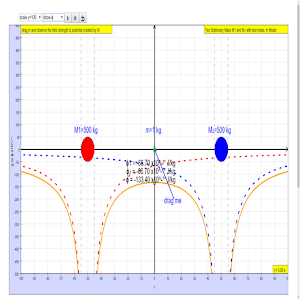
This document reviews the "Virtual Laboratory of 2 Stationary Mass" JavaScript HTML5 applet simulation model, found on the Open Educational Resources / Open Source Physics @ Singapore website. The simulation, designated as "gravity10a," is designed to allow users to explore gravitational field strengths and potentials generated by two stationary masses. This interactive tool is intended for educational purposes, specifically for Junior College level physics, and is accessible on various devices (desktops, laptops, tablets, smartphones).
2. Key Themes & Features:
- Interactive Simulation: The core of this resource is the interactive simulation, accessible via an embedded iframe. This allows users to directly manipulate parameters (likely the mass and position of the objects) to observe how they influence the gravitational field and potential. The fact it is HTML5 means it is broadly accessible across devices.
- Focus on Gravitational Fields and Potential: The simulation's primary goal is to visualize and explore the concepts of gravitational fields and gravitational potential, specifically in the context of two stationary masses.
- Open Educational Resource: The resource is explicitly identified as an open educational resource (OER), emphasizing its free and accessible nature for educational purposes. The site uses a Creative Commons Attribution-Share Alike 4.0 Singapore License. The simulation is part of a broader OER project at Singapore.
- Accessibility: The simulation is available on a variety of devices and platforms, including Android/iOS, Windows/MacOSX/Linux, and Chromebooks, ensuring broad accessibility for students.
- Part of a Larger Ecosystem: This applet appears to be part of a larger collection of physics simulations and resources, as demonstrated by the numerous related links and resources on the page.
- Pedagogical Focus: The inclusion of links to e-pedagogy resources and specific worksheets indicate that this simulation is intended for classroom instruction and learning.
- Toolkits and Versions: There are also links to the software used to build this applet (EasyJavaScriptSimulation) along with app downloads. Additionally, references to previous Java versions ("ejs_model_GField_and_Potential_1D_v8wee.jar") and an alternative version at a university site suggest this is an evolution of a simulation that has been improved over time and used in various contexts.
- Crediting: The resource acknowledges the contributions of multiple individuals, including Anne Cox, Wolfgang Christian, Francisco Esquembre, and Andrew Duffy. This further suggests this work is part of a collaborative effort.
3. Most Important Ideas & Facts:
- Direct Visualization of Abstract Concepts: The main value of this simulation lies in its ability to visualize abstract concepts like gravitational field and potential, making them more intuitive for students. It helps with a deeper conceptual understanding, rather than relying purely on equations.
- Inquiry-Based Learning: The availability of worksheets ("ICT inquiry worksheet," "Virtual Lab") suggests that the simulation is designed for inquiry-based learning, where students actively investigate concepts through experimentation and observation. This is consistent with the e-pedagogy links provided.
- Technological Integration: The resource highlights the use of technology in physics education through interactive simulations. The specific technology (JavaScript HTML5) is emphasized as this enables the accessibility noted earlier.
- Multi-Platform Accessibility: The resource is designed to be broadly accessible. The multiple formats allow for use by students with different technologies and devices, a common challenge in education.
- Collaboration & Iteration: The simulation represents an iterative development process, with different versions and contributors. It showcases an open and collaborative process for developing educational resources.
4. Key Quotes (and Paraphrases):
- "Virtual Laboratory of 2 Stationary Mass to explore field strengths and potentials JavaScript HTML5 Applet Simulation Model": This title explicitly states the purpose of the simulation.
- "Embed this model in a webpage:" This shows the flexibility of the resource, allowing educators to place the simulation into their own materials.
- "Open Educational Resources / Open Source Physics @ Singapore": Indicates the philosophy of the development team.
5. Supporting Materials:
The website provides a substantial list of supporting materials:
- Worksheets: Specifically designed for classroom use, both student and teacher versions. Examples include:
- "IJC2016 H2 Phy Topic 7 Gravitational field - ICT inquiry worksheet 3 on Geostationary satellite.doc"
- "ejss_model_gravity10P09 Virtual Lab on G Fields (st).docx"
- e-Pedagogy Resources: Links to sites discussing teaching with technology and reflections on its use.
- Toolkits: Links to download the software for modifying or creating similar simulations.
- Links to Geogebra simulations: Indicates an attempt to integrate with different platforms.
- Versions: Showing the different iterations of the simulation in both Java and HTML.
- Related Simulations: The extensive list of other simulations on the page demonstrates a rich ecosystem of resources for educators and students.
6. Potential Use Cases:
- Classroom Instruction: As a primary tool for demonstrating and exploring gravitational fields and potentials.
- Inquiry-Based Activities: As a platform for students to investigate and test hypotheses about gravitational forces.
- Homework and Practice: As an interactive learning tool for students outside the classroom.
- Teacher Professional Development: As an example of how interactive simulations can enhance physics education.
7. Conclusion:
The "Virtual Laboratory of 2 Stationary Mass" simulation is a valuable educational resource that combines interactive technology, open accessibility, and a focus on pedagogical best practices. It provides a hands-on, visual approach to understanding gravitational fields and potentials, supporting student learning through exploration and experimentation. Its integration into a wider network of physics simulations and resources further enhances its value for educators. The use of HTML5 and the extensive support materials suggests a well-considered approach to meeting educational needs.
Gravitational Fields and Potentials Study Guide
Quiz
Instructions: Answer the following questions in 2-3 sentences each.
- What does the provided simulation allow users to explore regarding gravitational fields?
- What type of technology is used to create the simulation, and why is this significant?
- Name two educational contexts where this simulation could be utilized effectively.
- What is the meaning of the "e-Pedagogy" links provided?
- What is the purpose of the provided "Toolkit" links?
- Why are there multiple "Worksheet" documents provided with the simulation?
- What does the presence of multiple versions (Java, HTML5) suggest about the simulation's design?
- How can the "Resources" links enhance the learning experience with the simulation?
- Based on the list of additional simulations provided at the bottom of the article, what is the broader scope of this educational resource project?
- What does the provided licensing information mean for educators and students regarding the simulation?
Quiz Answer Key
- The simulation allows users to explore the gravitational fields and potentials generated by two stationary masses. It enables visual and interactive understanding of how these masses influence the space around them.
- The simulation is created using JavaScript and HTML5. This makes it accessible on a wide range of devices, including computers, tablets, and smartphones, without requiring specialized software.
- This simulation could be effectively used in junior college physics classes to teach gravitational concepts and in independent study settings to promote active and personalized learning.
- The "e-Pedagogy" links provide resources and reflections on the educational methodology. They outline how technology can be effectively integrated into the learning process and the development of digital learning skills.
- The "Toolkit" links offer access to the software and development tools used to create the simulation. This can help educators or students interested in adapting or creating similar simulations.
- The multiple "Worksheet" documents provide differentiated learning activities. This can assist in adapting to different student needs, learning styles, and educational settings and providing guided inquiry.
- The existence of multiple versions (Java and HTML5) shows an effort to increase the availability. It ensures that the simulation can be used on various older platforms, modern web browsers and devices.
- The "Resources" links connect to complementary learning tools such as Geogebra applets. They provide additional visualizations and perspectives on the topic, allowing students to deepen their understanding.
- The long list of additional simulations indicates a broader commitment. The project strives to provide a comprehensive library of interactive tools across various physics topics.
- The Creative Commons license allows educators to use and adapt the simulation. It gives permission to share the material with proper attribution. However, commercial use of EasyJavaScriptSimulations library requires a separate license and direct contact.
Essay Questions
- Discuss the educational benefits of using interactive simulations like the one described in the document for teaching abstract physics concepts such as gravitational fields and potential. How does this method compare to more traditional teaching methods?
- Analyze the various types of resources (e.g., worksheets, toolkits, e-pedagogy links) provided alongside the simulation. How do these resources collectively enhance the pedagogical effectiveness of the simulation?
- Evaluate the accessibility and versatility of the simulation considering its design with HTML5 and JavaScript, its various device compatibilities, and its multiple versions. What implications does this have for its reach and impact in education?
- Compare and contrast the different resources on the page that directly relate to the central simulation of gravitational fields. How do these additional materials extend, support, and diversify the original learning experience?
- Based on the additional resources provided on the bottom of the page, extrapolate on the vision and commitment of the Open Educational Resources / Open Source Physics @ Singapore project. Discuss the significance of offering this volume of free and diverse educational resources.
Glossary of Key Terms
- Gravitational Field: A force field that exists in space around a mass, causing any other mass to experience a force of attraction.
- Gravitational Potential: The work done per unit mass in moving a mass from infinity to a specific point in a gravitational field.
- JavaScript: A programming language commonly used for web development, enabling interactive elements on websites.
- HTML5: The latest version of Hypertext Markup Language, a standard language for structuring and presenting content on the web.
- Applet: A small application, often designed to perform a specific task or function, that runs within a larger application or browser.
- Open Educational Resources (OER): Freely accessible teaching, learning, and research materials that can be used, adapted, and shared without restriction.
- e-Pedagogy: The study and application of digital technologies in teaching and learning, including the development of best practices and learning theories.
- Interactive Simulation: A computer-based model that allows users to manipulate variables and observe results, promoting hands-on learning.
- Creative Commons License: A type of copyright license that allows free use, adaptation, and distribution of creative works with certain conditions, such as attribution.
- Geogebra: A dynamic mathematics software that combines geometry, algebra, calculus, and other mathematical elements for visual learning.
e-Pedagogy
https://weelookang.blogspot.com/2021/03/etd-version-of-e-pedagogy-2021.html my personal reflection
https://weelookang.blogspot.com/2020/09/e-pedagogy-moe-skillsfuture-for.html moe skill-future reflection
Apps
Worksheet
- IJC2016 H2 Phy Topic 7 Gravitational field - ICT inquiry worksheet 3 on Geostationary satellite.doc
- YJC2016 H2 Phy Topic 7 G field - ICT worksheet (Teacher).pdf
- YJC2016 H2 Phy Topic 7 G field - Lect notes (Teacher).pdf
- YJC2016 H2 Phy Topic 7 G field - Tutorial (Teacher).pdf
- ejss_model_gravity10P09 Virtual Lab on G Fields (st).docx
- ejss_model_gravity10P09 Virtual Lab on G Fields (tr).docx
Versions:
- ejs_model_GField_and_Potential_1D_v8wee.jar by Andrew Duffy and Loo Kang Wee Java version
- https://www.phy.ntnu.edu.tw/ntnujava/index.php?topic=1921.0
Video
{source}
<iframe width="560" height="315" src="https://www.youtube.com/embed/mArSyqDP6g8" frameborder="0" allow="autoplay; encrypted-media" allowfullscreen></iframe>
{/source}
Resources
https://www.geogebra.org/m/hzfyjejx by Tan Seng Kwang
https://www.geogebra.org/m/yfhyxdm4 by Tan Seng Kwang
https://www.geogebra.org/m/z8cr66wb by Tan Seng Kwang
FAQ: Exploring Gravitational Fields and Simulations
- What is the "Virtual Laboratory of 2 Stationary Mass" simulation model, and what does it allow users to explore?
- This simulation model, referred to as "gravity10a," is a JavaScript HTML5 applet designed to visually represent and explore the concepts of gravitational fields and potentials generated by two stationary masses. Users can manipulate the parameters of the masses, such as their magnitude and position, and observe the changes in the resulting field strengths and potential, providing a hands-on way to understand these complex physics concepts. The simulation is accessible on various devices, including computers and mobile platforms.
- What are the main educational goals or pedagogical purposes behind creating and sharing this simulation?
- The primary educational goals are to facilitate a deeper understanding of gravity, gravitational fields, and potential through interactive exploration and visualization. This approach allows learners to move beyond rote memorization and develop an intuitive grasp of the underlying principles. The simulation also fosters engagement and promotes self-directed learning through inquiry-based investigation using e-pedagogy principles which includes personalized learning and technology integration.
- What types of resources are available alongside the "gravity10a" simulation to enhance learning?
- Several supplementary resources are available to support teaching and learning using the simulation. These include downloadable worksheets (both for students and teachers), lecture notes, and tutorial materials. There are also links to e-pedagogy related sites and example lessons to showcase how the model can be integrated into teaching practices. The simulation is also connected to toolkits for creating similar models and apps, demonstrating the potential for customization and adaptation.
- What is Easy JavaScript Simulation (EJS) and how is it related to this simulation model?
- Easy JavaScript Simulation (EJS) is a software tool, sometimes referred to as EJSS, used to create interactive simulations for teaching and learning. The "gravity10a" simulation model is built using this framework which facilitates cross-platform compatibility and easy embedding into websites. EJS allows educators and students to create their own interactive physics models for learning. The availability of the source code and tools further supports customizaton and adoption.
- Can this simulation be used on different platforms and devices?
- Yes, a major advantage of the "gravity10a" simulation is its broad accessibility. Being developed as a JavaScript HTML5 applet, it can be run on a wide range of platforms, including Windows, macOS, Linux, Android, iOS, and even Chromebook laptops, making it a versatile learning tool for diverse users and environments. This is a key factor for the e-pedagogical approach which promotes equity in learning opportunities.
- Besides this specific simulation, what other physics and science-related educational simulations and resources are available from the same source?
- The platform hosts a vast collection of simulations that cover a wide spectrum of physics and other scientific topics. These include models exploring projectile motion, harmonic oscillators, electromagnetic fields, wave phenomena, nuclear physics, and many more. Also included are models for use in primary school math, and chemical reactions. There are also tools and resources for teaching and using these open educational resources, such as Tracker for video analysis and GeoGebra for interactive geometry and other models.
- Are there any awards or recognitions associated with this project, or the broader platform where the simulation is hosted?
Yes, the platform and its resources have been recognized with several prestigious awards for excellence and innovation in educational technology. These include awards from the Ministry of Education in Singapore, UNESCO, and public service awards recognizing the value and impact of the resources. These awards highlight the commitment of the team to quality and innovation in science education.
- What is the licensing of these simulations and resources, and how does it impact their use and adaptation?
The simulations and related resources are primarily licensed under the Creative Commons Attribution-Share Alike 4.0 Singapore License. This allows for their free use and adaptation for educational purposes, promoting openness and collaboration in education. However, commercial use of the EasyJavaScriptSimulations Library requires a separate license and communication with the library developers directly. This open licensing approach underscores the community-driven nature of the project and fosters its widespread adoption.