{source}
<?php  require_once JPATH_SITE.'/TTcustom/TT_contentparser.php';\(parameters = array("topicname" => "02_newtonianmechanics_7gravity", "modelname" => "ejss_model_gravity04_1");echo generateSimHTML(\)parameters, "EJSS");
?>
{/source}
{source}<iframe style="border-radius:12px" src="https://open.spotify.com/embed/episode/10K9pqQuyGr1AJ3crs2utu?utm_source=generator" width="100%" height="352" frameBorder="0" allowfullscreen="" allow="autoplay; clipboard-write; encrypted-media; fullscreen; picture-in-picture" loading="lazy"></iframe>{/source}Briefing Document: 🌎Gravitational Field Earth JavaScript HTML5 Applet Simulation Model
1. Overview
This document analyzes a resource from Open Educational Resources / Open Source Physics @ Singapore, specifically focusing on their JavaScript HTML5 applet simulation model for the Earth's gravitational field (designated as "7.2.7 Gravitational Field Earth JavaScript HTML5 Applet Simulation Model"). The resource provides an interactive simulation and accompanying explanations, primarily for use in Junior College level physics education. The resource aims to help students visualize and understand the concept of gravitational field strength and its characteristics.
2. Main Themes
- Gravitational Field Strength (g): The central theme revolves around understanding gravitational field strength as a vector quantity, its dependence on distance and mass, and the distinction between generic 'g' and the specific 'gE' at Earth's surface.
- Interactive Simulation: The resource leverages a JavaScript HTML5 applet simulation model to provide an interactive and dynamic learning experience. This allows students to manipulate parameters and observe the resulting changes in the gravitational field.
- Technology-Enhanced Learning: The resource emphasizes using technology to effectively represent physics concepts, incorporating micro, macro, and symbolic representations. It also stresses the importance of accessibility across different devices for anytime, anywhere learning.
- Pedagogical Approach: The resource emphasizes a clear conceptual understanding rather than rote memorization, with the inclusion of model builder activity that is meant to test understanding. This is meant to improve teaching by connecting images (static or dynamic) and stories to the concepts presented.
3. Key Ideas and Facts
- Definition of Gravitational Field Strength (g): The document clearly defines 'g' as the gravitational field strength on a test mass 'm' due to Earth's mass alone. The formula is given as:
- g = -G * M / r^2 (when the test mass is to the right of the source mass/Earth)
- g = +G * M / r^2 (when the test mass is to the left of the source mass/Earth)
- It's critical to understand that the sign of 'g' (+/-) indicates the direction of the force on the test mass relative to the source mass (Earth), with the sign depending on the side of the Earth the test mass sits. The document also stresses the vector nature of 'g' and its SI unit (N kg-1 or m s-2).
- Distinction between generic 'g' and 'gE': The document clarifies that while 'g' generally refers to the gravitational field strength, it's not always 9.81 m/s^2 (or N/kg). The value 9.81 m/s^2 is the gravitational field strength at Earth's surface, denoted specifically as 'gE'. The equation for gE is given by gE = -G * M / R^2, where RE is the radius of the earth. This distinction is important to avoid misconceptions about gravitational field strength.
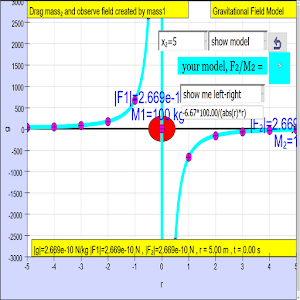
- Visualization: The resource highlights the use of a "magenta color data line" for visual representation of the gravitational field strength. This suggests that the simulation includes visual aids to help students comprehend the direction and magnitude of the gravitational field vector.
- Interactive Model: The document notes the availability of a simulation (accessible via a provided link) for interactive exploration of the gravitational field model. This allows students to test and apply their understanding through experimentation.
- Technology and Accessibility: The resource is developed to work across various platforms (Windows, macOS, Linux, Android/iOS devices) which supports a flexible learning experience. The emphasis on 'anytime anywhere' learning implies that the resource is suitable for both in-class and out-of-class learning, encouraging independent study.
- Pedagogical Intent: The resource encourages use of moving images to represent the idea as micro-very big, macro (real world) and symbolic levels. This highlights the importance of connecting to a concept from different perspectives and therefore promote deeper understanding. The goal of the resource is to engage students, enhance teaching, and provide learning at all times and from any place.
4. Relevant Quotes
- "g is a vector quantity and the SI unit for g is N kg-1 (or m s-2). g is + when the test mass is on the left of the source mass Earth and g is - when the test mass is on the right of the source mass Earth M."
- "But the generic gravitational field strength ‘g’ is not necessarily 9.81 N kg-1 (which is the value of g on Earth’s surface). Its magnitude varies with distance r and mass M according to g = - G M / r^2"
- "To avoid misrepresentation, we will use the symbol, gE to specifically represent the gravitational field strength at the Earth’s surface (ie gE = 9.81 N kg-1)."
- "While images paints a thousand words, a moving image would paint even more words. When choosing images , visualization with technology can be coherently represented when the moving images shows micro-very big ( invisible), macro ( what you see in real world) and symbolic ( want we use to represent, g = phi*M/r^2) where possible."
5. Implications
- Educational Resource: This resource is intended to be used as a teaching tool for understanding the gravitational field concept by providing an interactive simulation and model building activity.
- Accessibility: The simulation's availability across devices and platforms promotes flexible learning, allowing students to engage with the material both inside and outside the classroom.
- Technology Integration: The resource represents a model for technology integration in physics education, demonstrating how interactive simulations can enhance conceptual understanding and visualization.
- Concept Clarity: The distinction between 'g' and 'gE' and the emphasis on 'g' as a vector can help students avoid common misconceptions about gravitational field strength.
6. Further Exploration The document highlights that the simulation is available at http://iwant2study.org/ospsg/index.php/56 for further exploration. The document contains references to various other applets and educational content, highlighting the importance of exploring the website for additional related simulations for teaching and learning physics and other STEM disciplines.
7. Conclusion
The "7.2.7 Gravitational Field Earth JavaScript HTML5 Applet Simulation Model" resource is an example of how interactive simulations can enhance the teaching and learning of physics concepts. The resource clearly defines key terms, emphasizes the importance of visual and interactive learning, and promotes accessibility across different devices. The resource has both theoretical and practical components that are essential for understanding the concept of gravitational field strength.
Gravitational Fields Study Guide
Quiz
Instructions: Answer the following questions in 2-3 sentences each.
- What is the symbol used to represent gravitational field strength? How does it differ from acceleration due to free-fall?
- What is the SI unit for gravitational field strength? Give two different expressions for this unit.
- According to the provided source, how does the sign of gravitational field strength (+/-) relate to the test mass's position relative to the Earth?
- Is gravitational field strength a vector or a scalar quantity? Explain your answer.
- What does the symbol ‘gE’ represent, and what is its approximate value?
- Explain why the generic gravitational field strength 'g' is not always 9.81 N kg-1.
- State the mathematical relationship between gravitational field strength (g), gravitational constant (G), mass of the source (M), and the distance from the source (r).
- What do the resources suggest as a way to test your understanding of gravitational field strength?
- Why does the source emphasize the use of technology and simulations when learning about the gravitational field?
- What is the purpose of using moving images in teaching about gravitational fields, according to the source?
Quiz Answer Key
- The symbol ‘g’ is used for gravitational field strength. Unlike the acceleration due to free-fall on Earth's surface, which is a constant of 9.81 m/s², the generic 'g' is not necessarily a constant value, but varies depending on distance and mass.
- The SI unit for gravitational field strength is N/kg. This unit can also be expressed as m/s², representing the force per unit mass or the acceleration experienced by a mass in the gravitational field.
- The gravitational field strength is positive (+) when the test mass is on the left of the source mass (Earth), and negative (-) when the test mass is on the right of the source mass.
- Gravitational field strength is a vector quantity because it has both magnitude and direction. The direction of the force is always towards the source mass and the sign of 'g' (+/-) depends on this direction.
- The symbol ‘gE’ specifically represents the gravitational field strength at the Earth’s surface. Its approximate value is 9.81 N kg-1.
- The generic gravitational field strength ‘g’ varies with distance and mass according to the formula g = -GM/r^2, where 'r' is the distance from the source. Thus, it is only 9.81 N kg-1 at the surface of the Earth.
- The magnitude of gravitational field strength (g) is given by the equation g = -GM/r², where G is the gravitational constant, M is the mass of the source (like the Earth), and r is the distance from the center of the source mass.
- The resource suggests testing understanding of gravitational field strength through using a model builder to manipulate values and examine the effect.
- The source emphasizes technology to visualize concepts that are both micro (invisible) and macro (real-world) and also represent the symbolic nature of gravitational forces, making it easier to grasp.
- Moving images, as opposed to static images, provide a more comprehensive visualization, showcasing both macro, micro, and symbolic representations, enhancing learning.
Essay Questions
Instructions: Answer the following questions in essay format.
- Discuss the significance of differentiating between the general gravitational field strength ‘g’ and the specific gravitational field strength at the Earth’s surface ‘gE’. How does understanding this difference affect our calculations and predictions?
- Explain how the vector nature of the gravitational field strength affects the forces experienced by a test mass in the vicinity of a source mass, as discussed in the provided source.
- Elaborate on the advantages of using interactive simulations, like the one referenced in the source, for learning about gravitational fields. What specific learning opportunities do these simulations provide?
- Analyze how the conceptual model of gravity presented in the source connects with other areas of physics such as kinematics and Newtonian mechanics.
- Compare the advantages and disadvantages of learning about gravity using static images, moving images, and interactive simulations. Support your arguments using details from the text.
Glossary
Gravitational Field Strength (g): A vector quantity that represents the force exerted per unit mass at a specific location due to a gravitational field. It indicates the strength of the gravitational field at that point.
Vector Quantity: A quantity that has both magnitude and direction, such as gravitational field strength.
Scalar Quantity: A quantity that has only magnitude, such as mass or time.
SI Unit: The International System of Units, the standard system of measurement used in science. In this context, the SI unit for gravitational field strength is N/kg or m/s².
Test Mass: A small mass used to experience the gravitational force exerted by a source mass, such as the Earth. Its presence is assumed not to alter the source's gravitational field.
Source Mass: The mass that creates the gravitational field, like the Earth in the given context.
Gravitational Constant (G): A universal constant that defines the strength of the gravitational force. It is used in the calculation of gravitational fields.
Acceleration Due to Free-fall: The acceleration experienced by an object solely due to gravity, usually denoted as ‘g’ or 'gE' (approximately 9.81 m/s² at the Earth's surface).
gE: The specific gravitational field strength at the surface of the Earth, which is equal to approximately 9.81 N/kg.
Kinematics: The branch of mechanics that deals with the motion of objects without considering the forces that cause the motion.
Newtonian Mechanics: The study of the motion of objects under the influence of forces, formulated by Isaac Newton.
Open Educational Resources (OER): Educational materials that are freely available for anyone to use, adapt, and share.
App
Process
| Process | Lesson Implementation | |
| Sub-Process(es) | Introducing the Lesson, Using appropriate trigger | |
| Teaching Action | Connecting through images (static or dynamic) and stories | |
Possible Technology.
While images paints a thousand words, a moving image would paint even more words.
When choosing images , visualization with technology can be coherently represented when the moving images shows micro-very big ( invisible), macro ( what you see in real world) and symbolic ( want we use to represent, g = phi*M/r^2) where possible. https://sg.iwant2study.org/ospsgx/index.php/interactive-resources/physics/02-newtonian-mechanics/08-gravity/56-gravity04-1
Points to Note when use technology:
can it work on the students' devices, supporting learning anytime anywhere?
Video
https://notebooklm.google.com/notebook/8beb037e-50b5-4296-aa90-8611a6acc665/audio
Timeline of Main Events
This source primarily focuses on the development and use of interactive physics simulations, specifically regarding gravity and related concepts. The events are not presented in a chronological narrative but rather as a collection of resources and activities related to a specific project and its broader context. Therefore, I've constructed a timeline based on the implied progression of research, development, and application:
- Conceptual Foundation (Implied): The need to accurately model gravitational field strength (g) and differentiate it from the acceleration due to free fall (gE) is established. This is not a single event, but an underlying principle of the entire project.
- Development of the Gravitational Field Earth Simulation Model (gravity04_1): The creation of a JavaScript HTML5 applet simulation model to demonstrate gravitational field strength and its variations. This model is central to the resource. The model uses g = - G M r 2 and g = + G M r 2 to show the gravitational field on the right and left side of the earth respectively, as well as g E = - G M R E 2 to indicate gravitational field strength at Earth's surface.
- Deployment and Accessibility: The simulation is made available online and as an app for various platforms (Android/iOS, Windows/MacOSX/Linux). It is made embeddable in webpages.
- Integration into Educational Resources: The simulation is integrated into a broader set of open educational resources for physics instruction, designed for Junior College level (roughly equivalent to high school). This resource is linked from the Open Educational Resources / Open Source Physics @ Singapore website.
- Development of Related Simulations and Interactive Tools: A significant number of other physics and math simulations using Easy JavaScript Simulations (EJS) are developed, covering topics like:
- Moon Phases and Sea Tides
- Energy Pendulum
- Newton's Cradle
- Collision Carts
- Friction Models
- Projectile Motion
- Vector Addition
- Optics (Slit Diffraction, etc.)
- And many more topics across math, science, geography, and other disciplines.
- Teacher Training and Workshops: Workshops and professional development sessions are conducted to train educators in using EJS and developing interactive simulations. Dates given are 20240718-24 Web EJS beta Workshop by Francisco Esquembre and Félix J. García Clemente supported by MOE CPDD1 Registration for Web EJS Workshop (18-24 July 2024) and 20230327 Brown Bag Educators as Designers of Simulation using Easy JavaScript Simulation authoring toolkit (EJSS).
- Exploration of Analytics: Research and discussions focus on using data analytics from interactive simulations to enhance teaching, with dates given such as: 20230511 Analytics x Interactives A Senior Specialist Track Research Fund (SSTRF) presentation 10th May 2023 (45 mins) Science Unit Meeting.
- Continued Development and Sharing: The site continues to be updated with new simulations, workshops, and resources. For example there is mention of: 2024 Silver Innergy Award Write up Empowering High-Ability Learners through Localized Inquiry-Based Math Resources - Critical and Creative Thinking (C²T) and Advancing UNESCO's 2030 Educational Goal.
Cast of Characters with Brief Bios
- Anne Cox: Listed in the "Credits" section, Anne Cox contributed to the creation of the gravity simulation. Her exact role is not specified, but she is likely a developer or content creator.
- Wolfgang Christian: Also listed in the "Credits" section, Wolfgang Christian was involved in the development of the gravity simulation, alongside Anne Cox and Francisco Esquembre. Based on the scope of work, he is likely an experienced software developer and/or a physics professor specializing in computer modeling. He also co-developed 3D Wave Machine JavaScript HTML5 Applet Simulation Model with Loo Kang WEE.
- Francisco Esquembre: Credited as part of the team behind gravity04_1 in the "Credits" section. He is very heavily involved in the development of EJS tools and appears as a key workshop leader. He is likely a lead developer of Easy JavaScript Simulations and an educator interested in interactive science education.
- Loo Kang WEE (lookang): User who has uploaded and created the content. This strongly suggests that he is the main maintainer of this website.
Frequently Asked Questions about Gravitational Fields and Simulations
- What is gravitational field strength (g), and how is it different from acceleration due to gravity? Gravitational field strength (g) is the force exerted per unit mass at a specific point in space due to a massive object, like Earth. It's a vector quantity, with units of N/kg or m/s². While 'g' is often used to represent the acceleration due to free fall on Earth's surface (approximately 9.81 m/s²), the general gravitational field strength 'g' varies depending on the distance from and mass of the source and is calculated using the formula g = -GM/r², where G is the gravitational constant, M is the mass of the source, and r is the distance to the source. The value of 9.81 m/s² is specifically the gravitational field strength at Earth's surface and is denoted as gE to avoid misrepresentation.
- Why does the gravitational field strength (g) have a negative or positive sign? The sign of gravitational field strength (g) indicates the direction of the force experienced by a test mass. If a test mass is to the right of the source mass (like Earth), the gravitational field vector points towards the Earth, and 'g' is negative (-GM/r²). If the test mass is to the left of the source mass, the gravitational field vector points towards the Earth and we express this using a positive sign (+GM/r²). The sign depends on the test mass's direction relative to the source mass and is visualized by the magenta colored data line in the simulation model.
- How does the provided JavaScript HTML5 applet simulation model help understand gravitational fields? The simulation model allows users to interactively explore and visualize the gravitational field strength around Earth. It demonstrates how the magnitude of g varies with distance r and mass M. This helps users understand the concept of gravitational field strength more concretely than what is achievable in traditional settings. The simulation enables students to see the vector nature of gravitational field through the changing sign and magnitude of the value as they move the test mass. This ability to manipulate variables helps with building an intuitive and concrete understanding of the concepts.
- How can I use the provided simulation model on my devices? The simulation model is accessible via web browsers and is compatible with various devices, including computers (Windows/MacOSX/Linux, Chromebooks), tablets, and smartphones (Android/iOS). This versatility makes it accessible for students learning anywhere and anytime, supporting a flexible learning environment. The model can be embedded in a webpage using the iframe code provided. There is also an Android app version of the simulation available.
- What is the mathematical relationship used to calculate the magnitude of the gravitational field strength? The magnitude of the gravitational field strength 'g' is calculated using the formula: g = -GM/r², where:
- G is the universal gravitational constant,
- M is the mass of the source object (e.g. Earth), and
- r is the distance between the source and the point where the gravitational field strength is being calculated.
- Besides gravity, what other educational resources are available on the Open Educational Resources / Open Source Physics @ Singapore platform? The platform hosts a diverse range of interactive simulations and educational resources spanning physics, mathematics, chemistry, and more. Examples include models for: projectile motion, collisions, electromagnetism, wave phenomena, geometric shapes, kinetics, radioactivity, and even games for educational purposes. Many simulations are adaptable for different age groups from primary school to higher education, utilizing JavaScript HTML5 and are focused on enhancing learning by providing engaging and interactive activities.
- What is Web Easy JavaScript Simulation (WebEJS) and how is it used in these resources? WebEJS is a software tool used to create interactive simulations. These simulations are based on mathematical models and present those models to the user in a way that can be manipulated and explored. WebEJS has been used extensively on the provided website, and many of the resources listed have been developed with this tool. It allows educators to create customizable learning experiences, making complex concepts more accessible through simulations and interactive visualizations. The platform not only provides finished simulation resources, but also offers tutorials, guides, and workshops for educators who want to learn how to build interactive simulations with WebEJS themselves.
- How are these simulations designed for effective learning? The simulations are often designed with multiple perspectives in mind. Simulations present information in multiple modes of representation including: micro-very big ( invisible), macro ( what you see in real world) and symbolic (want we use to represent, g = phi*M/r^2). They often incorporate data visualization tools and encourage students to interact with the model by varying parameters to encourage a deep conceptual understanding of the phenomenon under investigation. Resources are tested and designed to work on student devices so students can have access to resources anywhere and at any time.