{source}
<?php  require_once JPATH_SITE.'/TTcustom/TT_contentparser.php';\(parameters = array("topicname" => "02_newtonianmechanics_8oscillations", "modelname" => "ejss_model_SHM21SLS_dampingcar");echo generateSimHTML(\)parameters, "EJSS");
?>
{/source}
1. Overview:
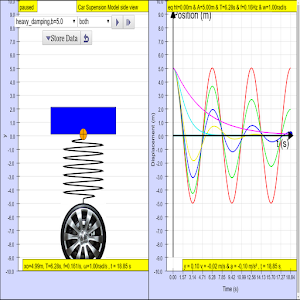
This document summarizes the key features and concepts presented within the "Student Learning Space Damping Car HTML5 Applet Simulation Model" resource, available through Open Educational Resources / Open Source Physics @ Singapore. The resource provides an interactive simulation to demonstrate the principles of damped harmonic motion, specifically in the context of a car suspension system.
{source}<iframe style="border-radius:12px" src="https://open.spotify.com/embed/episode/1si70rcEFJPkwwWFBMYFah?utm_source=generator" width="100%" height="352" frameBorder="0" allowfullscreen="" allow="autoplay; clipboard-write; encrypted-media; fullscreen; picture-in-picture" loading="lazy"></iframe>{/source}
2. Main Themes & Key Ideas:
- Damped Harmonic Motion: The core concept explored is damped harmonic motion, which is oscillation where the amplitude decreases over time due to energy loss (damping).
- Applications of Critical Damping: The resource focuses on the application of critical damping, particularly within car suspension systems.
- Damping Coefficient (b): The damping coefficient 'b' is identified as a crucial factor. "Factors that affects the damping coefficient b includes the drag in the oscillating spring-mass system that takes energy out of the system as heat loss etc." The simulation allows users to observe how different values of 'b' affect the system's behavior. It also indicates "the higher the viscosity of the medium the system is in, the greater the drag coefficient b."
- Car Suspension System Example: The simulation uses a car suspension as a practical example of damping. The site notes: "The spring of a car’s suspension is critically damped so that when a car goes over a bump, the passenger in the car quickly and smoothly regains equilibrium."
- Types of Damping: The simulation demonstrates different damping scenarios:
- No Damping (b=0): Shows continuous oscillation without decay.
- Light Damping (b=0.1): Shows oscillation with a gradual decrease in amplitude.
- Critical Damping (b=2.0): Shows the quickest return to equilibrium without oscillation. The resource notes the importance of critical damping in enabling "the car ready to respond to further bumps in the road quickly."
- Heavy Damping (b=5.0): Shows a slow return to equilibrium without oscillation (overdamped).
- Slightly Under Critical Damping in Cars: The resource highlights that "car suspensions are often adjusted to slightly under critical damped condition to give a more comfortable ride."
3. Key Facts & Information:
- HTML5 Applet Simulation: The resource is delivered as an HTML5 applet, making it accessible in web browsers without requiring plugins like Flash.
- Interactive Model: Users can interact with the simulation, presumably by adjusting the damping coefficient 'b' and observing the resulting motion. A link to run the sim is provided: "http://iwant2study.org/ospsg/index.php/85".
- Embeddable: The simulation can be embedded in other webpages using an iframe:
- <iframe width="100%" height="100%" src="https://iwant2study.org/lookangejss/02_newtonianmechanics_8oscillations/ejss_model_SHM21SLS_dampingcar/SHM21SLS_dampingcar_Simulation.xhtml " frameborder="0"></iframe>
- Related Resources: The page links to other interactive physics simulations and resources, including Geogebra applets and simulations covering various topics in physics and mathematics.
4. Potential Uses:
- Physics Education: The simulation is a valuable tool for teaching and learning about damped harmonic motion and its applications.
- Engineering Education: The car suspension example provides a practical application relevant to engineering students.
- Interactive Learning: The HTML5 applet format allows for engaging and hands-on learning experiences.
5. Conclusion:
The "Student Learning Space Damping Car HTML5 Applet Simulation Model" provides a clear and interactive demonstration of damped harmonic motion. Its focus on a practical application (car suspension) and the ability to manipulate the damping coefficient make it a valuable resource for physics and engineering education.
Damped Harmonic Motion in Car Suspension Systems
Study Guide
This study guide focuses on the concepts of damped harmonic motion, particularly as it applies to car suspension systems. It utilizes the provided simulation and text to explore the effects of different damping coefficients.
Key Concepts
- Harmonic Motion: A repetitive motion where the restoring force is proportional to the displacement from equilibrium. (e.g., a spring oscillating.)
- Damping: The dissipation of energy from an oscillating system, causing the amplitude of oscillations to decrease over time.
- Damping Coefficient (b): A measure of the strength of the damping force. Higher values of b indicate stronger damping.
- Critical Damping: The optimal level of damping where the system returns to equilibrium as quickly as possible without oscillating.
- Overdamping (Heavy Damping): Damping is so strong that the system returns to equilibrium slowly without oscillating.
- Underdamping (Light Damping): Damping is weak, resulting in oscillations with gradually decreasing amplitude before reaching equilibrium.
- No Damping: Absence of damping forces which results in continuous oscillation.
- Equilibrium: A state of balance where opposing forces or influences are equal. In the context of car suspension, it's the resting position of the car after a disturbance (like hitting a bump).
- Car Suspension: A system of springs, shock absorbers, and linkages that connect a vehicle to its wheels. It reduces the effect of traveling over rough ground, leading to improved ride quality and vehicle handling.
Simulation Use
The provided HTML5 applet simulation allows you to visualize the effects of different damping coefficients on a car suspension system. Utilize the simulation to observe the differences between no damping, light damping, critical damping, and heavy damping. Pay attention to:
- The speed at which the system returns to equilibrium.
- The presence and amplitude of oscillations.
- The value of the damping coefficient (b) associated with each case.
Quiz
Answer the following questions in 2-3 sentences each.
- What is the purpose of damping in a car suspension system?
- Explain what the damping coefficient (b) represents.
- Describe the motion of a car suspension system with no damping after hitting a bump.
- How does light damping affect the ride comfort in a car compared to no damping?
- What is the defining characteristic of critical damping?
- Why is critical damping often preferred in car suspension systems?
- What are the disadvantages of heavy damping in a car suspension system?
- Why are car suspensions often adjusted to be slightly under critically damped?
- How does the viscosity of the medium affect the damping coefficient (b)?
- Explain how damping helps to improve vehicle handling.
Quiz Answer Key
- Damping in a car suspension system aims to dissipate energy from the oscillating spring-mass system, minimizing unwanted vibrations and oscillations after encountering a bump or road imperfection. This leads to a smoother and more comfortable ride.
- The damping coefficient (b) represents the strength of the damping force in the system. It quantifies how quickly energy is removed from the oscillating system; a higher value of b indicates stronger damping and faster energy dissipation.
- With no damping, the car suspension system will oscillate continuously after hitting a bump, as there is no force to dissipate the energy introduced by the impact. The car will bounce up and down repeatedly without settling back to its equilibrium position quickly.
- Light damping improves ride comfort compared to no damping by reducing the duration and amplitude of oscillations. While oscillations still occur, they are dampened more rapidly, providing a less bouncy and more controlled ride experience.
- The defining characteristic of critical damping is that the system returns to equilibrium as quickly as possible without any oscillations. This represents the ideal balance between responsiveness and stability in the suspension system.
- Critical damping is preferred because it allows the car to quickly return to a stable position after an impact, ensuring the tires maintain contact with the road for optimal control and handling. It also prepares the car to respond to further bumps in the road quickly.
- Heavy damping can make the ride feel stiff and uncomfortable, as it resists movement and prevents the suspension from effectively absorbing bumps. It may also reduce the car's ability to handle rough roads, and reduce road feel for the driver.
- Car suspensions are often adjusted to be slightly under critically damped to provide a more comfortable ride, as a slight amount of oscillation can soften the impact felt by passengers. This also still allows for quick response to further road imperfections.
- The viscosity of the medium in which the system operates directly affects the damping coefficient (b). A higher viscosity results in a greater drag coefficient, which increases the damping force and thus the value of b.
- Damping improves vehicle handling by minimizing uncontrolled oscillations and maintaining consistent tire contact with the road. This allows for better steering response, stability, and overall control of the vehicle, particularly when encountering uneven surfaces.
Essay Questions
Consider the following questions and develop well-supported essays:
- Discuss the trade-offs between ride comfort and handling performance in the design of car suspension systems, considering different levels of damping.
- Explain how the principles of damped harmonic motion are applied in various engineering applications beyond car suspension systems. Provide specific examples.
- Analyze the factors that influence the damping coefficient in a real-world car suspension system.
- Compare and contrast the advantages and disadvantages of different types of damping methods used in car suspension systems (e.g., using different types of dampers).
- Design a car suspension system for a specific type of vehicle (e.g., sports car, off-road vehicle) justifying your choice of damping level.
Glossary of Key Terms
- Amplitude: The maximum displacement of an oscillating object from its equilibrium position.
- Damping: The process of dissipating energy from an oscillating system, reducing the amplitude of oscillations.
- Damping Coefficient (b): A measure of the strength of the damping force. A higher coefficient indicates stronger damping.
- Equilibrium: The state of balance where the net force on an object is zero.
- Frequency: The number of oscillations or cycles per unit of time (usually measured in Hertz, Hz).
- Harmonic Motion: A repetitive motion where the restoring force is proportional to the displacement from equilibrium.
- Oscillation: A repetitive variation, typically in time, of some measure about a central value or between two or more different states.
- Spring Constant (k): A measure of the stiffness of a spring. A higher spring constant indicates a stiffer spring.
- Viscosity: A measure of a fluid's resistance to flow.
Apps
Other resources
https://www.geogebra.org/m/ev62ku7w by tan Seng kwang
Damping Car and Oscillations FAQ
- What is the purpose of the Damping Car simulation?
- The Damping Car simulation is designed to illustrate the principles of damped harmonic motion, particularly as it applies to car suspensions. It allows users to visualize how different levels of damping (no damping, light damping, critical damping, and heavy damping) affect the car's response to a bump, with the goal of quickly and smoothly regaining equilibrium.
- What factors affect the damping coefficient 'b' in the simulation?
- The damping coefficient 'b' represents the drag force acting on the oscillating system. In the context of the car suspension, factors that contribute to 'b' include the viscosity of the medium (e.g., the shock absorber fluid) and any form of energy loss from the system, such as heat. A higher viscosity leads to a greater drag coefficient and increased damping.
- Why is critical damping important in car suspensions?
- Critical damping is ideal because it allows the car to return to its equilibrium position in the shortest time possible without oscillating. This ensures that passengers experience a smooth and controlled ride, quickly recovering from bumps in the road.
- Why are car suspensions sometimes adjusted to be slightly under-damped instead of critically damped?
- While critical damping provides the fastest return to equilibrium, it can feel somewhat stiff or harsh to passengers. Adjusting the suspension to be slightly under-damped can provide a more comfortable ride by allowing a small amount of oscillation before settling. This provides a better driving experience.
- What are the different damping scenarios presented in the simulation?
- The simulation presents four damping scenarios:
- No Damping (b=0): The car oscillates indefinitely after hitting a bump.
- Light Damping (b=0.1): The car oscillates for a while before settling.
- Critical Damping (b=2.0): The car returns to equilibrium as quickly as possible without oscillating.
- Heavy Damping (b=5.0): The car returns to equilibrium slowly without oscillating.
- How can the Damping Car simulation be used for educational purposes?
- The simulation allows students to visualize the effects of different damping coefficients on the motion of an oscillating system. It enhances understanding of the relationship between damping, oscillation, and equilibrium, making it suitable for teaching concepts in dynamics, oscillations, and applications of physics principles in engineering.
- Where can I access the Damping Car simulation?
- The Damping Car simulation can be accessed through the provided iframe embed code, which can be integrated into a webpage. A direct link to the simulation is also provided: http://iwant2study.org/ospsg/index.php/85. Additionally, an app version is available on the Google Play Store.
- What other resources and simulations are available on the Open Educational Resources / Open Source Physics @ Singapore platform?
- The platform offers a wide range of interactive physics simulations and resources, covering topics from foundations of physics to electromagnetism, waves, circuits, and more. These simulations are designed to promote interactive learning and conceptual understanding of physics principles. A variety of simulations for other subjects are also available such as Math, Chemistry and Biology.