{source}
<?php  require_once JPATH_SITE.'/TTcustom/TT_contentparser.php';\(parameters = array("topicname" => "02_newtonianmechanics_8oscillations", "modelname" => "ejss_model_shmbungee_phasegraph");echo generateSimHTML(\)parameters, "EJSS");
?>
{/source}
1. Main Theme: Modeling Bungee Jumping with SHM
The central idea across both sources is the exploration and visualization of bungee jumping dynamics through the lens of Simple Harmonic Motion. This involves understanding how the forces acting on a bungee jumper can lead to oscillatory motion that, under certain idealizations, can be approximated by SHM.
2. Key Concepts and Ideas:
- Simple Harmonic Motion (SHM): The "SHM Bungee Phase Graph HTML5 Applet Javascript" title explicitly links bungee oscillation to SHM. SHM is a specific type of periodic motion where the restoring force is directly proportional to the displacement and acts in the direction opposite to that of displacement.
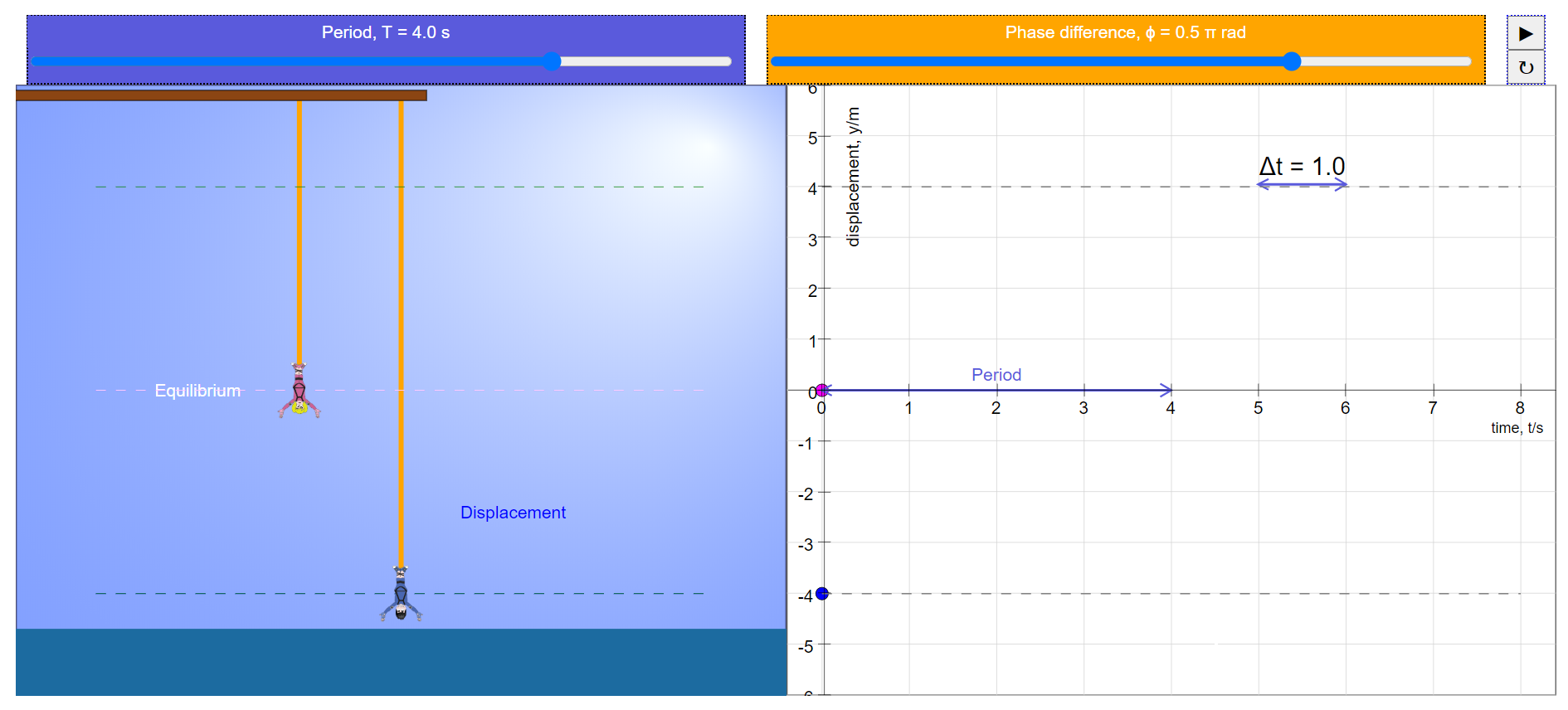
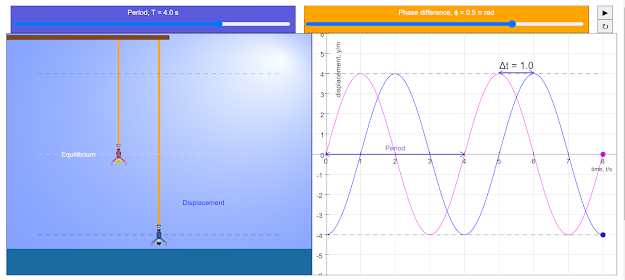
- Phase Difference: The "Initial Setup" description for the applet highlights the presence of "two bungee jumpers at two different positions" and that the simulation "shows the phase difference between the two Bungee Jumpers." This suggests a focus on comparing the oscillatory motion of multiple jumpers and understanding the relative timing of their oscillations.
- Controllable Variables: The applet allows users to manipulate "the Period and the Phase Difference." This indicates that these are crucial parameters in understanding and modeling the system. The period defines the time it takes for one complete oscillation, and the phase difference describes the shift in time between the oscillations of the two jumpers.
- Visualization and Simulation: The inclusion of the embed code (<iframe ...>) and the description as an "HTML5 Applet Javascript" clearly point to the use of interactive simulations as a primary tool for learning and exploration. This allows users to visualize the abstract concepts of SHM and phase differences in a concrete context.
- Open Educational Resource: The header "Open Educational Resources / Open Source Physics @ Singapore" and the mention of a "license" for "Bungee SHM" indicate that these materials are intended for educational use and are likely freely accessible and modifiable under the specified terms. The link to the Easy JavaScript/JavaScript Simulations Toolkit further reinforces this open-source nature.
- Learning Goals: The mention of "Sample Learning Goals" and a section "For Teachers" suggests that the resources are designed with pedagogical considerations in mind, aiming to facilitate student learning and provide guidance for educators.
- Activities: The presence of an "Activities" section under "Bungee Oscillation" implies that the resource includes structured learning tasks or exercises related to the simulation.
3. Important Facts and Details:
- Authorship: Both the "Bungee SHM" resource and the applet credit "Leong Tze Kwang; Lawrence Wee Loo Kang; Francisco Esquembre; Felix Garcia Clemente" as creators. This consistent attribution suggests a collaborative effort in developing these materials.
- Technology: The applet is built using "HTML5 Applet Javascript," making it web-based and accessible across various devices without requiring specific software installations. The compilation with "EJS 6.1 BETA (200414)" for "Bungee SHM" indicates the specific tool used in its creation.
- Platform: The applet is hosted under "Open Educational Resources / Open Source Physics @ Singapore," suggesting a specific institutional or project context for its development and dissemination. The breadcrumbs further confirm this origin.
- Accessibility: The inclusion of "Translations" and a link to a blog post ("https://weelookang.blogspot.com/2020/07/simple-harmonic-motion-bungee-phase.html") suggests efforts to make the resource more accessible and provide further context or discussion.
- Context within OSP@SG: The extensive list of other applets and resources on the "SHM Bungee Phase Graph HTML5 Applet Javascript" page provides context, showcasing the breadth of topics covered by Open Source Physics @ Singapore, ranging from Newtonian mechanics and oscillations to other areas of physics, mathematics, and even games for learning.
4. Potential Applications and Implications:
- Physics Education: These resources offer valuable tools for teaching and learning about Simple Harmonic Motion in a relatable and engaging context. The visual nature of the simulation and the ability to manipulate parameters can enhance student understanding of abstract concepts like period and phase difference.
- Interactive Learning: The HTML5 applet promotes active learning by allowing students to experiment with different scenarios and observe the resulting oscillations.
- Open Educational Practices: The open licensing encourages the adaptation, reuse, and sharing of these educational materials, potentially increasing their impact and reach.
- Curriculum Development: Educators can integrate these resources into their lesson plans on oscillations, waves, and introductory mechanics. The provided learning goals can also inform the design of assessment tasks.
5. Noteworthy Aspects:
- The detailed list of other resources on the applet page, while not directly about bungee SHM, highlights the rich collection of interactive physics simulations available from the Open Source Physics @ Singapore project.
- The "Sample Learning Goals" are mentioned but not explicitly provided in the excerpts. Accessing the full resource would be necessary to understand these specific learning objectives.
In conclusion, the provided sources focus on utilizing interactive simulations, specifically an HTML5 applet, to explore the connection between bungee jumping and Simple Harmonic Motion. The resources, developed by Leong Tze Kwang and colleagues under the Open Source Physics @ Singapore initiative, emphasize visualization, manipulation of key parameters like period and phase difference, and open educational practices to enhance physics learning. The materials are designed for educators and students to actively engage with the concepts of SHM in a practical and engaging context.
Study Guide: Bungee Jumping and Simple Harmonic Motion
Overview of Concepts
This study guide focuses on the application of Simple Harmonic Motion (SHM) principles to the scenario of bungee jumping, particularly as explored in the provided resources "Bungee SHM" and the "SHM Bungee Phase Graph HTML5 Applet Javascript" description. Key concepts include:
- Simple Harmonic Motion (SHM): Understanding the conditions for SHM (restoring force proportional to displacement), its characteristics (period, frequency, amplitude), and mathematical description.
- Oscillations: The repetitive back-and-forth movement around an equilibrium position.
- Bungee Jumping Physics: Analyzing the forces acting on a bungee jumper, including gravity and the elastic force of the bungee cord.
- Combining Gravity and Elasticity: Recognizing how the interplay of gravitational force and the spring-like force of the bungee cord can lead to oscillatory motion.
- Phase Difference: Understanding the concept of phase in oscillatory motion and how it describes the relative timing of two oscillations.
- Modeling and Simulation: Appreciating the role of computational models and simulations (like the HTML5 applet) in visualizing and understanding physical phenomena.
- Period and Phase Difference Control: Identifying these as key controllable variables in the provided simulation.
Key Learning Objectives
After reviewing these materials, you should be able to:
- Define Simple Harmonic Motion and identify its key characteristics.
- Explain how the forces acting on a bungee jumper can result in oscillatory motion.
- Describe the role of the bungee cord's elasticity in the motion.
- Understand the concept of phase difference between two oscillating systems.
- Identify the controllable parameters within the "SHM Bungee Phase Graph" simulation.
- Recognize the value of simulations as tools for learning physics.
Review Questions
Short Answer Quiz
- What are the two primary forces acting on a bungee jumper after the bungee cord becomes taut? Explain how these forces contribute to the jumper's oscillation.
- In the context of the "SHM Bungee Phase Graph" simulation, what does the phase difference between the two bungee jumpers represent? Why is understanding phase difference important when studying oscillations?
- Based on the provided information, what are the two main controllable variables in the "SHM Bungee Phase Graph HTML5 Applet Javascript"? How might changing these variables affect the simulated motion?
- While a bungee jump involves elasticity, is the entire motion purely Simple Harmonic Motion? Explain your reasoning based on the forces involved throughout the entire jump (from freefall to oscillation).
- What is the significance of the term "Open Educational Resources / Open Source Physics @ Singapore" mentioned in the context of the HTML5 applet? How does this relate to the accessibility and use of the simulation?
- The description mentions "Sample Learning Goals." Infer one possible learning goal for students using the "SHM Bungee Phase Graph" simulation, based on the controllable variables.
- The resources mention "Activities" related to "Bungee Oscillation." What kind of activities do you think might be included in this section to enhance learning about the topic?
- How can a phase graph (as suggested by the applet's name) be useful in visualizing and analyzing the motion of the bungee jumpers? What information does it typically display?
- The "Bungee SHM" resource is attributed to multiple authors and compiled with EJS 6.1 BETA. What does this suggest about the development and potential use of this material?
- How does the inclusion of a video (mentioned in the description but not provided) likely contribute to understanding the concepts related to bungee jumping and SHM?
Answer Key
- The two primary forces are gravity (downwards) and the elastic force of the bungee cord (upwards when stretched beyond its equilibrium length). Gravity provides a constant downward force, while the elastic force acts as a restoring force, pulling the jumper back towards the equilibrium position when stretched.
- The phase difference represents the difference in the stage of oscillation between the two jumpers at any given time. Understanding phase difference is crucial for analyzing how multiple oscillating systems interact and for predicting their relative positions and velocities.
- The two main controllable variables are the Period and the Phase Difference. Changing the period would alter the time it takes for one complete oscillation, while changing the phase difference would adjust the initial offset in the oscillatory motion of the two jumpers relative to each other.
- The entire motion is not purely SHM. The initial freefall portion is under constant gravitational acceleration. SHM begins predominantly once the bungee cord becomes taut and stretched, providing a restoring force proportional to the displacement from equilibrium (though even then, damping forces could be present in a real system).
- This indicates that the simulation and related materials are freely available for educational purposes and that the underlying code might be accessible for modification and adaptation. This promotes wider use and collaborative improvement in physics education.
- A possible learning goal is to investigate how changing the period of oscillation affects the phase relationship between two bungee jumpers, or to observe and analyze the graphical representation of different phase differences.
- Activities might include using the simulation to explore different period and phase difference values, making predictions about the jumpers' motion, analyzing the resulting graphs, and possibly comparing the simulation to real-world bungee jumping scenarios (simplified).
- A phase graph typically plots position or velocity against momentum or velocity, providing a visual representation of the state of the oscillator over time. It can reveal important characteristics like the amplitude and period of oscillation and illustrate the phase relationship between different oscillations.
- This suggests a collaborative effort in creating the educational resource, likely involving physics educators and potentially software developers. The use of EJS (Easy JavaScript Simulations) indicates that the material might include interactive simulations for students to engage with the concepts.
- A video could provide a visual demonstration of bungee jumping, potentially showing the oscillatory motion and relating it to the concepts of SHM. It could also explain the simulation or show real-world examples that help students connect abstract physics principles to a tangible experience.
Essay Format Questions
- Discuss how the principles of Simple Harmonic Motion can be used to model the vertical oscillations of a bungee jumper after the cord becomes taut. What are the limitations of this model in representing a real bungee jump?
- Explain the concept of phase difference in the context of oscillatory motion. Using the "SHM Bungee Phase Graph" simulation as a potential example, describe how visualizing phase difference can enhance understanding of the dynamics of multiple oscillating systems.
- Analyze the role of computational simulations, such as the "SHM Bungee Phase Graph HTML5 Applet Javascript," in physics education. What are the advantages of using such tools for learning about complex phenomena like bungee jumping oscillations?
- Consider the forces acting on a bungee jumper throughout the entire jump, from the initial freefall to the subsequent oscillations. How does the interplay between gravity and the elastic force of the bungee cord determine the nature of the motion at different stages?
- Based on the provided resources, discuss the importance of open educational resources in promoting accessibility and collaboration in physics education. How does the "SHM Bungee Phase Graph" applet exemplify the potential benefits of such resources?
Glossary of Key Terms
- Simple Harmonic Motion (SHM): A type of periodic motion where the restoring force is directly proportional to the displacement and acts in the direction opposite to that of displacement.
- Oscillation: A repetitive variation, typically in time, of some measure about a central value or between two or more different states.
- Period (T): The time taken for one complete cycle of an oscillation.
- Frequency (f): The number of oscillations per unit time, usually measured in Hertz (Hz). It is the inverse of the period (f = 1/T).
- Amplitude (A): The maximum displacement or distance moved by a point on a vibrating body or wave measured from its equilibrium position.
- Equilibrium Position: The central position around which an object oscillates when in simple harmonic motion, where the net force is zero.
- Restoring Force: A force that acts to bring a displaced object back towards its equilibrium position. In SHM, this force is proportional to the displacement.
- Elastic Force: The force exerted by a deformed elastic material (like a stretched bungee cord) that tends to restore it to its original, undeformed shape.
- Phase: A point or stage in a cycle of oscillation or vibration relative to a standard or a reference point.
- Phase Difference (Δφ): The difference in phase between two or more oscillations or waves, indicating how much one is ahead or behind the other in their cycles.
- Simulation: A model or representation of a real-world system or process, often implemented using computer software, that allows for experimentation and observation.
- Open Educational Resources (OER): Teaching, learning, and research materials in any medium, digital or otherwise, that reside in the public domain or have been released under an open license that permits no-cost access, use, adaptation, and redistribution by others with no or limited restrictions.
Sample Learning Goals
[text]
For Teachers
Research
[text]
Video
[text]
Version:
Other Resources
[text]
Frequently Asked Questions: Bungee Jumping and Simple Harmonic Motion
1. What is the relationship between a bungee jump and Simple Harmonic Motion (SHM)?
A bungee jump can exhibit behavior similar to Simple Harmonic Motion under certain idealizations. After the initial freefall, once the bungee cord starts to stretch, it exerts a restoring force proportional to the displacement from its equilibrium position. This restoring force causes the jumper to oscillate up and down, much like a mass attached to a spring or a simple pendulum with small oscillations, which are characteristic examples of SHM.
2. How can a simulation help in understanding the SHM of a bungee jump?
Simulations allow for the visualization and manipulation of the parameters involved in a bungee jump, such as the stiffness of the cord, the mass of the jumper, and the initial conditions (e.g., jump height). By observing the resulting motion, particularly the oscillations after the initial fall, one can gain an intuitive understanding of how these parameters influence the period and amplitude of the motion, and how closely it resembles ideal SHM. Furthermore, simulations can often display phase graphs, illustrating the relationship between the jumper's position and velocity over time, which is a key tool in analyzing oscillatory motion.
3. What factors might cause a real bungee jump to deviate from ideal Simple Harmonic Motion?
Real-world bungee jumps involve several factors that are not accounted for in a simple SHM model. These include: * Non-linear Elasticity of the Bungee Cord: The restoring force of a real bungee cord might not be perfectly proportional to the displacement, especially at large stretches. * Damping Forces: Air resistance and internal friction within the bungee cord will dissipate energy, causing the oscillations to decrease in amplitude over time. This is not present in ideal undamped SHM. * Initial Freefall: The initial part of the jump, before the cord stretches, is a period of freefall and not part of the oscillatory motion governed by the cord's elasticity. * Variable Gravitational Force: While often considered constant, the gravitational force acts throughout the entire motion, influencing both the equilibrium position and the restoring force provided by the stretched cord.
4. What is a phase graph in the context of a bungee SHM simulation, and what information does it provide?
A phase graph plots the velocity of the oscillating object (the bungee jumper) against its position. For ideal SHM, this graph is an ellipse. In the context of a bungee SHM simulation, the phase graph provides a visual representation of the relationship between the jumper's displacement from equilibrium and their velocity at any given time during the oscillation. Deviations from a perfect ellipse on the phase graph can indicate non-ideal SHM behavior due to factors like damping or non-linear restoring forces.
5. What are some controllable variables in a typical bungee SHM simulation, and how do they affect the motion?
Common controllable variables in a bungee SHM simulation include: * Period: This directly sets the time it takes for one complete oscillation. Changing the period (which is related to the mass and the stiffness of the bungee cord in SHM) will alter the rate at which the jumper moves up and down. * Phase Difference: In simulations with multiple jumpers, this variable controls the difference in the starting points of their oscillations. It determines if the jumpers are moving in sync, out of sync, or somewhere in between. * Stiffness of the Bungee Cord: A stiffer cord will result in a stronger restoring force for a given stretch, leading to a shorter period of oscillation and potentially a smaller maximum displacement. * Mass of the Jumper: A larger mass will have more inertia, resulting in a longer period of oscillation and potentially a larger maximum displacement. * Initial Jump Height: This affects the initial stretch of the cord and the amplitude of the subsequent oscillations. * Damping Coefficient: This controls the strength of the damping forces, affecting how quickly the oscillations decay.
6. How can studying the phase difference between multiple bungee jumpers be useful?
Analyzing the phase difference between multiple simulated bungee jumpers can illustrate concepts of relative motion and synchronization in oscillatory systems. It allows one to observe how different initial conditions or system parameters can lead to variations in the timing of their oscillations. This can be relevant in understanding more complex oscillatory systems with multiple interacting components.
7. What are some learning goals that can be achieved by using a Bungee SHM simulation?
By interacting with a Bungee SHM simulation, learners can: * Develop a conceptual understanding of Simple Harmonic Motion in a real-world context. * Investigate the relationship between system parameters (mass, stiffness) and the characteristics of SHM (period, amplitude, frequency). * Visualize and interpret phase graphs as a tool for analyzing oscillatory motion. * Explore how damping and non-linearities can cause deviations from ideal SHM. * Understand the concept of phase difference in oscillatory systems. * Gain familiarity with using simulations as a tool for scientific exploration and learning.
8. Who are the creators and what is the licensing of the "Bungee SHM" resources mentioned?
The "Bungee SHM" resource and the "SHM Bungee Phase Graph HTML5 Applet Javascript" were created by Leong Tze Kwang, Lawrence Wee Loo Kang, Francisco Esquembre, and Felix Garcia Clemente. The content is licensed under a Creative Commons Attribution-Share Alike 4.0 Singapore License. For commercial use of the underlying EasyJavaScriptSimulations Library, separate terms apply as detailed on the Easy JavaScript Simulations website.