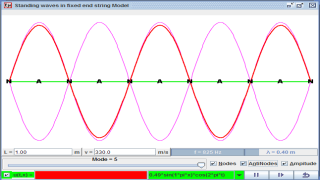
{source}
<?php  require_once JPATH_SITE.'/TTcustom/TT_contentparser.php';\(parameters = array("topicname" => "04waves_12generalwaves", "modelname" => "ejss_model_pipestringwee02");echo generateSimHTML(\)parameters, "EJSS");
?>
{/source}
Briefing Document: 〜Standing Waves Simulation Applet
1. Overview:
This document reviews an online educational resource: a JavaScript HTML5 applet designed to simulate and demonstrate the principles of standing waves, specifically in a fixed-end string and within pipes with various end conditions. The resource, hosted by Open Educational Resources / Open Source Physics @ Singapore, is intended to be interactive and accessible on multiple platforms (desktops, laptops, tablets, and smartphones). It aims to assist students in understanding key wave concepts and their mathematical representation.
2. Main Themes:
- Standing Waves: The central focus is on standing waves (also known as stationary waves), which are formed by the superposition of two waves traveling in opposite directions.
- Normal Modes: The applet demonstrates the first five normal modes of vibration for a string or pipe. Each mode corresponds to a specific pattern of oscillation with a characteristic number of nodes and antinodes.
- Mathematical Representation: The applet models the wave behavior using equations that describe the displacement of the string/air column as a function of time and position.
- Interactive Learning: The resource is designed to be highly interactive, encouraging students to explore the effects of different parameters such as mode number, time step, and the nature of the medium.
- Relationship between Wavelength, Frequency, and Speed: The applet provides a practical way for students to understand the relationship between these wave properties, represented by the equation v = fλ.
3. Key Concepts and Ideas:
- Transverse and Longitudinal Waves: The resource addresses both transverse waves (like those in a string) and longitudinal waves (like those in a pipe).
- Displacement, Amplitude, Phase Difference, Period, Frequency, Wavelength, and Speed: The applet aims to reinforce the understanding of these basic wave parameters. As stated, "(a) show an understanding and use the terms displacement, amplitude, phase difference, period, frequency, wavelength and speed."
- Nodes and Antinodes: The resource emphasizes identifying nodes (points of zero displacement) and antinodes (points of maximum displacement) in stationary wave patterns. The description states, "(c) explain the formation of a stationary wave using a graphical method, and identify nodes and antinodes"
- Modeling Equations:Fixed-End String: The displacement of a point on a fixed-end string is described by the equation u(t,x) = A sin(n π x) cos(ω t + δ), where 'n' represents the mode number.
- Pipes with different End Conditions: The document provides modeling equations for four different cases of pipes:
- Both ends closed: u ( t , x ) = A sin( n π x ) cos( ω t + δ)
- Left end closed, right end open: u ( t , x ) = A sin(( n -1/2)π x ) cos( ω t + δ)
- Left end open, right end closed: u ( t , x ) = A cos(( n -1/2)π x ) cos( ω t + δ)
- Both ends open: u ( t , x ) = A cos( n π x ) cos( ω t + δ)
- Pressure and Displacement Relationship: In the pipe simulations, students can analyze the relationship between pressure and displacement waves. The description states, "Which is the relationship between the displacement and pressure waves? How does it appears in the animation?"
- Arbitrary Units: The simulation uses arbitrary units, set to SI units for calculation purposes. The text mentions that, "Units are arbitrary set to be in SI unit for calculation purposes" and "Units are arbitrary." It is important to note that scale has been "arbitrarily enhanced" for visualization and students should keep in mind they are looking at very small displacements.
- Experimental Verification: The resource emphasizes using the simulation to check calculations, particularly concerning the position of nodes. "Use the simulation to check your calculation."
4. Activities and Learning Goals:
The resource suggests specific activities for students:
- Calculating Node Positions: Students are asked to compute the position of nodes for different modes and to verify these calculations using the simulation. "Compute the position of the nodes(always zero displacement) for mode number n=1,2,3,4,5 cases... Use the simulation to check your calculation."
- Modeling Equation Selection: Students need to choose the correct modeling equation corresponding to each case of standing wave. "select the correct modeling equation for fixed end string n=1,2,3,4,5 respectively."
- Analyzing Relationships Between Parameters: Students are encouraged to investigate how various parameters describe stationary waves. "how can you suggest is the parameter that describe these series of stationary waves."
- Analyzing Graphical Representations: The learning goals include the ability to analyze and interpret graphs of transverse and longitudinal waves. The text states, "(f) analyse and interpret graphical representations of transverse and longitudinal waves"
- Experimentation and Deduction: Students are encouraged to deduce equations, recall equations, and show understanding of experiments that demonstrate stationary waves. For instance, it is noted that students should "(b) deduce, from the definitions of speed, frequency and wavelength, the equation v = fλ" and "(b) show an understanding of experiments which demonstrate stationary waves using microwaves, stretched strings and air columns"
- Determination of Wavelength: Students are meant to be able to "determine the wavelength of sound using stationary waves."
5. Technical Details:
- Technology: The simulation is built using JavaScript and HTML5, making it accessible on modern web browsers without the need for additional plugins. It mentions that the model is designed to work on "Android/iOS including handphones/Tablets/iPads" and "Windows/MacOSX/Linux including Laptops/Desktops."
- Easy JavaScript Simulations (Ejs): The simulation is created using Easy Java Simulations (Ejs), an authoring toolkit for creating interactive simulations, and translated from a Basque original for a mechanics course.
6. Additional Resources:
The document includes links to related resources:
- Other simulations of transverse standing waves
- Desmos graphing calculator tool
- OPhysics page on waves
7. Conclusion:
This simulation applet is a valuable educational tool for teaching the fundamentals of standing waves. Its interactive nature, coupled with the visualization of the mathematical models, enables students to gain a deeper understanding of these complex phenomena. The variety of activities and learning goals promotes active learning and reinforces key physics concepts.
Standing Waves Study Guide
Quiz
Instructions: Answer the following questions in 2-3 sentences each.
- What are the two types of waves discussed in the source material?
- In the context of standing waves, what is a node?
- What is an antinode in the context of standing waves?
- What equation relates wave speed (v), frequency (f), and wavelength (λ)?
- What is the formula for a standing wave in a fixed end string, according to the source?
- What are the four equations provided for standing waves in a pipe, and what determines which equation is used?
- How can one determine the wavelength of sound using stationary waves?
- What are the parameters that describe the series of stationary waves in the fixed end string simulation?
- According to the source, how are displacement and pressure related in the simulation of standing waves in a pipe?
- What are some resources given in the provided text that one can use to better understand standing waves?
Quiz Answer Key
- The two types of waves discussed are transverse waves, where the displacement of the medium is perpendicular to the wave's direction of travel, and longitudinal waves, where the displacement is parallel to the wave's direction of travel. These are general wave types that standing waves can be composed of.
- A node is a point along a standing wave where the displacement is always zero. This means the medium at a node does not move as the wave oscillates.
- An antinode is a point along a standing wave where the displacement is at its maximum. This means the medium at an antinode moves with the largest amplitude during oscillation.
- The equation that relates wave speed (v), frequency (f), and wavelength (λ) is v = fλ. This equation is a fundamental relationship for all types of waves.
- The formula for a standing wave in a fixed end string, according to the source, is u(t,x) = A sin(nπx) cos(ωt + δ), where n is the mode number.
- The four equations for standing waves in a pipe are based on open and closed end combinations, varying the location and formula of the cosine and sine components. When both ends are closed, the formula is u(t,x) = A sin(nπx) cos(ωt + δ). When the left end is closed and the right is open, the formula is u(t,x) = A sin((n-1/2)πx) cos(ωt + δ). When the left end is open and the right is closed, the formula is u(t,x) = A cos((n-1/2)πx) cos(ωt + δ). When both ends are open, the formula is u(t,x) = A cos(nπx) cos(ωt + δ).
- The wavelength of sound can be determined by using stationary waves and identifying the distance between nodes or antinodes. Specifically, the distance between two consecutive nodes (or antinodes) is equal to half the wavelength.
- The parameter that describes the series of stationary waves in the fixed end string simulation is the mode number n. This parameter determines the number of nodes and antinodes in the standing wave pattern.
- In the simulation of standing waves in a pipe, the displacement and pressure waves are related and can be visualized. The text notes that lighter or darker blue in the contour plot corresponds to higher or lower pressure. Specifically, where displacement is a maximum, the pressure changes will be minimal, and vice versa.
- Some additional resources to better understand standing waves provided in the text include websites with similar HTML5 simulations and Desmos graphing. These can be found at: http://physics.bu.edu/~duffy/HTML5/transverse_standing_wave.html, https://www.desmos.com/calculator/7gjvsgjrp6, and https://ophysics.com/waves5.html.
Essay Questions
Instructions: Choose one of the following essay questions to write about. Be sure to cite the source to support your claims.
- Analyze the formation of standing waves in both a fixed-end string and a pipe, explaining how boundary conditions (open or closed ends) affect the resulting wave patterns.
- Compare and contrast transverse and longitudinal waves, providing examples of each, and discuss how they both can contribute to the formation of stationary waves.
- Discuss how the mathematical representations of standing waves (u(t,x) equations) for different scenarios (fixed string, closed pipe, open pipe) accurately reflect the physical behavior of the waves in those contexts.
- Evaluate the interactive elements and learning goals of the provided simulation applets, explaining how these elements can improve understanding of concepts related to wave physics and standing waves.
- Describe the experimental methods that can be used to generate standing waves in a laboratory setting, covering microwave experiments, stretched strings, and air columns.
Glossary of Key Terms
- Amplitude: The maximum displacement or distance moved by a point on a vibrating body or wave measured from its equilibrium position.
- Antinode: A point in a standing wave where the amplitude is at its maximum.
- Displacement: The distance of a particle from its equilibrium position in a wave.
- Frequency (f): The number of complete oscillations or cycles of a wave that occur per unit of time, usually measured in Hertz (Hz).
- Longitudinal Wave: A wave in which the displacement of the medium is parallel to the direction of the wave propagation.
- Mode Number (n): An integer that identifies a specific resonant pattern in a standing wave.
- Node: A point in a standing wave where the amplitude is always zero.
- Phase Difference (δ): The difference in phase between two waves, usually measured in radians or degrees.
- Standing Wave (Stationary Wave): A wave that appears to be standing still, formed by the superposition of two waves traveling in opposite directions.
- Superposition: The combining of two or more waves, resulting in a new wave pattern.
- Transverse Wave: A wave in which the displacement of the medium is perpendicular to the direction of the wave propagation.
- Wavelength (λ): The spatial period of a wave; the distance over which the wave’s shape repeats.
- Wave Speed (v): The speed at which a wave propagates through a medium, related to frequency and wavelength by the equation v=fλ.
Other Resources
http://physics.bu.edu/~duffy/HTML5/transverse_standing_wave.html
https://www.desmos.com/calculator/7gjvsgjrp6
https://ophysics.com/waves5.html
FAQ: Standing Waves and Simulations
- What are standing waves, and how do they differ from regular traveling waves? Standing waves, also known as stationary waves, are formed when two waves of the same frequency and amplitude travel in opposite directions and interfere with each other. Unlike traveling waves, which propagate through a medium, standing waves appear to be fixed in space. They have regions of maximum displacement called antinodes and regions of zero displacement called nodes. This simulation focuses on demonstrating the formation of standing waves in fixed-end strings and pipes, using a mix of transverse (string) and longitudinal (pipe) wave examples.
- How does the simulation model standing waves in fixed-end strings? The simulation models standing waves in a fixed-end string along the x-axis using the equation u(t,x) = A sin(n π x) cos(ω t + δ). Here, 'n' represents the mode number, which corresponds to the number of antinodes. By selecting different mode numbers (n = 1, 2, 3, 4, 5) from a drop-down menu, users can visualize the first five normal modes of the standing wave, examining how the amplitude and wavelength are related to 'n'. The simulation allows users to explore these relationships while maintaining arbitrary SI units.
- What factors determine the formation of standing waves in pipes? The formation of standing waves in pipes depends primarily on whether the ends are open or closed, along with the mode number 'n'. The simulation demonstrates four different scenarios: 1) both ends closed, 2) left end closed, right end open, 3) left end open, right end closed, and 4) both ends open. Each of these scenarios is governed by a different equation relating displacement to position x. These equations dictate the positions of the nodes and antinodes and thereby the shape of the standing waves within the pipe. Pressure waves also play a role, with pressure nodes and antinodes appearing at locations different from displacement nodes.
- How can the simulation help in understanding the concepts of nodes and antinodes? The simulation allows users to observe the physical locations of nodes and antinodes. Nodes are the points of zero displacement, and the simulation can optionally highlight their positions in both string and pipe examples. Antinodes, on the other hand, are the points of maximum displacement. By observing the behavior of the simulation at different mode numbers, one can visually identify how these positions change. Activities built around the simulation include calculations and experimental verification of the node positions for a deeper understanding.
- What is the relationship between wavelength, frequency, and wave velocity in standing waves? The relationship between wavelength (λ), frequency (f), and wave velocity (v) for all waves (including standing) is given by the equation v = fλ. The simulation activities encourage users to explore how altering one parameter, like frequency, will affect others like wavelength and velocity. Even though the simulation focuses on fixed-end standing wave scenarios, the fundamental relationship remains intact and can be explored in activities. By manipulating various parameters and using the simulation, one can better grasp how they interact.
- How does the simulation represent the pressure waves in a pipe and what is their relationship to the displacement waves? In the pipe simulation, the animation displays both displacement and pressure. While the displacement shows the physical movement of particles in the pipe, pressure is shown with varying color (lighter/darker blue representing higher/lower pressure). The locations of pressure nodes and antinodes don’t coincide with the displacement ones. Where displacement is maximum, pressure is minimum and vice-versa. This simulation allows a direct comparison between the two aspects, offering a visual aid in understanding that displacement and pressure nodes and antinodes are typically opposite in a standing wave in a pipe
- What are some of the key learning goals associated with using this simulation? Several learning goals are addressed with the simulation: (a) understanding and using terms like displacement, amplitude, phase difference, period, frequency, wavelength, and speed; (b) understanding and using the equation v = fλ; (c) analyzing and interpreting graphical representations of both transverse and longitudinal waves; (d) determining the wavelength of sound through stationary waves; (e) understanding experiments demonstrating stationary waves using different setups; and (f) explaining the graphical formation of a stationary wave and identifying nodes and antinodes.
- What additional resources are available to explore concepts related to waves and oscillations? The webpage provides links to various other interactive simulations and learning tools, such as those modeling transverse waves, harmonic motion, and various physics phenomena. These additional resources can be explored to gain a broader understanding of wave physics. The page provides links to various resources such as: http://physics.bu.edu/~duffy/HTML5/transverse_standing_wave.html, https://www.desmos.com/calculator/7gjvsgjrp6, and https://ophysics.com/waves5.html which provide alternative or related visualizations that may deepen understanding of the material.