{source}
<?php  require_once JPATH_SITE.'/TTcustom/TT_contentparser.php';\(parameters = array("topicname" => "05electricitynmagnetism_17AC", "modelname" => "ejss_model_highpowertransmissionline");echo generateSimHTML(\)parameters, "EJSS");
?>
{/source}
1. Overview:
This briefing document reviews the "High Power Transmission Line Simulator JavaScript Simulation Applet HTML5" resource available on the Open Educational Resources / Open Source Physics @ Singapore website. This resource is an interactive simulation designed to help users understand the principles of high-power AC transmission lines. The document summarizes the key information provided about the simulator, its purpose, and its context within the broader Open Source Physics Singapore initiative.
{source}<iframe style="border-radius:12px" src="https://open.spotify.com/embed/episode/4yKdBeuyT63YM3Wvvg1RlF?utm_source=generator" width="100%" height="352" frameBorder="0" allowfullscreen="" allow="autoplay; clipboard-write; encrypted-media; fullscreen; picture-in-picture" loading="lazy"></iframe>{/source}
2. Main Themes and Important Ideas/Facts:
- Interactive Learning Tool: The core theme is the provision of an interactive JavaScript simulation applet for educational purposes. The resource is explicitly categorized under "Interactive Resources" and "Mathematics," suggesting its utility in both science and mathematics education.
- Focus on High Power AC Transmission Lines: The title clearly indicates the simulation's specific focus, suggesting it allows users to explore parameters and behaviors related to the transmission of high-power alternating current.
- HTML5 and JavaScript Technology: The mention of "JavaScript Simulation Applet HTML5" highlights the technology used, indicating its accessibility through modern web browsers without the need for additional plugins like Java applets. This ensures broader compatibility and ease of use.
- Open Educational Resource (OER) / Open Source Physics: The resource is part of a larger initiative focused on providing open educational resources and promoting open-source physics education. This implies that the simulation is freely available for use, adaptation, and sharing, subject to the specified license.
- Embeddable Model: The provision of an <iframe> code snippet signifies that the simulation can be easily embedded into other web pages or learning management systems. This enhances its utility for educators who wish to integrate it into their online teaching materials. The provided code is:
- <iframe width="100%" height="100%" src="https://iwant2study.org/lookangejss/05electricitynmagnetism_17AC/ejss_model_highpowertransmissionline/highpowertransmissionline_Simulation.xhtml " frameborder="0"></iframe>
- Credits to Developers: The resource acknowledges the individuals responsible for its creation: "Fu-Kwun Hwang - Dept. of Physics, National Taiwan Normal Univ.; Fremont Teng; Loo Kang Wee." This provides attribution and allows for potential contact or further exploration of their work.
- Sample Learning Goals and For Teachers Section: The presence of these sections (though marked as "[text]" indicating their content is not provided in the excerpt) suggests that the resource is designed with specific pedagogical objectives in mind and includes guidance for educators on how to utilize the simulation effectively.
- Instructions via Sliders and Full Screen Toggle: The description of "Sliders" for manipulation and a "Toggle Full Screen" option points to a user-friendly interface that allows for interactive exploration and optimized viewing.
- Part of a Wider Collection of Simulations: The extensive list of other available JavaScript HTML5 applet simulations on various physics and mathematics topics demonstrates the breadth of the Open Source Physics @ Singapore project. These range from mechanics and waves to electricity and magnetism, showcasing a comprehensive collection of interactive learning tools. Examples include:
- "Wave in 2D of Particles and Springs JavaScript Simulation Applet HTML5"
- "Magnetic Field Lines with the Right-Hand Grip Rule"
- "Projectile Motion with System of Masses and Spring JavaScript HTML5 Applet Simulation Model by Darren Tan"
- Licensing Information: The footer explicitly states that "Contents are licensed Creative Commons Attribution-Share Alike 4.0 Singapore License." It also provides specific instructions for commercial use of the "EasyJavaScriptSimulations Library," directing users to the license details and a contact email. This clearly outlines the terms of use and redistribution for the resource.
- Popular Tags: The list of "Popular Tags" such as "Electricity and Magnetism," "Junior College," and "Learning and Teaching Mathematics using Simulations" further contextualizes the target audience and subject area of the High Power Transmission Line Simulator and the broader collection.
3. Potential Use Cases and Implications:
- Educational Instruction: The simulator can be a valuable tool for teachers to visually demonstrate the concepts and parameters involved in high-power AC transmission lines, enhancing student understanding and engagement.
- Self-Learning: Students can use the interactive simulation independently to explore the effects of different variables and deepen their grasp of the subject matter.
- Curriculum Development: Educators and curriculum developers can leverage this OER as a component of their learning materials, saving development time and providing students with a high-quality interactive resource.
- Research and Exploration: While primarily educational, the simulator might also be useful for introductory research or for individuals seeking a basic interactive model to understand transmission line behavior.
4. Missing Information and Further Questions:
- The actual learning goals for the High Power Transmission Line Simulator are not provided in the excerpt. Understanding these would give a clearer picture of the intended learning outcomes.
- The "Research" and "Video" sections are also marked as "[text]," indicating a lack of information about any accompanying research materials or video explanations.
- Details about the specific parameters that can be manipulated using the sliders are not mentioned. Knowing these parameters would help understand the depth and scope of the simulation.
- The "For Teachers" section likely contains valuable guidance on how to integrate the simulation into teaching, but its content is not available in this excerpt.
5. Conclusion:
The "High Power Transmission Line Simulator JavaScript Simulation Applet HTML5" is a freely available, embeddable, and interactive tool for learning about high-power AC transmission lines. Its use of HTML5 and JavaScript ensures accessibility, and its presence within the extensive Open Source Physics @ Singapore collection highlights a commitment to open education in STEM fields. While specific details about the learning goals and simulation parameters are not provided in this excerpt, the available information suggests a valuable resource for both educators and learners. The clear licensing information promotes its wider adoption and adaptation within the educational community.
High Power Transmission Line Simulator Study Guide
Overview
This study guide is designed to help you review the concepts related to the High Power Transmission Line Simulator JavaScript Simulation Applet HTML5. The resource is an interactive tool that allows users to manipulate parameters and observe the effects on a high power transmission line. Understanding the purpose and functionality of such simulations within an educational context is key.
Key Concepts
- Simulation as a Learning Tool: Understand the benefits of using interactive simulations in learning, particularly in subjects like physics and mathematics. Consider how they aid visualization and exploration of abstract concepts.
- High Power Transmission Lines: While the specific physics of transmission lines isn't detailed in this source, recognize that the simulator likely models aspects of AC electricity related to their operation.
- Interactive Parameters: The simulator uses sliders that allow users to change variables. Consider what kind of parameters might be relevant in a high power transmission line model (e.g., voltage, current, resistance, length, frequency - though these are not explicitly stated).
- HTML5 and JavaScript: Understand that the simulation is built using these web technologies, making it accessible through web browsers without the need for additional plugins.
- Open Educational Resources (OER): Recognize that this resource is openly available for educational purposes, often allowing for embedding and adaptation.
- Embeddability: The provided HTML iframe code indicates that the simulation can be easily integrated into other web pages or learning management systems.
- Learning Goals: The existence of "Sample Learning Goals" suggests that the simulation is designed with specific educational objectives in mind.
- Teacher Resources: The "For Teachers" section implies that there are pedagogical considerations and potential support materials for educators using the simulation.
Quiz
Answer the following questions in 2-3 sentences each.
- What is the primary function of the "High Power Transmission Line Simulator JavaScript Simulation Applet HTML5" according to the information provided?
- What does the mention of "sliders" in the "Instructions" section suggest about how users interact with the simulation?
- What does the HTML <iframe> tag provided indicate about the potential use of this simulation?
- Based on its categorization under "Open Educational Resources / Open Source Physics @ Singapore," what does this suggest about the accessibility and potential usability of the simulation?
- What do the "Sample Learning Goals" and "For Teachers" sections imply about the intended audience and purpose of this resource?
- What web technologies are used to create this simulation, as indicated by its title?
- Besides the transmission line simulator, what is the general theme of many other listed resources on the same webpage? Provide one example.
- Who are some of the individuals credited for their work on similar resources listed on the page?
- What does the "Embed this model in a webpage" option suggest about the flexibility of using this simulation in different online learning environments?
- What are "Breadcrumbs" as used on this webpage, and what purpose do they serve for a user navigating the site?
Answer Key
- The primary function of the simulation is to allow users to interact with a model of a high power transmission line, likely to observe how different parameters affect its behavior. The "Sliders" instruction indicates that users can manipulate variables within the simulation.
- The mention of sliders suggests that users can dynamically adjust different parameters of the high power transmission line model to see the immediate effects of these changes on the system being simulated. This allows for hands-on exploration of the concepts.
- The <iframe> tag indicates that the simulation can be embedded into other HTML documents, such as web pages, online learning platforms, or educational resources, making it easily shareable and integrable.
- Being categorized as an Open Educational Resource suggests that the simulation is freely available for educational use, and the "Open Source Physics" label implies that its underlying code might also be accessible or modifiable.
- The presence of "Sample Learning Goals" indicates that the simulation is designed to help students achieve specific educational outcomes, while the "For Teachers" section suggests that there are resources or guidance provided for educators on how to effectively use the tool in their teaching.
- The title explicitly states that the simulation is a "JavaScript Simulation Applet HTML5," indicating that it is built using these two key web technologies for interactive content.
- Many other listed resources on the page are also interactive simulations covering a wide range of physics and mathematics topics, designed for educational purposes. For example, the "Reflection From Wall Simulator JavaScript Simulation Applet HTML5" simulates wave reflection.
- Fu-Kwun Hwang, Fremont Teng, Loo Kang Wee, and MeiYoke are among the individuals credited for their work on creating or contributing to various interactive simulations and educational resources listed on the webpage.
- The embed option highlights the portability and ease with which the simulation can be incorporated into various online platforms, enhancing digital learning materials and providing interactive experiences directly within them.
- "Breadcrumbs" are navigational aids that show the user's current location within the website's hierarchy. They help users understand where they are on the site and easily navigate back to previous sections or the homepage.
Essay Format Questions
- Discuss the pedagogical benefits of using interactive simulations, like the High Power Transmission Line Simulator, in the teaching and learning of physics or related subjects. Provide specific examples of how manipulating parameters in such a simulation could enhance student understanding compared to static resources.
- Considering the context of Open Educational Resources, analyze the potential impact and advantages of freely available simulations like the one described for educators and students globally. How does the embeddability of the tool further contribute to its utility?
- While the specific scientific principles modeled by the High Power Transmission Line Simulator are not detailed, speculate on the types of concepts related to AC electricity that such a simulation might aim to illustrate. How could interactive features help students grasp these concepts more effectively?
- Examine the role of web technologies like HTML5 and JavaScript in the development and accessibility of educational simulations. What advantages do these technologies offer over older methods of creating and distributing interactive learning tools?
- Based on the variety of other simulations listed on the webpage, discuss the broader movement of incorporating interactive digital resources into education. What trends or philosophies in education might drive the creation and sharing of such a diverse collection of tools?
Glossary of Key Terms
- Simulation: A computer-based model of a real-world system or process, allowing users to interact with it and observe the effects of different inputs or conditions.
- JavaScript: A high-level, often just-in-time compiled language that conforms to the ECMAScript specification. It is a programming language that makes web pages interactive.
- HTML5: The latest evolution of the standard that defines the structure and content of the World Wide Web. It supports multimedia and interactive elements without the need for plugins.
- Applet: A small application, often written in Java but in this context referring to a JavaScript-based interactive element, designed to run within another application (like a web browser).
- Open Educational Resources (OER): Teaching, learning, and research materials that are in the public domain or have been released under an open license, permitting no-cost access, use, adaptation, and redistribution by others with no or limited restrictions.
- Embed: To integrate content, such as a simulation or video, from one digital source into another, often using code like <iframe>.
- Interactive: Allowing for two-way communication and response between the user and the system, enabling users to actively participate and influence the experience.
- Parameter: A variable that can be adjusted or manipulated in a model or simulation to observe its effect on the outcome.
- Pedagogical: Relating to teaching or education.
- Visualization: The process of representing data or concepts in a visual format to aid understanding.
Sample Learning Goals
[text]
For Teachers
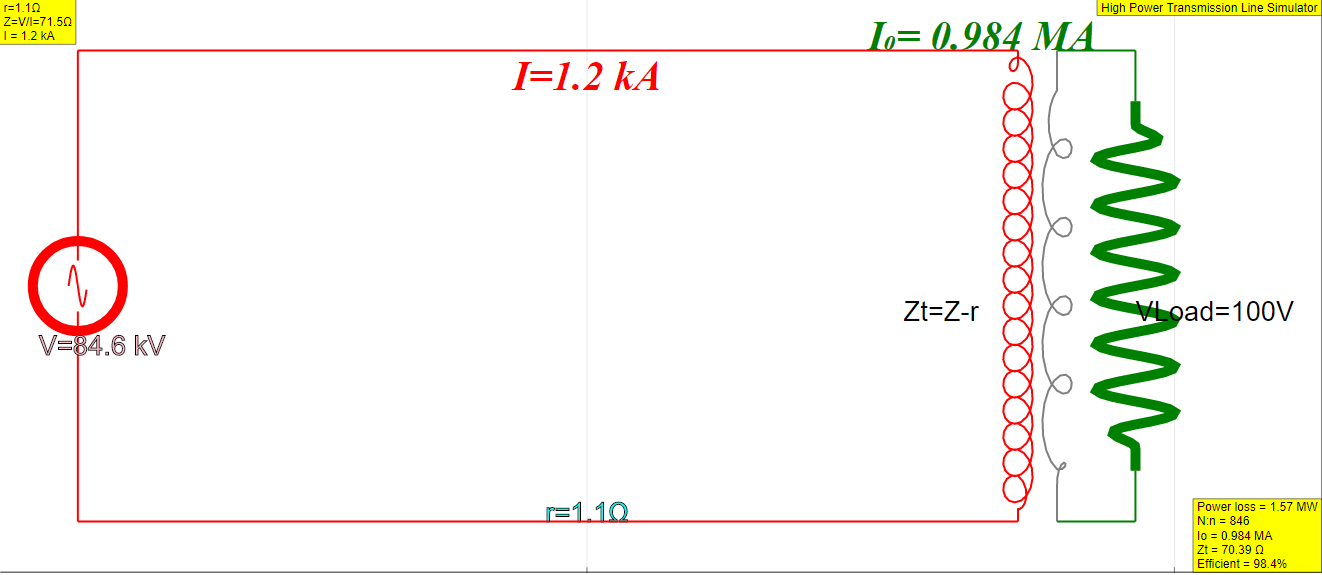
High Power Transmission Line Simulator JavaScript Simulation Applet HTML5
Instructions
Sliders

Toggle Full Screen
Research
[text]
Video
[text]
Version:
Other Resources
[text]
Frequently Asked Questions: Open Source Physics Simulations @ Singapore
What is the purpose of the "High Power Transmission Line Simulator JavaScript Simulation Applet HTML5"?
Based on the title and its categorization under "Electricity and Magnetism," this simulation is likely designed as an interactive tool to help users understand the principles and behavior of high power transmission lines, potentially exploring factors like voltage, current, resistance, power loss, and efficiency. The JavaScript and HTML5 format indicates it's designed to be accessible through web browsers without requiring additional plugins.
Who created these simulations and resources?
The credits indicate that Fu-Kwun Hwang from the Dept. of Physics, National Taiwan Normal Univ., Fremont Teng, and Loo Kang Wee are the primary creators and contributors to these Open Educational Resources.
What are "Open Educational Resources (OER)" and "Open Source Physics (OSP)" in this context?
Open Educational Resources (OER) are teaching, learning, and research materials that are freely available for everyone to use, adapt, and share. Open Source Physics (OSP) likely refers to a project or initiative focused on creating and sharing physics-related educational resources with open-source licenses, allowing for modification and distribution of the underlying code and materials.
How can teachers use the "High Power Transmission Line Simulator" in their lessons?
The "For Teachers" heading suggests that educators can utilize this simulation as an interactive tool to demonstrate the concepts related to high power transmission lines. The "Sliders" instruction implies that parameters within the simulation can be adjusted to show real-time effects, aiding in visual learning and exploration of different scenarios. Embedding the model in a webpage further facilitates its integration into online learning platforms or resources.
What other types of physics simulations are available on this platform?
The extensive list of simulations covers a wide range of physics topics, including mechanics (e.g., roller coaster, collisions, projectile motion), waves (e.g., wave in 2D, electromagnetic waves, sound waves), optics (e.g., reflection, refraction, lenses), electricity and magnetism (e.g., magnetic fields, circuits, Faraday's law), thermal physics (e.g., black-body radiation), and even some quantum physics concepts (e.g., Bohr's theory). There are also simulations related to data analysis and modeling.
Are these simulations suitable for different educational levels?
The variety of topics, ranging from basic mechanics and circuits to more advanced concepts like Coriolis effect and atomic spectra, suggests that these simulations cater to a wide range of educational levels, from primary and secondary school to potentially introductory college physics. The inclusion of resources like "Primary2" tagged materials further supports this idea.
Can these simulations be modified or used for commercial purposes?
The license information at the bottom indicates that the contents are licensed under the Creative Commons Attribution-Share Alike 4.0 Singapore License, which generally allows for sharing and adaptation with proper attribution and similar licensing. However, for commercial use of the EasyJavaScriptSimulations Library used to create some of these simulations, a separate license from the University of Murcia (um.es) is required.
Where can I find more information or explore other interactive resources on this platform?
The breadcrumbs at the top provide navigation back to the homepage and a section on "Interactive Resources." The sidebar also lists numerous other simulations and interactive tools. The "Open Educational Resources / Open Source Physics @ Singapore" title at the top and bottom suggests this is the central hub for these resources.