{source}
<?php  require_once JPATH_SITE.'/TTcustom/TT_contentparser.php';\(parameters = array("topicname" => "05electricitynmagnetism_17AC", "modelname" => "ejss_model_transformer");echo generateSimHTML(\)parameters, "EJSS");
?>
{/source}
1. Overview:
This document provides a review of the "Transformer Simulator JavaScript Simulation Applet HTML5" resource hosted on the Open Educational Resources / Open Source Physics @ Singapore website. This resource consists primarily of an interactive JavaScript simulation of a transformer, accompanied by introductory information, learning goals, instructions for use, and links to related materials. The core purpose of this resource is to provide Upper Secondary students taking Physics or Science (Physics) with an interactive tool to understand the principles of operation of iron-cored transformers, specifically voltage transformation (step-up and step-down).
{source}<iframe style="border-radius:12px" src="https://open.spotify.com/embed/episode/2RC7YLjdfbwDD0VW89XqQr?utm_source=generator" width="100%" height="352" frameBorder="0" allowfullscreen="" allow="autoplay; clipboard-write; encrypted-media; fullscreen; picture-in-picture" loading="lazy"></iframe>{/source}
2. Main Themes and Important Ideas:
- Principle of Transformer Operation: The resource centers around the fundamental concept of electromagnetic induction as the basis for transformer functionality. It explicitly states: "When an alternating current (AC) flows through the primary coil, it induces a changing magnetic field in the core, which, in turn, induces a voltage in the secondary coil through electromagnetic induction."
- Voltage Transformation (Step-Up and Step-Down): A key theme is the ability of transformers to either increase (step-up) or decrease (step-down) AC voltage. The introduction clearly defines these concepts:
- Step-Up Transformer: "In a step-up transformer, the secondary coil has more turns than the primary coil, resulting in a higher output voltage compared to the input voltage."
- Step-Down Transformer: "Conversely, in a step-down transformer, the secondary coil has fewer turns than the primary coil, leading to a lower output voltage compared to the input voltage."
- Turns Ratio and Voltage Ratio: The resource implicitly highlights the relationship between the number of turns in the primary (Np) and secondary (Ns) coils and the corresponding voltages (Vp and Vs). The "Objectives" section explicitly mentions the recall and application of the equation "Vp / Vs = Np / Ns" for an ideal transformer. This is a central concept for understanding how voltage transformation is achieved.
- Power in an Ideal Transformer: The resource also mentions the principle of conservation of power in an ideal transformer through the equation "Vp Ip = Vs Is", where Ip and Is are the primary and secondary currents, respectively. This indicates that while voltage is transformed, the power remains (ideally) the same.
- Energy Loss in Transmission and Advantages of High Voltage: One of the stated learning objectives is to "describe the energy loss in cables and deduce the advantages of high voltage transmission." While the simulation itself might not directly visualize this, the objective points to a crucial real-world application of step-up transformers in minimizing energy loss during long-distance power transmission.
- Interactive Learning through Simulation: The resource leverages a JavaScript simulation applet to provide an engaging and hands-on learning experience. The "Instructions" section details how users can interact with the simulation by adjusting sliders for different variables and using play/pause, step, and reset buttons. The goal is to allow students to "visualize this process" and "witness the step-down transformation in action" by manipulating parameters.
- Real-World Applications: The resource emphasizes the practical significance of transformers in power systems: "Step-up transformers are indispensable in power generation stations, where they elevate the voltage for efficient long-distance transmission over power lines. Step-down transformers, on the other hand, are ubiquitous in residential and commercial settings, reducing high-voltage electricity from the grid to safer levels suitable for household appliances."
- Target Audience and Prerequisites: The resource is specifically designed for "Upper Secondary students taking Physics or Science (Physics) at Express or Normal Academic level" following the 2023 syllabuses. It also clearly states the necessary "Pre-requisites": "laws of electromagnetic induction" and "how a simple alternating current generator works."
3. Key Facts and Information:
- Resource Type: Interactive JavaScript Simulation Applet (HTML5).
- Subject Area: Physics, specifically Electricity and Magnetism (AC circuits).
- Learning Goals: Describe the structure and operation of iron-cored transformers, apply the transformer equations, and understand the advantages of high-voltage transmission.
- Simulation Features: Allows users to adjust variables via sliders and control the simulation with play/pause, step, and reset buttons. Full-screen toggle is also available.
- Credits: Developed by Wee Loo Kang, Fremont Teng, and Fu-Kwun Hwang.
- Integration with SLS: The resource is linked to a specific lesson on the Singapore Student Learning Space (SLS).
- Embeddable: The simulation can be embedded into other webpages using an iframe code provided.
- Related Resources: The page includes links to various versions of the transformer simulator and related blog posts by Wee Loo Kang, offering further context and information.
4. Quotes from Original Sources:
- On the core principle: "When an alternating current (AC) flows through the primary coil, it induces a changing magnetic field in the core, which, in turn, induces a voltage in the secondary coil through electromagnetic induction."
- On step-up transformers: "In a step-up transformer, the secondary coil has more turns than the primary coil, resulting in a higher output voltage compared to the input voltage."
- On step-down transformers: "Conversely, in a step-down transformer, the secondary coil has fewer turns than the primary coil, leading to a lower output voltage compared to the input voltage."
- On the fundamental equations: "recall and apply the equations Vp / Vs = Np / Ns and Vp Ip = Vs Is to new situations or to solve related problems (for an ideal transformer)" (from the "Objectives" section).
- On the importance in power systems: "Transformers are marvels of engineering that play a crucial role in power distribution networks worldwide. These devices allow us to efficiently step up or step down voltage levels, facilitating the transmission and distribution of electrical energy over long distances with minimal losses."
5. Potential Use Cases:
- Classroom Instruction: Teachers can use the simulation as a visual aid to explain the principles of transformer operation and voltage transformation.
- Independent Learning: Students can explore the effect of changing the turns ratio and input voltage on the output voltage and current.
- Homework and Practice: Students can use the simulation to test their understanding of the transformer equations and concepts.
- Conceptual Understanding: The interactive nature of the simulation can help students develop a more intuitive understanding of how transformers work.
6. Conclusion:
The "Transformer Simulator JavaScript Simulation Applet HTML5" is a valuable open educational resource for Upper Secondary Physics students. It provides a clear introduction to transformers, outlines specific learning goals aligned with the Singaporean syllabus, and offers an interactive simulation that allows students to explore the concepts of step-up and step-down voltage transformation. By connecting theoretical concepts with a dynamic visual representation, this resource can significantly enhance student understanding of transformers and their crucial role in electrical power systems. The inclusion of learning objectives related to energy loss in transmission further emphasizes the practical relevance of this topic.
Transformer Study Guide
Key Concepts
- Electromagnetic Induction: The process by which a changing magnetic field induces a voltage in a nearby conductor. This is the fundamental principle behind transformer operation.
- Alternating Current (AC): An electric current that periodically reverses direction, making it suitable for transformer operation due to the constantly changing magnetic field it produces.
- Primary Coil: The coil in a transformer connected to the input AC voltage source. The changing current in this coil creates the varying magnetic field.
- Secondary Coil: The coil in a transformer where a voltage is induced by the changing magnetic field from the primary coil. This coil provides the output voltage.
- Iron Core: A ferromagnetic material, usually laminated iron, that forms the core of most practical transformers. It concentrates and strengthens the magnetic field, improving the efficiency of induction.
- Step-Up Transformer: A transformer where the secondary coil has more turns than the primary coil (Ns > Np). This results in a higher output voltage (Vs > Vp) and a lower output current (Is < Ip) compared to the input.
- Step-Down Transformer: A transformer where the secondary coil has fewer turns than the primary coil (Ns < Np). This results in a lower output voltage (Vs < Vp) and a higher output current (Is > Ip) compared to the input.
- Turns Ratio (Np/Ns): The ratio of the number of turns in the primary coil (Np) to the number of turns in the secondary coil (Ns). This ratio directly determines the voltage transformation ratio in an ideal transformer.
- Voltage Transformation Ratio (Vp/Vs): In an ideal transformer, this ratio is equal to the turns ratio (Vp/Vs = Np/Ns).
- Ideal Transformer: A theoretical transformer with 100% efficiency and no energy losses. In an ideal transformer, the input power equals the output power (Vp Ip = Vs Is).
- Energy Loss in Cables: Electrical energy is lost as heat when current flows through the resistance of transmission cables. This loss is proportional to the square of the current (I²R).
- High Voltage Transmission: Transmitting electrical power at high voltage and low current reduces energy loss in transmission cables, making long-distance power distribution more efficient.
Quiz
- Explain the role of electromagnetic induction in the operation of a transformer. How does the alternating current in the primary coil lead to a voltage in the secondary coil?
- Describe the physical structure of a simple iron-cored transformer. What are the key components and what is the function of each?
- What is the difference between a step-up transformer and a step-down transformer in terms of their coil windings and their effect on voltage?
- State the relationship between the voltages in the primary and secondary coils and the number of turns in each coil for an ideal transformer. Write down the relevant equation and explain what each term represents.
- For an ideal transformer, how is the power in the primary circuit related to the power in the secondary circuit? Write down the relevant equation and explain its significance.
- If a transformer has 100 turns in the primary coil and 200 turns in the secondary coil, and an input voltage of 120V AC is applied to the primary, what is the output voltage across the secondary coil (assuming an ideal transformer)?
- Explain why transmitting electrical power at high voltage is advantageous for long-distance transmission. What does it help to minimize?
- In a step-down transformer, if the output voltage is lower than the input voltage, how does the output current compare to the input current in an ideal transformer? Explain your reasoning.
- Briefly describe one real-world application of a step-up transformer and one real-world application of a step-down transformer.
- What are some of the learning objectives intended for students using the Transformer Simulator JavaScript Simulation Applet HTML5, as outlined in the source material?
Quiz Answer Key
- Electromagnetic induction is the core principle of transformer operation. The alternating current in the primary coil produces a changing magnetic field around it. This changing magnetic field passes through the iron core and induces a changing magnetic flux in the secondary coil, which in turn induces an alternating voltage across the secondary coil according to Faraday's law of induction.
- A simple iron-cored transformer consists of two coils of wire, the primary coil and the secondary coil, wound around a core made of a ferromagnetic material like iron. The iron core serves to concentrate and enhance the magnetic field produced by the primary coil, ensuring efficient transfer of magnetic flux to the secondary coil.
- In a step-up transformer, the secondary coil has more turns of wire than the primary coil (Ns > Np), resulting in a higher output voltage (Vs > Vp) and lower output current (Is < Ip). Conversely, in a step-down transformer, the secondary coil has fewer turns than the primary coil (Ns < Np), leading to a lower output voltage (Vs < Vp) and higher output current (Is > Ip).
- For an ideal transformer, the ratio of the primary voltage (Vp) to the secondary voltage (Vs) is equal to the ratio of the number of turns in the primary coil (Np) to the number of turns in the secondary coil (Ns). The equation is Vp / Vs = Np / Ns. This equation shows the direct proportionality between the voltage and the number of turns in each coil.
- In an ideal transformer, there are no energy losses, so the power in the primary circuit is equal to the power in the secondary circuit. The relevant equation is Vp Ip = Vs Is, where Ip is the primary current and Is is the secondary current. This indicates that while voltage can be stepped up or down, the power remains constant (ideally).
- Using the formula Vp / Vs = Np / Ns, we have 120V / Vs = 100 / 200. Solving for Vs, we get Vs = (120V * 200) / 100 = 240V. Therefore, the output voltage across the secondary coil would be 240V.
- Transmitting electrical power at high voltage is advantageous because for a given amount of power (P = VI), a higher voltage (V) means a lower current (I). Since energy loss in cables is proportional to the square of the current (I²R), reducing the current significantly minimizes the amount of power lost as heat during long-distance transmission.
- In an ideal step-down transformer, if the output voltage is lower than the input voltage, the output current will be higher than the input current. This is because the power in an ideal transformer remains constant (Vp Ip = Vs Is). If Vs is smaller than Vp, then Is must be larger than Ip to maintain the equality.
- A real-world application of a step-up transformer is in power generation stations, where the voltage produced by generators is increased for efficient long-distance transmission. A real-world application of a step-down transformer is in household electronics, where the high-voltage electricity from the grid is reduced to lower, safer voltages suitable for operating appliances.
- According to the source material, the learning objectives include being able to describe the structure and principle of operation of a simple iron-cored transformer, recall and apply the equations Vp / Vs = Np / Ns and Vp Ip = Vs Is to new situations or problems, and describe the energy loss in cables and deduce the advantages of high voltage transmission.
Essay Format Questions
- Discuss the principle of electromagnetic induction and explain in detail how it is applied in the functioning of a transformer. Elaborate on the roles of the primary coil, secondary coil, and iron core in this process.
- Compare and contrast step-up and step-down transformers. Explain how their construction (specifically the turns ratio) leads to their different effects on voltage and current, and provide examples of their typical applications in electrical systems.
- Explain the concept of an ideal transformer and the relationships between voltage, current, and the number of turns in its primary and secondary coils. Discuss the equation for power in an ideal transformer and its implications for voltage and current transformation.
- Describe the phenomenon of energy loss in electrical transmission cables. Explain why transmitting power at high voltage significantly reduces these losses and discuss the crucial role of step-up and step-down transformers in enabling efficient long-distance power distribution.
- Based on the provided resources, discuss the educational value of using simulations, such as the Transformer Simulator JavaScript Simulation Applet HTML5, for learning about the principles and applications of transformers. What specific learning goals can these simulations help students achieve?
Glossary of Key Terms
- Alternating Current (AC): Electrical current that changes direction periodically.
- Electromagnetic Induction: The generation of an electromotive force (voltage) in a conductor by a changing magnetic field.
- Faraday's Law of Induction: States that the magnitude of the induced electromotive force (EMF) in any closed circuit is equal to the time rate of change of the magnetic flux through the circuit.
- Ferromagnetic Material: A material, such as iron, that can be strongly magnetized by an external magnetic field.
- Ideal Transformer: A theoretical transformer with no energy losses and perfect magnetic coupling between the primary and secondary coils.
- Primary Coil: The input coil of a transformer connected to the voltage source.
- Secondary Coil: The output coil of a transformer where voltage is induced.
- Step-Down Transformer: A transformer that decreases the voltage from the primary to the secondary coil.
- Step-Up Transformer: A transformer that increases the voltage from the primary to the secondary coil.
- Transformer: An electrical device that transfers electrical energy between two or more circuits through electromagnetic induction.
- Turns Ratio: The ratio of the number of turns in the primary coil to the number of turns in the secondary coil (Np/Ns).
- Voltage Transformation: The process by which a transformer changes the voltage from one level to another.
SLS https://vle.learning.moe.edu.sg/moe-library/lesson/view/approved/773c08b4-cc46-4c9b-9e29-8f32de0d8f23/page/50662782 Transformers [Sec Phy][2023]
Sample Learning Goals
- laws of electromagnetic induction
- how a simple alternating current generator works
- describe the structure and principle of operation of a simple iron-cored transformer as used for voltage transformations
- recall and apply the equations Vp / Vs = Np / Ns and Vp Ip = Vs Is to new situations or to solve related problems (for an ideal transformer)
- describe the energy loss in cables and deduce the advantages of high voltage transmission.
For Teachers
Transformer Simulator JavaScript Simulation Applet HTML5
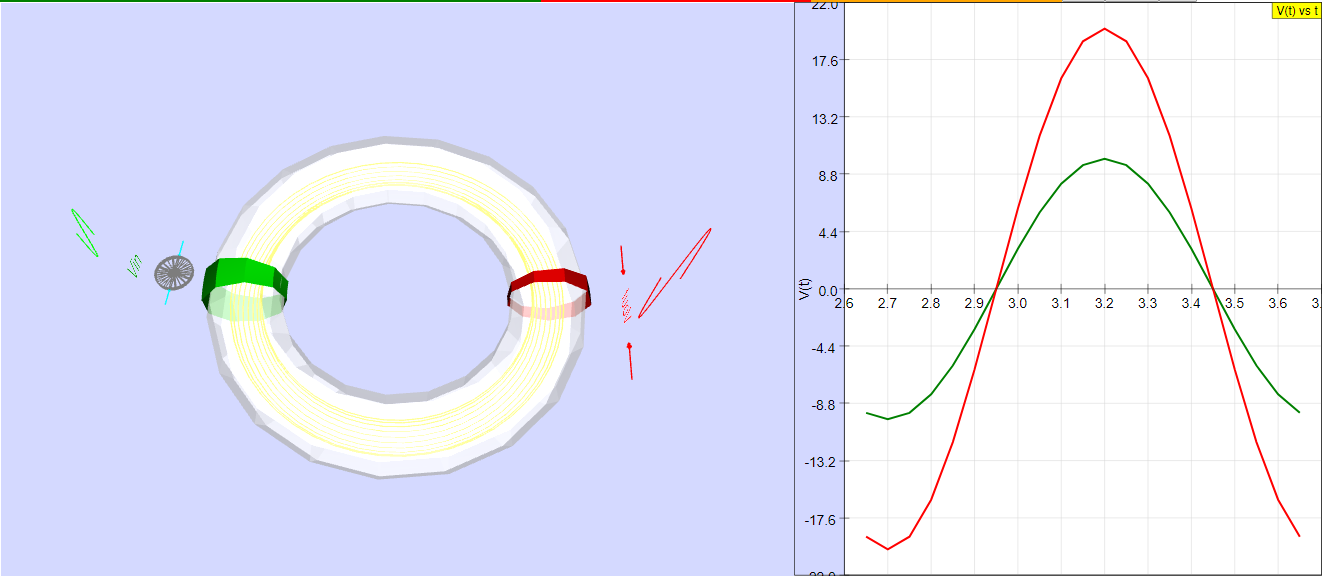
Instructions
Sliders

Toggling Full Screen
Play/Pause, Step and Reset Buttons

Title: Unveiling the Magic of Transformers: Exploring Step-Up and Step-Down Simulations
 |
| https://sg.iwant2study.org/ospsgx/index.php/693-transformer link |

Introduction:
Transformers are marvels of engineering that play a crucial role in power distribution networks worldwide. These devices allow us to efficiently step up or step down voltage levels, facilitating the transmission and distribution of electrical energy over long distances with minimal losses. In this blog, we'll embark on a journey to unravel the inner workings of transformers through step-up and step-down simulations.
Understanding Transformers:
Before delving into simulations, let's grasp the fundamentals of transformers. At their core, transformers consist of two coils of wire, known as the primary and secondary coils, wound around a core made of ferromagnetic material. When an alternating current (AC) flows through the primary coil, it induces a changing magnetic field in the core, which, in turn, induces a voltage in the secondary coil through electromagnetic induction.
Step-Up Transformer Simulation:
In a step-up transformer, the secondary coil has more turns than the primary coil, resulting in a higher output voltage compared to the input voltage. To visualize this process, we'll explore a simulation where you can adjust parameters such as the number of turns in the primary and secondary coils, input voltage, and frequency. By increasing the turns ratio, you'll observe how the output voltage increases proportionally, demonstrating the principle of step-up transformation.
Step-Down Transformer Simulation:
Conversely, in a step-down transformer, the secondary coil has fewer turns than the primary coil, leading to a lower output voltage compared to the input voltage. Through another simulation, you'll have the opportunity to manipulate parameters and witness the step-down transformation in action. By decreasing the turns ratio, you'll observe a decrease in the output voltage relative to the input voltage, highlighting the versatility of transformers in adapting voltage levels to meet specific requirements.
Real-World Applications:
The applications of step-up and step-down transformers are widespread across various industries and sectors. Step-up transformers are indispensable in power generation stations, where they elevate the voltage for efficient long-distance transmission over power lines. Step-down transformers, on the other hand, are ubiquitous in residential and commercial settings, reducing high-voltage electricity from the grid to safer levels suitable for household appliances.
Conclusion:
Transformers are indispensable components of modern electrical systems, enabling the efficient transmission and utilization of electrical energy. Through step-up and step-down simulations, we've gained valuable insights into the transformative power of these devices, illustrating their versatility and importance in our daily lives. As we continue to innovate and advance in the field of electrical engineering, transformers will undoubtedly remain at the forefront, empowering the world with reliable and sustainable energy solutions.
Research
[text]
Video
[text]
Version:
- http://www.phy.ntnu.edu.tw/ntnujava/index.php?topic=631.0
- http://weelookang.blogspot.com/2018/04/transformer-simulator-javascript.html
- https://weelookang.blogspot.com/2019/07/transformer-simulator-javascript.html
- https://weelookang.blogspot.com/2024/03/unveiling-magic-of-transformers.html
SLS lesson
Frequently Asked Questions: Transformer Simulations
1. What is a transformer and what is its primary function?
A transformer is an electromagnetic device consisting of two or more coils of wire wound around a common ferromagnetic core. Its primary function is to efficiently transfer electrical energy between circuits through electromagnetic induction, typically to step up (increase) or step down (decrease) AC voltage levels. This capability is crucial for the efficient transmission and distribution of electrical power.
2. How does a transformer work based on electromagnetic induction?
When an alternating current (AC) flows through the primary coil of a transformer, it creates a changing magnetic field in the core. This changing magnetic field then induces a voltage in the secondary coil (and any other coils present) according to Faraday's law of electromagnetic induction. The magnitude of the induced voltage in the secondary coil depends on the rate of change of the magnetic flux and the number of turns in the secondary coil.
3. What is the difference between a step-up and a step-down transformer?
A step-up transformer has more turns in its secondary coil than in its primary coil. This results in a higher output voltage in the secondary coil compared to the input voltage in the primary coil. Conversely, a step-down transformer has fewer turns in its secondary coil than in its primary coil, leading to a lower output voltage in the secondary coil.
4. What is the turns ratio and how does it relate to voltage transformation in an ideal transformer?
The turns ratio of a transformer is the ratio of the number of turns in the primary coil (Np) to the number of turns in the secondary coil (Ns), i.e., Np / Ns. For an ideal transformer (neglecting losses), the ratio of the primary voltage (Vp) to the secondary voltage (Vs) is directly proportional to the turns ratio: Vp / Vs = Np / Ns. This equation highlights how the number of turns determines whether the transformer steps up or steps down the voltage.
5. What is the relationship between voltage and current in an ideal transformer?
In an ideal transformer, power input equals power output. Power is the product of voltage and current (P = VI). Therefore, for an ideal transformer, the power in the primary coil (Vp Ip) is equal to the power in the secondary coil (Vs Is), leading to the equation Vp Ip = Vs Is. This relationship shows that when voltage is stepped up, the current is stepped down proportionally, and vice versa, maintaining power conservation.
6. What are some real-world applications of step-up and step-down transformers?
Step-up transformers are essential in power generation plants to increase the voltage of the generated electricity for efficient long-distance transmission, minimizing energy loss in the cables. Step-down transformers are widely used to reduce the high voltage from the transmission lines to safer levels suitable for distribution to homes and businesses, as well as within electronic devices to provide the required operating voltages.
7. Why is high voltage transmission more advantageous for long distances?
High voltage transmission reduces energy loss in the power cables. For a given amount of power being transmitted, increasing the voltage decreases the current (since P = VI). Because power loss in a cable is proportional to the square of the current (P_loss = I^2 * R, where R is the resistance of the cable), transmitting at a higher voltage and lower current significantly minimizes these losses, making long-distance power delivery more efficient.
8. What can be learned from using a transformer simulation applet?
Using a transformer simulation applet allows users to visually and interactively explore the principles of transformer operation. By adjusting parameters such as the number of turns in the primary and secondary coils, input voltage, and frequency, users can observe in real-time how these changes affect the output voltage and current. This hands-on approach helps in understanding the concepts of step-up and step-down transformation, the relationship between turns ratio and voltage, and the fundamental principles of electromagnetic induction in transformers.