{source}
<?php  require_once JPATH_SITE.'/TTcustom/TT_contentparser.php';\(parameters = array("topicname" => "05electricitynmagnetism_21electromagnetism", "modelname" => "ejss_model_EMStrengthpaperclips_numberofocoilandbattery");echo generateSimHTML(\)parameters, "EJSS");
?>
{/source}
Executive Summary:
These sources describe and provide access to a JavaScript HTML5 simulation designed to help students understand the factors affecting the strength of an electromagnet. The primary variables explored in the simulation are the number of coils around the electromagnet and the number of batteries used to power it. The simulation allows users to manipulate these variables and observe the resulting change in the electromagnet's strength, measured by the number of paper clips it can attract. The materials emphasize the importance of controlled experiments and provide guidance for both students and teachers on using the simulation for educational purposes.
Main Themes and Important Ideas/Facts:
- Purpose of the Simulation: The core purpose of the simulation is to allow students to investigate the relationship between the strength of an electromagnet and two key variables: the number of coils and the number of batteries. The title of the second source explicitly states this: "Strength of an Electromagnet Number of Coils and Batteries Only on paper clips JavaScript HTML5 Applet Simulation Model".
- Interactive Learning Tool: The simulation is designed as an interactive tool for student learning, falling under the umbrella of Open Educational Resources / Open Source Physics @ Singapore. It is built using Easy JavaScript Simulations (EJS). The first source mentions it was "Compiled with EJS 6.02_BETA (201222)".
- User Interface and Controls: The second source provides detailed instructions on how to operate the simulation:
- Reset: The "Reset Setup" button restarts the simulation and allows enabling the data logger.
- Number of Coils: A "slider found beside the words 'no. of coils = 3'" allows adjustment between 3 to 9 coils.
- Number of Batteries: A "slider found beside the words 'no. of batteries = 2'" allows adjustment between 1 to 5 batteries.
- Start/Stop: The "Play" button or clicking the "switch" in the circuit diagram closes the circuit and activates the electromagnet.
- Measuring Strength: Users "drag the electromagnet downwards into the tray of paper clips and drag it back up" to determine the number of paper clips attracted, which is recorded in a data table if 'Enable Data Logger' is ticked.
- Restarting with New Variables: "Reset Setup" opens the circuit for variable changes, followed by the "play" button to restart.
- Clearing Data: "Reset Table" clears the results table for new data collection.
- Learning Goals and Pedagogical Approach: The materials highlight several educational objectives:
- Understanding Variables: A key "Learning Issue to be Addressed" is that "Students have difficulty in appreciating the importance of variables in a fair experiment." The simulation encourages students to manipulate one variable at a time while keeping others constant.
- Scientific Inquiry: The lesson design emphasizes "Ways of thinking and doing in Science": "Students get to plan their experimental steps for the investigation, conduct the experiment, analyse and interpret data, construct explanations with evidence."
- Metacognition: Students are encouraged to "reflect on the challenges they face while conducting the experiment as part of developing" metacognitive skills.
- Student-Student Interaction: The lesson plan suggests opportunities for "Student-student interaction" where they share results and discuss potential differences or similarities in their data.
- Flexibility: "Options can be given for students to investigate both factors or just one of the factors."
- Prerequisite Knowledge: Students are expected to have prior knowledge of:
- "the parts of an electromagnet"
- "how to make an electromagnet"
- "how to identify various variables in an experiment"
- Recommended Lesson Duration: The suggested time for this learning activity is "2 to 3 one-hour lessons excluding offline learning". This timeframe acknowledges that students may need time to grasp the concept of variables.
- Integration with Learning Management Systems: The mention of "LA7" and "LA8" suggests integration with a learning activity sequence, likely within a platform like the Singapore Student Learning Space (SLS). Access to this simulation (LA7) is recommended after completion of prior activities. LA8 provides a video recap on setting up an electromagnet.
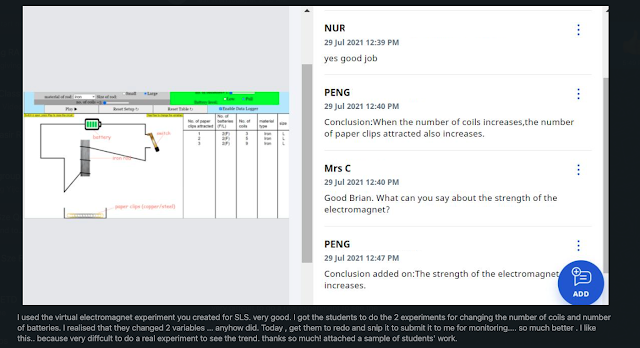
- Teacher Feedback: Feedback from a teacher ("From Teacher: 20210801") indicates positive experiences using the simulation with students on the SLS: "[The simulation is]very good. I got the students to do the 2 experiments for changing the number of coils and number of batteries. I realized that they changed 2 variables [and] anyhow did [it]. Today get them to redo and snip it to submit it to me for monitoring.... so much better. I like this [this is] because [it is usually] very difficult to do a real experiment to see the trend. Thanks so much!" This highlights the simulation's value in visualizing trends that are hard to observe in physical experiments.
- Accessibility and Embeddability: The simulation can be embedded into webpages using an <iframe> tag, making it easily accessible.
- Credits and Licensing: The authors and contributors include This email address is being protected from spambots. You need JavaScript enabled to view it., Francisco Esquembre, Felix J. Garcia Clemente, Siti, and Coco. The resources are licensed under a "Creative Commons Attribution-Share Alike 4.0 Singapore License". Commercial use of the underlying EasyJavaScriptSimulations Library requires a separate license.
- Supporting Resources: The second source provides direct links for teachers to specific actions within the simulation (e.g., enabling the data logger, changing coils) and mentions related video resources on YouTube that demonstrate the simulation.
Quotes from Original Sources:
- On the simulation's focus: "Strength of an Electromagnet Number of Coils and Batteries Only on paper clips JavaScript HTML5 Applet Simulation Model"
- On the range of variables: "The number of coils in this simulation ranges from 3 to 9." and "The number of batteries in this simulation ranges from 1 to 5."
- On how to measure strength: "drag the electromagnet downwards into the tray of paper clips and drag it back up."
- On a key learning goal: "Students have difficulty in appreciating the importance of variables in a fair experiment."
- Teacher feedback: "[The simulation is]very good... I like this [this is] because [it is usually] very difficult to do a real experiment to see the trend."
Conclusion:
The provided materials detail a valuable educational simulation designed to teach students about the factors influencing the strength of an electromagnet. By allowing interactive manipulation of the number of coils and batteries and providing clear instructions and pedagogical guidance, the simulation offers a practical and engaging way for students to explore scientific concepts, develop experimental skills, and understand the importance of controlled variables. Teacher feedback reinforces its effectiveness in visualizing abstract concepts and facilitating better experimental practices.
Strength of an Electromagnet Study Guide
Key Concepts
- Electromagnet: A type of magnet in which the magnetic field is produced by an electric current.
- Magnetic Field: The region around a magnet where a magnetic force is exerted.
- Coils (Turns): The loops of wire in an electromagnet. Increasing the number of coils generally increases the strength of the magnetic field.
- Electric Current: The flow of electric charge. In an electromagnet, the current is supplied by a power source like batteries.
- Batteries (Voltage Source): Provide the electrical energy to drive the current through the coils. Increasing the number of batteries (in series) increases the voltage and thus the current, generally strengthening the magnetic field.
- Strength of an Electromagnet: The ability of an electromagnet to exert a magnetic force, often demonstrated by how many magnetic objects (like paper clips) it can attract.
- Variables: Factors that can change in an experiment. In this context, the number of coils and the number of batteries are the independent variables.
- Fair Experiment: An experiment where only one variable is changed at a time to observe its effect on the outcome (dependent variable), while other variables are kept constant.
- Data Logger: A tool (in this case, a feature of the simulation) that records the results of an experiment, such as the number of paper clips attracted.
- Simulation: A computer program that models a real-world phenomenon, allowing users to manipulate variables and observe the outcomes.
Review Questions
- What is the fundamental principle behind how an electromagnet works?
- Explain the relationship between the electric current flowing through the coils of an electromagnet and its magnetic field.
- According to the simulation instructions, what is the range for the number of coils that can be set?
- What is the range for the number of batteries that can be selected in the simulation?
- Describe the steps to start the electromagnet working in the simulation.
- How can a user determine the strength of the electromagnet (in terms of paper clips) using the simulation?
- What is the importance of clicking the "Reset Setup" button when wanting to change the number of coils or batteries?
- Why is it important to only change one variable at a time when investigating the strength of an electromagnet?
- What are the learning goals mentioned in the source material regarding students' understanding of variables?
- How does the simulation provide opportunities for students to develop "ways of thinking and doing in Science"?
Answer Key
- An electromagnet works because an electric current flowing through a wire creates a magnetic field around the wire. When the wire is coiled, these magnetic fields combine to create a stronger magnetic field, similar to that of a permanent magnet.
- The strength of the magnetic field produced by an electromagnet is directly proportional to the electric current flowing through its coils. Increasing the current leads to a stronger magnetic field.
- The simulation allows the user to set the number of coils around the electromagnet in a range from 3 to 9.
- In the simulation, the number of batteries can be adjusted using a slider, ranging from 1 to 5 batteries.
- To start the electromagnet working in the simulation, the user needs to click the "Play" button or click on the "switch" in the circuit diagram to close the circuit and allow current to flow.
- To find out how many paper clips the electromagnet can attract, the user must drag the electromagnet downwards into the tray of paper clips and then drag it back up. The number of attracted paper clips will be recorded in the data table.
- Clicking "Reset Setup" opens the circuit, stopping the flow of current. This is necessary before changing the number of coils or batteries to ensure that the previous settings do not influence the new investigation.
- Changing only one variable at a time in an experiment allows for the observation of the specific effect of that variable on the outcome. This ensures a fair test and helps to establish a clear cause-and-effect relationship.
- The learning goal addressed is that students often have difficulty appreciating the importance of variables in a fair experiment. The lesson aims to help them understand why controlling variables is crucial.
- The simulation allows students to plan experimental steps, conduct the experiment by manipulating variables, analyze the data recorded, and construct explanations based on their observations, thus mirroring the practices of scientific inquiry.
Essay Format Questions
- Discuss how the number of coils in an electromagnet affects its strength, based on the information provided in the simulation and general scientific principles. Explain why this relationship exists.
- Explain the role of batteries in an electromagnet and how increasing the number of batteries influences the strength of the magnetic field produced. What are the underlying electrical concepts at play?
- Describe how the provided simulation can be used as a tool to teach students about the concept of variables in a scientific experiment. Highlight the features of the simulation that support this learning goal.
- Based on the teacher's feedback provided, discuss the challenges students might face when conducting experiments with electromagnets and how virtual simulations can help overcome these difficulties.
- Compare and contrast the process of investigating the strength of an electromagnet using a real-world setup versus using the provided computer simulation. What are the advantages and disadvantages of each approach for student learning?
Glossary of Key Terms
- Ampere (A): The SI unit of electric current, measuring the rate of flow of electric charge.
- Circuit (Electrical): A closed loop that allows electric current to flow from a voltage source through electrical components.
- Direct Current (DC): An electric current that flows in only one direction, typically provided by batteries.
- Electromagnetic Induction: The process of generating an electric current in a conductor by changing the magnetic field around it (related but not the primary focus of these sources).
- Force (Magnetic): The attraction or repulsion exerted by a magnetic field on magnetic materials or moving electric charges.
- Iron Core: A piece of iron placed inside the coils of an electromagnet to concentrate and strengthen the magnetic field. (Implied in the context of an electromagnet attracting paper clips, though not explicitly detailed in the instructions).
- Metacognition: Awareness and understanding of one's own thought processes, allowing for reflection on learning.
- Ohm's Law: A fundamental law in electrical circuits stating that the current through a conductor between two points is directly proportional to the voltage across the two points and inversely proportional to the resistance. (Relevant in understanding how batteries affect current).
- Open Educational Resources (OER): Teaching, learning, and research materials that are freely available for everyone to use, adapt, and share.
- Voltage (V): The electric potential difference between two points, representing the electrical pressure that drives the current.
| What you want to do | How to do it |
| start/ restart the simulation | Click on the "Reset Setup" button. Tick 'Enable Data Logger' |
| set the number of coils around the electromagnet | Click the slider found beside the words "no. of coils = 3" in the dark grey cell on the top left corner of the simulation. The number of coils in this simulation ranges from 3 to 9. |
| set the number of batteries | Click the slider found beside the words "no. of batteries = 2" in the bright green cell on the top right corner of the simulation. The number of batteries in this simulation ranges from 1 to 5. |
| start the electromagnet working |
click the "Play" button or click on the "switch" in the circuit diagram to close the circuit. |
| to find out how many paper clips the electromagnet can attract | drag the electromagnet downwards into the tray of paper clips and drag it back up. The number of paper clips attracted will be automatically recorded in the data/ results table. Ensure the 'Enable Data Logger' is ticked. |
| restart the electromagnet to change the variables |
Click "Reset Setup" to open the circuit. After you change the variables, click the "play" button again.
|
| clear the data/results table and restart the collection of a new set of data.
|
Click "Reset Table" |
Sample Learning Goals
| Pre-requisite Knowledge: |
Students should already know:
|
| Recommended Lesson Duration: |
2 to 3 one-hour lessons excluding offline learning
(students may be still grasping the concept of variables so time is factored for teachers to address the gaps before students proceed.)
|
| Learning Issue to be Addressed: | Students have difficulty in appreciating the importance of variables in a fair experiment. |
For Teachers
 |
| Initial Setup https://sg.iwant2study.org/ospsgx/index.php/973 Direct link |
 |
| Enable data logger https://sg.iwant2study.org/ospsgx/index.php/973 Direct link |
 |
| Change the number of coils and close the switch https://sg.iwant2study.org/ospsgx/index.php/973 Direct link |
 |
| Drag the rod to attract steel paper clips and obtain data https://sg.iwant2study.org/ospsgx/index.php/973 Direct link |
 |
| Plastic rod https://sg.iwant2study.org/ospsgx/index.php/973 Direct link |
 |
| Increase the number of batteries https://sg.iwant2study.org/ospsgx/index.php/973 Direct link |
 |
| Low battery level https://sg.iwant2study.org/ospsgx/index.php/973 Direct link |
 |
| Small iron rod https://sg.iwant2study.org/ospsgx/index.php/973 Direct link |
Research
From CK 20250923

From Teacher: 20210801
I used the virtual electromagnet experiment you created for SLS. [The simulation is]very good. I got the students to do the 2 experiments for changing the number of coils and number of batteries. I realized that they changed 2 variables [and] anyhow did [it]. Today get them to redo and snip it to submit it to me for monitoring.... so much better. I like this [this is] because [it is usually] very difficult to do a real experiment to see the trend. Thanks so much! Attached a sample of students' work.
 https://sg.iwant2study.org/ospsgx/index.php/973-emstrengthpaperclips
direct link
Video
{source}<iframe width="560" height="315" src="https://www.youtube.com/embed/HWopyO-nPYY" frameborder="0" allow="accelerometer; autoplay; encrypted-media; gyroscope; picture-in-picture" allowfullscreen></iframe>{/source}
Version:
- https://weelookang.blogspot.com/2020/07/strength-of-electromagnet-on-paper-clips.html
- https://weelookang.blogspot.com/2021/08/thank-you-from-school-teacher-after.html
- https://weelookang.blogspot.com/2021/11/strength-of-electromagnet-number-of.html
Other Resources
[text]
Frequently Asked Questions: Understanding Electromagnet Strength
1. What are the primary factors that influence the strength of an electromagnet, according to the provided sources? The sources explicitly identify two key variables affecting the strength of an electromagnet: the number of coils wrapped around the core and the number of batteries (which affects the current flowing through the wire). The simulation allows users to manipulate these two factors to observe their impact on the electromagnet's ability to attract paper clips.
2. How does changing the number of coils affect the strength of an electromagnet, based on the simulation? The simulation allows users to adjust the number of coils ranging from 3 to 9. The described activity encourages students to observe how increasing or decreasing the number of coils, while keeping other factors constant, affects the number of paper clips the electromagnet can attract. Generally, a higher number of coils results in a stronger magnetic field and thus a stronger electromagnet capable of attracting more paper clips.
3. How does changing the number of batteries affect the strength of an electromagnet in the simulation? The simulation enables users to vary the number of batteries between 1 and 5. Increasing the number of batteries increases the voltage and consequently the current flowing through the wire wrapped around the core. A higher current produces a stronger magnetic field, leading to a stronger electromagnet that can pick up more paper clips.
4. How can users interact with the provided simulation to investigate electromagnet strength? The simulation features sliders to adjust the number of coils and the number of batteries. To operate the simulation, users need to click the "Reset Setup" button to start or restart. They can then use the sliders to set the desired number of coils and batteries. Clicking the "Play" button or the switch in the circuit diagram activates the electromagnet. To measure the strength, users drag the electromagnet down into a tray of paper clips and then back up; the number of attracted paper clips is automatically recorded.
5. What are the learning goals associated with using this electromagnet simulation? The primary learning goal is to help students understand the relationship between variables (number of coils and number of batteries) and the strength of an electromagnet. It also aims to teach students about the importance of controlling variables in a fair experiment. Furthermore, it provides opportunities for students to plan experimental steps, conduct investigations, analyze data, and construct explanations based on evidence, fostering scientific thinking and metacognition.
6. What prerequisite knowledge should students have before using this simulation effectively? Students should already be familiar with the basic parts of an electromagnet, how to construct a simple electromagnet, and how to identify different variables in an experiment. This foundational understanding will allow them to better grasp the concepts explored in the simulation.
7. How does the lesson design encourage student interaction and the development of scientific inquiry skills? While students conduct their investigations individually using the simulation, the lesson plan recommends opportunities for student-student interaction where they share their experimental results and discuss potential reasons for any differences in their data despite using the same variables. This encourages collaboration and critical thinking. The activity also promotes scientific inquiry by having students plan their experiments, manipulate variables, collect data, and draw conclusions.
8. Why is a simulation like this considered a valuable tool for learning about electromagnetism? The teacher feedback highlights that it can be difficult to conduct real experiments to clearly observe the trends in electromagnet strength with varying numbers of coils and batteries. The simulation provides a virtual environment where students can easily and repeatedly change these variables and directly observe the effect on the electromagnet's strength (measured by the number of paper clips attracted). This allows for a more controlled and efficient way to understand the underlying principles and reinforces the importance of variables in scientific investigations.