{source}
<?php  require_once JPATH_SITE.'/TTcustom/TT_contentparser.php';\(parameters = array("topicname" => "06QuantumPhysics_20nuclear", "modelname" => "ejss_model_nuclear_binary_system_EJS");echo generateSimHTML(\)parameters, "EJSS");
?>
{/source}
1. Overview:
This document provides a review of the documentation for the "Nuclear Binary System Simulator JavaScript Simulation Applet HTML5" available on the Open Educational Resources / Open Source Physics @ Singapore website. The resource is an interactive simulation designed to model the motion of a binary system, specifically in the context of nuclear physics, utilizing a JavaScript applet embedded within an HTML5 framework. The simulation is based on a model developed in MATLAB and Octave by Javier E. Hasbun and Benjamin E. Hogan in 2012.
2. Main Themes and Important Ideas:
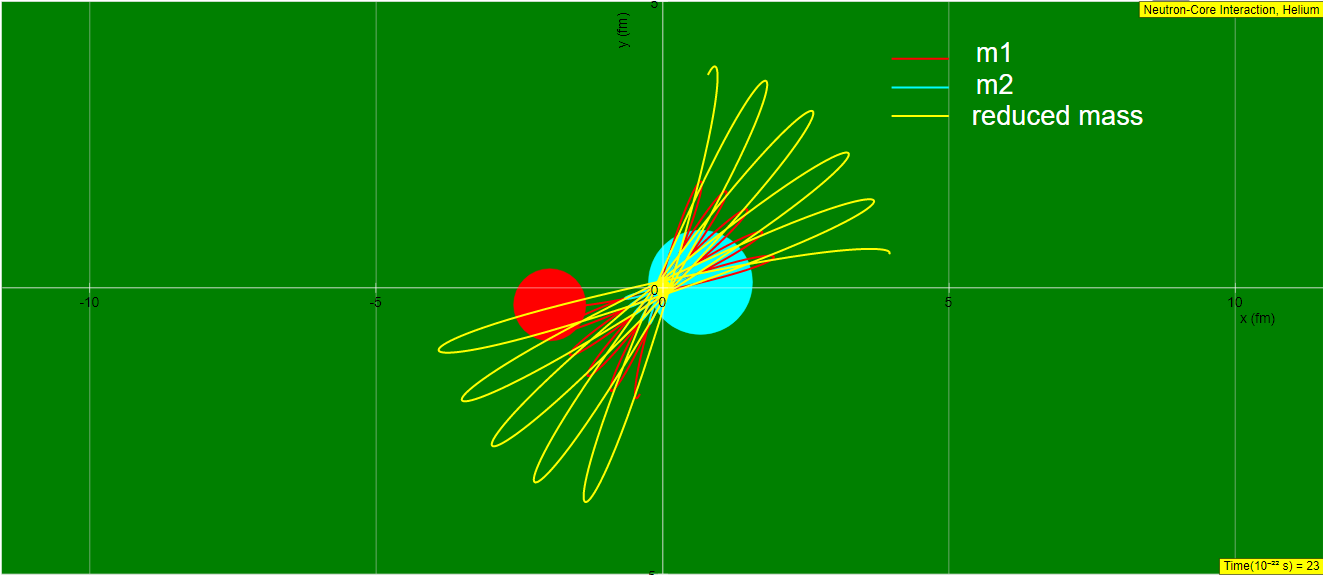
- Modeling a Nuclear Binary System: The core purpose of the resource is to simulate the dynamics of two interacting nuclear particles (m1 and m2) forming a binary system. The documentation explicitly states, "For a binary system, such as the one shown below, we can use the following equations to determine the motion of m1 and m2." This highlights the focus on understanding the motion governed by the forces between these particles.
- Equations of Motion: The documentation details the fundamental equations used to describe the motion. It starts with general expressions for the position vectors of the two masses relative to their center of mass (r1, r2, rcm) and then introduces the concept of reduced mass (μ) and the force (f) acting between them. The key equation of motion is given as:
- "μ r'' = f r/ r" This second-order differential equation forms the basis of the simulation.
- Woods-Saxon Potential: To define the force between the nuclear particles, the simulation employs the Woods-Saxon potential, a standard model for the average potential experienced by a nucleon in an atomic nucleus. The formula for this potential is provided:
- "V(r) = -V0*ff(r,R,a)" where "ff(r,R,a) = [1+exp(r-R/a)]-1" is the Fermi-function form factor, and the parameters (V0, a, R, R0) are defined with typical nuclear values.
- Derivation of the Force: The documentation explicitly shows how the force is derived from the potential by taking the negative gradient (in one dimension, the negative derivative):
- "f(r) = -V0exp(r-R/a)/{a[1+exp(r-R/a)]}." This derived force is then incorporated into the x and y components of the equations of motion.
- Scaled Equations for Simulation: To ensure unit compatibility and facilitate numerical simulation, the equations of motion are scaled using dimensionless variables (X, Y, T, etc.) and characteristic scales (a0, tau, Eb, m0). The final scaled equations of motion in Cartesian coordinates (X and Y) are presented:
- "d2X/dT2 = -V0exp((sqrt(X^2+Y^2)-R)/A)X/{Aμ[1+exp((sqrt(X^2+Y^2)-R)/A)]^2*√(X2+Y2)}"
- "d2Y/dT2 = -V0exp((sqrt(X^2+Y^2)-R)/A)Y/{Aμ[1+exp((sqrt(X^2+Y^2)-R)/A)]^2√(X2+Y2)}" The document notes that this scaling is done "after arbitrarily setting (Ebtau^2 / m0*a0^2) =1."
- Simulation Time Scale: The relationship between the simulation time (T) and real time (t) is established through the scaling factor tau. The documentation provides a crucial conversion: "Solving the above expression for tau, we see that the one second is equivalent to 1.02E-22 seconds of simulation time." This highlights the incredibly short timescales involved in nuclear interactions.
- Initial Conditions: The documentation outlines the initial conditions required to solve the equations of motion. These include setting the initial center of mass position and velocity to zero:
- "To determine the initial conditions, we set t=0, r CM=0, and d r CM/dt= v CM=0." This leads to specific relationships between the initial positions and velocities of the two particles:
- "r 1,0 = -(m2/m1)* r 2,0"
- "v 1,0 = -(m2/m1)* v 2,0" and their component forms (x1,0, y1,0, vx1,0, vy1,0). Specific values are also chosen for the initial conditions in the simulation ("For y we choose 1," "For vx we chose 0.085").
- Interactive Simulation Features: The documentation briefly describes the interactive elements of the JavaScript applet, including:
- "Atomic Mass and A Field Boxes": Allowing users to set the atomic mass and mass number (A) of the particles, which would likely affect the parameters in the Woods-Saxon potential (e.g., R).
- "Toggling Full Screen": Providing a better viewing experience.
- "Play/Pause and Reset Buttons": Enabling control over the simulation dynamics.
- Educational Context: The resource is presented within an open educational resources platform, indicating its intended use for learning and teaching physics, specifically nuclear physics. It is also categorized under "Learning and Teaching Mathematics using Simulations – Plus 2000 Examples from Physics," suggesting a pedagogical approach that integrates mathematical modeling with visual simulation. Sample learning goals are mentioned, and a section "For Teachers" further emphasizes its educational purpose.
- Technical Implementation: The use of a "JavaScript Simulation Applet HTML5" signifies a web-based interactive model accessible through modern web browsers without the need for additional plugins. The mention of the original MATLAB/Octave code highlights the computational foundation of the simulation.
- Licensing and Credits: The content is licensed under a Creative Commons Attribution-Share Alike 4.0 Singapore License, promoting sharing and adaptation. Credits are given to Javier E. Hasbun, Benjamin E. Hogan, Fremont Teng, and Loo Kang Wee for their contributions.
3. Key Facts:
- The simulation models a nuclear binary system using classical mechanics and a phenomenological potential (Woods-Saxon).
- The mathematical framework involves solving coupled second-order differential equations.
- The simulation is implemented as a JavaScript applet within an HTML5 webpage.
- Users can interact with the simulation by setting atomic mass and A values and controlling the simulation flow (play, pause, reset).
- The simulation operates on extremely short timescales relevant to nuclear interactions (1 second ≈ 1.02E-22 seconds of simulation time).
- The resource is intended for educational purposes in physics and mathematics.
4. Potential Areas for Further Exploration (Based on the Documentation):
- The specific visual representation of the binary system is not detailed in this documentation excerpt.
- The "Sample Learning Goals" and "Research" sections are mentioned but contain "[text]," indicating further information is available elsewhere.
- The connection between the user-defined "Atomic Mass and A Field Boxes" and the parameters in the Woods-Saxon potential is implied but not explicitly explained.
- The "Translations," "Video," and "Other Resources" sections also lack specific details in this excerpt.
5. Conclusion:
The documentation for the "Nuclear Binary System Simulator JavaScript Simulation Applet HTML5" provides a detailed mathematical and computational foundation for the interactive tool. It clearly outlines the physical model, the underlying equations of motion derived from the Woods-Saxon potential, the scaling of these equations for simulation, and the crucial initial conditions. The brief description of the interactive features and the context within open educational resources suggest its value as a pedagogical tool for exploring the dynamics of nuclear binary systems. The inclusion of credits and licensing information further supports its open and collaborative nature. However, certain aspects of the user interface and the specific learning objectives require further investigation beyond this documentation excerpt.
Nuclear Binary System Simulator Study Guide
Key Concepts
- Binary System: A system composed of two components, in this context, two nuclear particles.
- Center of Mass (r_cm): The average position of the mass of a system. It behaves as if all the mass were concentrated at this point and all external forces were applied here.
- Relative Position (r): The vector pointing from one particle in the binary system to the other.
- Reduced Mass (μ): An effective mass used in the two-body problem, simplifying the equations of motion to those of a one-body problem. For masses m1 and m2, μ = (m1*m2) / (m1 + m2).
- Equations of Motion: Mathematical expressions describing how the position of an object changes over time under the influence of forces. In this context, second-order differential equations.
- Force (f(r)): The interaction between the two nuclear particles, derived from the potential energy.
- Potential Energy (V(r)): The energy stored in the configuration of the two particles due to their interaction.
- Woods-Saxon Potential: A phenomenological potential used to describe the average potential experienced by a nucleon in an atomic nucleus. It is spherically symmetric.
- Fermi-function Form Factor (ff(r,R,a)): A mathematical function that defines the shape of the Woods-Saxon potential, characterized by a radius R and a surface diffuseness parameter a.
- Initial Conditions: The state of the system (positions and velocities of the particles) at a specific starting time (t=0), which are necessary to solve the equations of motion.
- Unit Compatibility: Ensuring that all physical quantities in an equation have consistent units. The text introduces scaling factors (a0, tau, Eb, m0) to achieve this.
- Simulation: A computational model that mimics the behavior of a real-world system over time, allowing for the visualization and analysis of its dynamics.
- JavaScript Applet HTML5: A type of interactive simulation that can be embedded in a webpage and run in a web browser.
Quiz
- Describe the purpose of the Nuclear Binary System Simulator as presented in the source. What kind of system does it model?
- Explain the concept of the center of mass in a binary system. How are the individual positions of the two particles (r1 and r2) related to the center of mass position (r_cm) and the relative position (r)?
- Define the reduced mass (μ) and explain its significance in the context of the binary system's motion. Why is it introduced?
- What fundamental relationship allows us to derive the force (f(r)) between the particles from the potential energy (V(r))? Describe the Woods-Saxon potential used in this simulation.
- Identify the parameters that define the Woods-Saxon potential and briefly explain what each parameter (V0, a, R, R0, A) represents in a nuclear context.
- What are the x and y components of the acceleration (r'') of the relative coordinate vector (r)? How are they derived from the force and reduced mass?
- Explain the process of ensuring unit compatibility in the equations of motion. What are some of the scaling factors introduced (e.g., a0, tau)?
- What are the initial conditions set for the simulation at t=0 regarding the center of mass position and velocity? How do these conditions relate the initial positions and velocities of the individual particles?
- According to the text, what happens to the y-component of position when a component of x is set to zero in the initial conditions? What about the velocity components under similar conditions?
- Briefly describe how a user can interact with the "Nuclear Binary System Simulator JavaScript Simulation Applet HTML5" based on the provided "Instructions."
Quiz Answer Key
- The Nuclear Binary System Simulator models the motion of two nuclear particles interacting via a potential. Its purpose is likely for learning and teaching about nuclear physics concepts through interactive simulation.
- The center of mass (r_cm) is the weighted average of the positions of the two particles. The individual positions are given by r1 = r_cm - (m2/M) r and r2 = r_cm + (m1/M) r, where M is the total mass (m1 + m2) and r is the relative position vector.
- The reduced mass (μ = m1m2 / (m1 + m2)) simplifies the two-body problem into an equivalent one-body problem where a single particle of mass μ moves under the influence of the central force. This makes the mathematical treatment easier.
- The force is the negative gradient of the potential energy, expressed in one dimension as f(r) = -dV(r)/dr. The Woods-Saxon potential is a spherically symmetric potential used to model the nuclear potential well, characterized by a flat interior and a diffuse surface.
- The parameters are: V0 (depth of the potential well), a (surface diffuseness), R (radius of the nucleus), R0 (proportionality constant for the radius), and A (atomic mass number).
- The x-component of acceleration is d2x/dt2 = (f/μ)*x/√(x2+y2), and the y-component is d2y/dt2 = (f/μ)*y/√(x2+y2), where f is the force derived from the Woods-Saxon potential. These are obtained by separating the vector equation of motion into Cartesian components.
- Unit compatibility is ensured by introducing scaling factors for position (a0), time (tau), energy (Eb), and mass (m0). This allows the simulation to work with dimensionless variables (X, Y, T, V0, M1, M2, μ) after setting a specific combination of the base units to unity.
- The initial conditions are r_cm = 0 and v_cm = 0 at t=0. This implies that m1r1,0 + m2r2,0 = 0 and m1v1,0 + m2v2,0 = 0, leading to r1,0 = -(m2/m1)*r2,0 and v1,0 = -(m2/m1)*v2,0.
- Setting a component of x to zero (x=0) in the initial conditions makes the y-component of the relative position vector a maximum (y=1 is chosen). Similarly, setting the y-component of velocity to zero (vy=0) makes the x-component of velocity a maximum (vx=0.085 is chosen).
- A user can interact with the simulator by typing values into the "Atomic Mass and A Field Boxes" to set the properties of the nuclei. They can also toggle full screen by clicking anywhere in the panel and control the simulation using the "Play/Pause and Reset Buttons."
Essay Format Questions
- Discuss the importance of the Woods-Saxon potential in nuclear physics and explain how its mathematical form, including the Fermi-function form factor and its parameters, contributes to modeling the interaction between nucleons in a nucleus.
- Explain the theoretical framework behind the Nuclear Binary System Simulator, detailing how the equations of motion for a two-body system are simplified using the concepts of center of mass and reduced mass, and how the force between the particles is derived from the potential energy.
- Analyze the role of initial conditions in solving the equations of motion for the nuclear binary system. How do the specific initial conditions chosen in the simulation (r_CM=0, v_CM=0, and the relationship between the components of r1,0, v1,0, r2,0, v2,0) influence the subsequent motion of the two particles?
- Evaluate the significance of using a JavaScript applet in HTML5 for creating educational physics simulations like the Nuclear Binary System Simulator. What are the advantages of this approach for accessibility and interactive learning compared to other methods?
- Based on the provided text, discuss the process of ensuring unit compatibility in physics simulations. Why is it crucial, and how are scaling factors employed in the Nuclear Binary System Simulator to handle the vastly different scales involved in nuclear physics compared to macroscopic units?
Glossary of Key Terms
- Atomic Mass (from Instructions): The mass of an atom, often expressed in atomic mass units (amu). In the context of the simulator, it likely refers to the mass number (A) which is related to the number of protons and neutrons in the nucleus.
- A (from Instructions): Likely refers to the mass number of a nucleus, representing the total number of protons and neutrons. This parameter influences the radius (R) of the Woods-Saxon potential.
- Fermi-function Form Factor: A mathematical function [1+exp(r-R/a)]-1 that describes the radial dependence of the Woods-Saxon potential, providing a smoothed step function at the nuclear radius.
- fm (femtometer): A unit of length equal to 10^-15 meters, commonly used to express distances at the nuclear level.
- MeV (Megaelectronvolt): A unit of energy equal to 1.602 × 10^-13 joules, often used in nuclear and particle physics to express energies such as the depth of the potential well (V0).
- Nucleon: A collective term for protons and neutrons, the constituents of an atomic nucleus.
- Phenomenological Potential: A potential energy function that is not derived from a fundamental theory but is constructed to fit experimental data. The Woods-Saxon potential is an example of this in nuclear physics.
- Spherically Symmetric Potential: A potential energy function that only depends on the distance (r) from a central point, not on the angular coordinates. The Woods-Saxon potential is considered spherically symmetric.
- Surface Diffuseness (a): A parameter in the Woods-Saxon potential that characterizes the thickness of the surface region where the potential transitions from its interior value to zero.
- Unit Compatibility: The property of physical equations where all terms have consistent physical units, ensuring that the equation is dimensionally correct.
Sample Learning Goals
[text]
For Teachers
Nuclear Binary System Simulator JavaScript Simulation Applet HTML5
Instructions
Atomic Mass and A Field Boxes

Toggling Full Screen
Play/Pause and Reset Buttons

Research
[text]
Video
[text]
Version:
Other Resources
[text]
Frequently Asked Questions: Nuclear Binary System Simulator
What is the purpose of the Nuclear Binary System Simulator?
The Nuclear Binary System Simulator is a JavaScript-based simulation applet designed to model the motion of two nuclear particles interacting via a potential. It allows users to visualize and explore the dynamics of a binary system at the nuclear level using a computational model.
What physical principles are implemented in the simulation?
The simulation implements classical mechanics to describe the motion of the two particles, governed by Newton's second law. The force between the particles is derived from the Woods-Saxon potential, a spherically symmetric potential commonly used to approximate the potential experienced by nucleons within an atomic nucleus. The simulation solves the resulting coupled differential equations for the x and y components of the particles' motion.
What is the Woods-Saxon potential, and why is it used?
The Woods-Saxon potential is a phenomenological potential used in nuclear physics to describe the average potential experienced by a nucleon (proton or neutron) inside an atomic nucleus. It is characterized by a depth (V0), a radius (R), and a surface diffuseness parameter (a). This potential provides a good approximation of the short-range attractive strong nuclear force and the finite size of the nucleus, making it suitable for modeling nuclear interactions in the binary system.
What are the key equations of motion used in the simulation?
The simulation solves a system of second-order differential equations for the x and y coordinates of the two particles. These equations are derived from Newton's second law, incorporating the force derived from the Woods-Saxon potential. The specific equations are: d2x/dt2 = -V0exp((r-R)/a)x/{aμ[1+exp((r-R)/a)]√(x2+y2)} d2y/dt2 = -V0exp((r-R)/a)y/{aμ*[1+exp((r-R)/a)]*√(x2+y2)} where r = √(x2+y2) is the distance between the particles, μ is the reduced mass, and the other parameters are defined by the Woods-Saxon potential.
How are initial conditions set for the simulation?
The simulation initializes the system with the center of mass at rest (r CM = 0 and v CM = 0). The initial positions and velocities of the individual particles (m1 and m2) are then defined relative to the center of mass, with the condition that r 1,0 = -(m2/m1)* r 2,0 and v 1,0 = -(m2/m1)* v 2,0. Specific starting values for one component of position and one component of velocity are chosen to initiate the binary motion.
What parameters can be adjusted in the simulator?
The description mentions "Atomic Mass and A Field Boxes," suggesting that users can input values related to the atomic mass number (A) of the particles in the binary system. This would likely affect the radius (R) of the Woods-Saxon potential, as R is defined in terms of A. The simulation also has "Play/Pause and Reset Buttons" for controlling the simulation flow.
What is the relationship between simulation time and real time?
The text states that by arbitrarily setting a combination of fundamental constants and simulation parameters to unity, it is found that "one second is equivalent to 1.02E-22 seconds of simulation time." This indicates that the processes being simulated occur on an extremely short timescale, characteristic of nuclear interactions.
How can this simulation be used for learning and teaching?
This simulator provides an interactive tool for visualizing abstract concepts in nuclear physics, such as the interaction potential between nucleons and the resulting orbital motion in a binary system. It can be used to:
- Demonstrate the influence of the Woods-Saxon potential on the trajectory of nuclear particles.
- Explore the concept of reduced mass in a two-body system.
- Illustrate how initial conditions affect the motion of the binary system.
- Provide a visual representation of the time scales involved in nuclear processes.
- Serve as a basis for discussions on nuclear models and potentials in physics education.