{source}
<?php  require_once JPATH_SITE.'/TTcustom/TT_contentparser.php';\(parameters = array("topicname" => "06QuantumPhysics_20nuclear", "modelname" => "ejss_model_braggslaw");echo generateSimHTML(\)parameters, "EJSS");
?>
{/source}
Executive Summary:
This document reviews the provided information about the "Bragg's Law Simulator (for n=1) JavaScript Simulation Applet HTML5," an interactive tool hosted on the Open Educational Resources / Open Source Physics @ Singapore platform. The simulator is designed to help users understand Bragg's Law, a fundamental principle in X-ray diffraction used to analyze the structure of crystalline materials. The core idea is the constructive interference of waves scattered by the atoms in a crystal lattice, which occurs under specific conditions defined by Bragg's Law: 2dsinθ = nλ. The simulator allows users to manipulate the key variables in this equation (atomic spacing 'd', incident angle 'θ' - represented as 'cta' in the initial page load, and wavelength 'λ') and observe when constructive interference, or Bragg diffraction, occurs (for n=1 in this specific simulator). This tool serves as an interactive aid for learning and teaching the principles of Bragg's Law.
Main Themes and Important Ideas/Facts:
- Bragg's Law Explained:
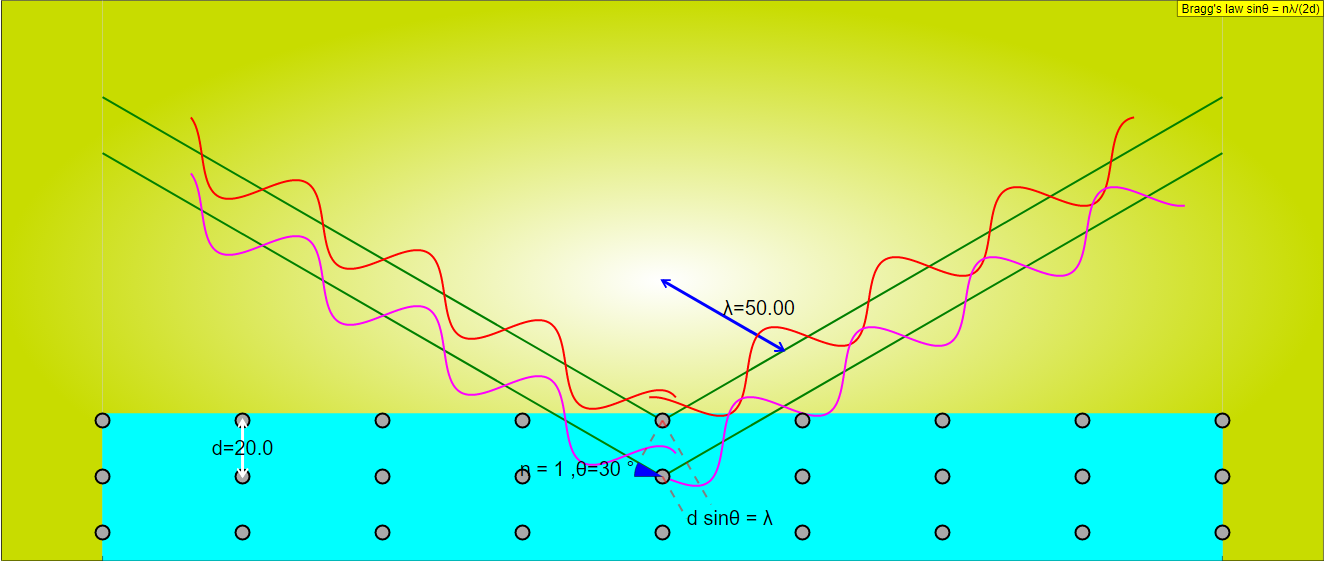
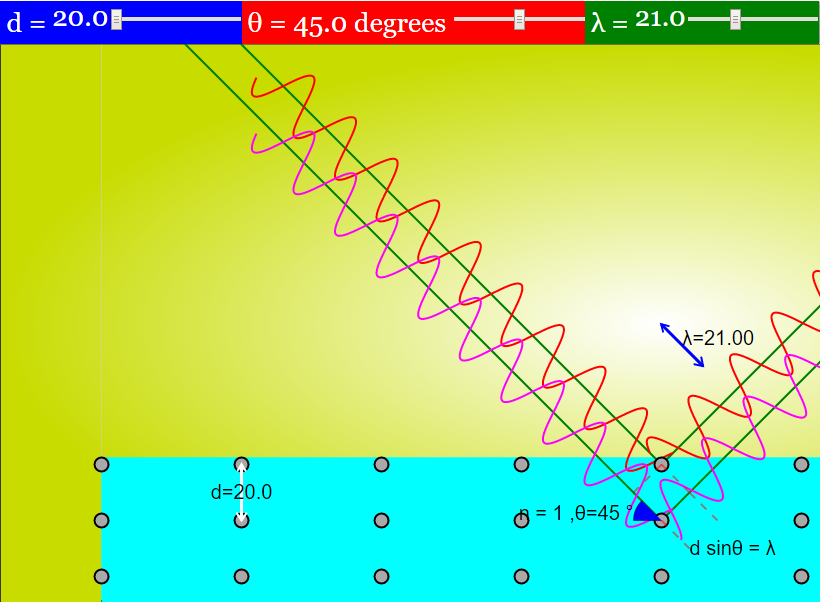
- The simulator focuses on Bragg's Law, which describes the conditions for constructive interference when radiation (with a wavelength comparable to atomic spacings) is scattered by the atoms of a crystalline system.
- The strongest constructive interference, leading to Bragg diffraction, occurs when the path difference between waves reflected from adjacent crystal planes is an integer multiple of the wavelength.
- The mathematical formulation of Bragg's Law presented is: "2dsinθ = n λ where n is a positive integer and λ is the wavelength of the incident wave".
- The simulator specifically operates for "n=1", meaning it demonstrates the first order of diffraction.
- Interactive Simulation:
- The resource is a "JavaScript Simulation Applet HTML5", indicating it is a web-based, interactive tool accessible through a browser without the need for additional plugins.
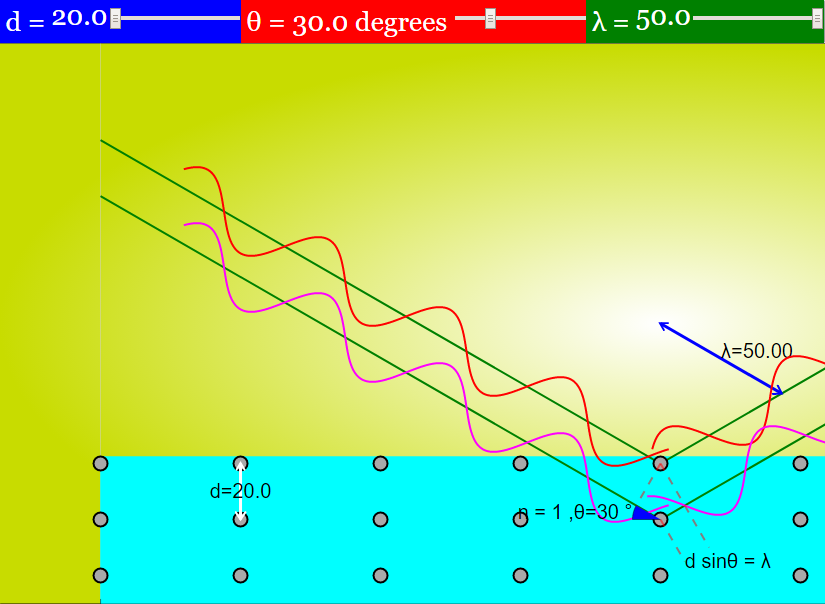
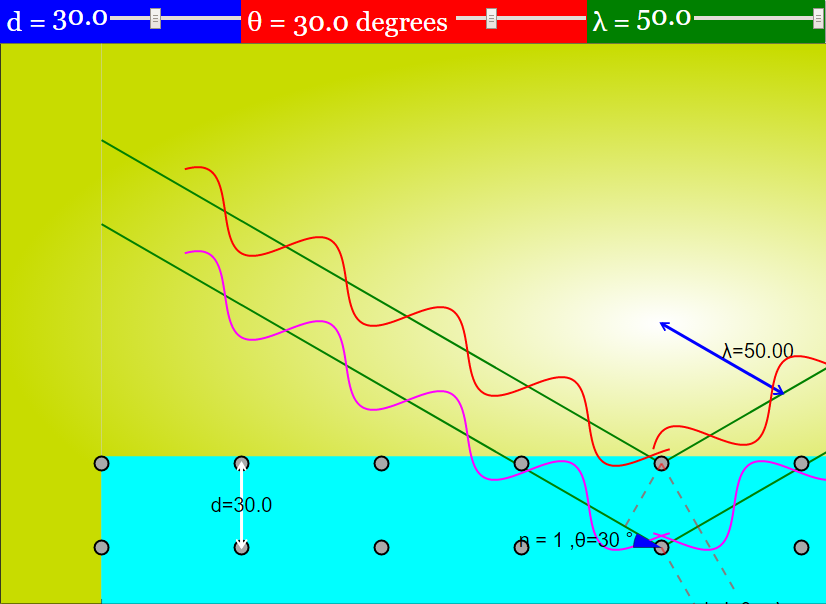
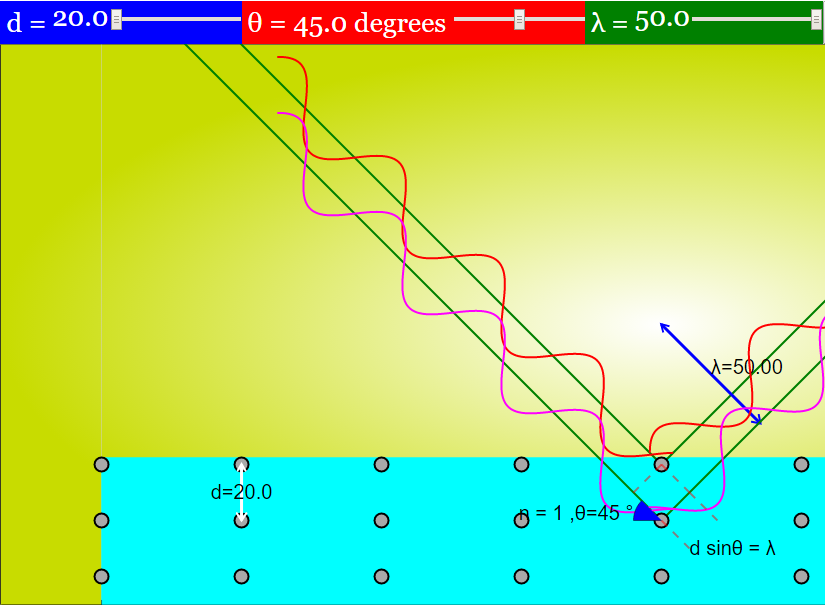
- Users can "adjust d, cta and lambda (wavelength)" using sliders within the simulation. The initial state of the simulator is set by the equation "2*d sin(cta)= lambda;".
- The simulation visually demonstrates that "you will find the outgoing waves only in phase at particular angle which satisfy 2d sin(cta)= nlambda" when Bragg diffraction occurs.
- Educational Purpose:
- The platform is "Open Educational Resources / Open Source Physics @ Singapore", highlighting its commitment to providing free and accessible learning materials.
- The resource includes sections like "About," "Sample Learning Goals," and "For Teachers," indicating its explicit intention for educational use.
- Instructions are provided for teachers on how to use the simulator, including details about the "Sliders" for adjusting variables and controls for "Toggling Full Screen," "Play/Pause," and "Reset."
- Technical Details:
- The simulator can be **"Embed"**ed into other webpages using an <iframe> tag, making it easily integrable into online learning environments.
- The credits acknowledge Fu-Kwun Hwang; Fremont Teng; Loo Kang Wee as the creators of the simulator.
- Context within the OER Platform:
- The simulator is categorized under "Home > Interactive Resources > Physics > 05 Electricity and Magnetism > 07 Magnetism > Mini Magnetic Golf Game JavaScript Simulation Applet HTML5 > Bragg's Law Simulator..." This breadcrumb trail, despite the slight miscategorization under "Magnetism" (Bragg's Law is related to wave phenomena and crystallography), places it within the broader collection of interactive physics resources.
- The page includes a vast list of other available JavaScript HTML5 applet simulations covering a wide range of physics and mathematics topics, demonstrating the extensive nature of the OER platform. These range from mechanics and waves to electromagnetism and even some mathematics-related simulations.
Key Quotes:
- "Bragg diffraction occurs when radiation, with a wavelength comparable to atomic spacings, is scattered in a specular fashion by the atoms of a crystalline system, and undergoes constructive interference" - This defines the phenomenon being simulated.
- "Bragg's law, which describes the condition on θ for the constructive interference to be at its strongest: 2dsinθ = n λ where n is a positive integer and λ is the wavelength of the incident wave" - This is the fundamental equation the simulator is based upon.
- "Initialize: 2*d sin(cta)= lambda;" - This indicates the starting relationship between the variables in the simulation.
- "You can adjust d,cta and lambda (wavelength) And you will find the outgoing waves only in phase at particular angle which satisfy 2d sin(cta)= nlambda" - This describes the interactive functionality and the observable outcome of satisfying Bragg's Law.
Conclusion:
The "Bragg's Law Simulator (for n=1) JavaScript Simulation Applet HTML5" is a valuable open educational resource for understanding the principles of Bragg's Law. Its interactive nature, allowing users to manipulate key parameters and observe the conditions for constructive interference, makes it an effective tool for both students and educators in the fields of physics, materials science, and related disciplines. The ease of embedding the simulator into other online platforms further enhances its utility. The inclusion of instructions and context within a broader collection of physics simulations underscores the commitment of Open Educational Resources / Open Source Physics @ Singapore to promoting interactive learning.
Bragg's Law Simulator Study Guide
Key Concepts
- Bragg Diffraction: The phenomenon where electromagnetic radiation or matter waves are scattered in a specular fashion by atoms in a crystalline system, leading to constructive interference at specific angles. This occurs when the wavelength of the radiation is comparable to the spacing between the atomic planes in the crystal lattice.
- Bragg's Law: A fundamental relationship in X-ray crystallography and solid-state physics that describes the conditions for constructive interference in Bragg diffraction. The law is mathematically expressed as 2dsinθ = nλ.
- Wavelength (λ): The spatial period of a periodic wave—the distance over which the wave's shape repeats. In the context of Bragg's Law, it refers to the wavelength of the incident radiation (e.g., X-rays).
- Atomic Spacing (d): The distance between parallel planes of atoms in a crystal lattice. This distance is a characteristic property of the crystal structure.
- Angle of Incidence/Scattering (θ): The angle between the incident wave (or beam) and the crystal planes. In Bragg's Law, θ is specifically the angle between the incident radiation and the reflecting planes.
- Order of Diffraction (n): A positive integer (1, 2, 3, ...) representing the order of the diffraction peak. For the provided simulator, n is fixed at 1.
- Constructive Interference: Occurs when two or more waves combine in phase, resulting in a wave with a larger amplitude. In Bragg diffraction, constructive interference leads to a strong reflected beam at specific angles.
- Specular Reflection: A type of reflection where the incident angle is equal to the reflected angle, similar to light reflecting from a mirror. In Bragg diffraction, the scattering by atomic planes is specular.
- Crystalline System: A solid material whose constituents (such as atoms, molecules, or ions) are arranged in a highly ordered microscopic structure, forming a crystal lattice that extends in all directions.
Quiz
- What phenomenon does Bragg's Law describe, and under what conditions does it primarily occur?
- State Bragg's Law in its mathematical form and briefly explain what each variable represents within the context of X-ray diffraction by crystals.
- According to the provided text, what must be true about the wavelength of the incident radiation for Bragg diffraction to be significant?
- Explain the role of atomic spacing (d) in determining the angles at which constructive interference will occur based on Bragg's Law.
- What is the significance of constructive interference in the context of Bragg diffraction experiments?
- In the Bragg's Law simulator described, which variables can the user directly adjust using sliders?
- For the Bragg's Law simulator where n=1, how does changing the wavelength of the incident wave affect the angle at which outgoing waves are in phase?
- Describe what happens at the atomic level within a crystalline system that leads to the diffraction of incident radiation.
- What does the term "specular fashion" imply about how radiation is scattered by the atoms in a crystalline system during Bragg diffraction?
- How does Bragg's Law provide a condition for the strongest constructive interference during the scattering of radiation by a crystal?
Quiz Answer Key
- Bragg's Law describes Bragg diffraction, which is the constructive interference of radiation scattered by the atoms of a crystalline system. This phenomenon primarily occurs when the wavelength of the incident radiation is comparable to the atomic spacings within the crystal.
- Bragg's Law is given by 2dsinθ = nλ. In this equation, 'd' represents the atomic spacing, 'θ' is the angle of incidence (and reflection) relative to the crystal planes, 'n' is the order of diffraction (a positive integer, 1 in the simulator), and 'λ' is the wavelength of the incident wave.
- The text states that Bragg diffraction occurs when radiation has a wavelength comparable to atomic spacings. This suggests that if the wavelength is significantly larger or smaller than the atomic spacing, observable diffraction effects will be minimal.
- Atomic spacing (d) is inversely proportional to the sine of the angle (θ) at which constructive interference occurs for a given wavelength. This means that crystals with smaller atomic spacing will exhibit strong diffraction peaks at larger angles, and vice versa.
- Constructive interference in Bragg diffraction leads to a strong reflected beam of radiation at specific angles. These angles are characteristic of the crystal structure and the wavelength of the incident radiation, allowing scientists to study the arrangement of atoms within the crystal.
- In the described Bragg's Law simulator, the user can directly adjust the atomic spacing (d), the angle of incidence/scattering (cta or θ), and the wavelength of the incident radiation (lambda or λ) using sliders.
- For n=1, according to Bragg's Law (2dsinθ = λ), if the wavelength (λ) is increased while the atomic spacing (d) remains constant, the sine of the angle (sinθ) must also increase to satisfy the equation, resulting in a larger angle (θ) for constructive interference. Conversely, a decrease in wavelength will lead to a smaller angle.
- When radiation strikes a crystalline system, it is scattered by the electrons surrounding each atom. If the conditions of Bragg's Law are met, the waves scattered from different atomic planes will have path length differences that are integer multiples of the wavelength, leading to constructive interference in specific directions.
- "Specular fashion" indicates that the radiation is scattered by the atomic planes in a mirror-like way, where the angle of incidence equals the angle of reflection for each plane. The constructive interference then depends on the path length differences between reflections from successive planes.
- Bragg's Law (2dsinθ = nλ) provides a precise mathematical condition that must be met for the path difference between waves reflected from adjacent crystal planes to be an integer multiple of the wavelength. When this condition is satisfied, the reflected waves interfere constructively, resulting in the strongest intensity at that particular angle.
Essay Format Questions
- Discuss the significance of Bragg's Law in the field of X-ray crystallography. How has this law enabled scientists to determine the structure of various materials, and what are some key applications of this technique?
- Explain the concept of constructive interference as it relates to Bragg diffraction. Describe how the interplay between wavelength, atomic spacing, and the angle of incidence leads to the observable diffraction patterns.
- The provided text mentions a Bragg's Law simulator with n=1. Discuss the role of the order of diffraction (n) in the general form of Bragg's Law (2dsinθ = nλ). How would observing higher orders of diffraction (n > 1) provide additional information about a crystal structure?
- Considering the interactive nature of the Bragg's Law simulator, how can such simulations enhance the learning experience for students studying wave phenomena and the structure of matter? Discuss the benefits of allowing users to manipulate variables like wavelength, atomic spacing, and angle of incidence.
- Beyond X-rays, Bragg diffraction principles are also applicable to other forms of radiation and matter waves. Discuss how neutron diffraction and electron diffraction utilize similar concepts and what advantages they might offer compared to X-ray diffraction in certain applications.
Glossary of Key Terms
- Amplitude: The maximum extent of a vibration or oscillation, measured from the position of equilibrium. In wave phenomena, it is related to the intensity or strength of the wave.
- Constructive Interference: The superposition of two or more waves that results in a wave with a greater amplitude than the original waves, occurring when the waves are in phase.
- Crystal Lattice: The regular, repeating three-dimensional arrangement of atoms, ions, or molecules in a crystalline solid.
- Diffraction: The bending of waves around obstacles or through narrow openings, or the spreading of waves as they pass by an edge. In the context of crystals, it refers to the scattering of waves by the periodic structure.
- Incident Wave: The wave that impinges on a surface or medium. In Bragg diffraction, it is the radiation directed towards the crystal.
- Open Educational Resources (OER): Teaching, learning, and research materials in any medium – digital or otherwise – that reside in the public domain or have been released under an open license, permitting no-cost access, use, adaptation, and redistribution by others with no or limited restrictions.
- Phase (of a wave): The position of a point in time on a waveform cycle. Waves are "in phase" if their crests and troughs align, leading to constructive interference.
- Scattered Wave: A wave that has been deflected or dispersed after interacting with an obstacle or a medium. In Bragg diffraction, these are the waves deflected by the atoms of the crystal.
- Simulation Applet: A small, self-contained application, often written in languages like JavaScript, that runs within another program (like a web browser) to model a physical or conceptual system interactively.
- Specular: Having the properties of a mirror; reflecting light or other radiation without scattering.
Sample Learning Goals
[text]
For Teachers
Bragg's Law Simulator (for n=1) JavaScript Simulation Applet HTML5
Instructions
Sliders

Toggling Full Screen
Play/Pause and Reset Buttons

Research
[text]
Video
[text]
Version:
Other Resources
[text]
Frequently Asked Questions about the Open Educational Resources / Open Source Physics @ Singapore Website
1. What is the main purpose of the Open Educational Resources / Open Source Physics @ Singapore website?
The website serves as a repository of open educational resources, primarily focusing on interactive physics simulations and applets created using JavaScript and HTML5. Its main purpose is to provide educators and learners with free, accessible, and interactive tools to enhance the understanding of physics concepts.
2. What is Bragg's Law, as described on this site?
Bragg's Law describes the condition for constructive interference, known as Bragg diffraction, to occur when radiation (like X-rays or neutrons) with a wavelength comparable to the atomic spacing in a crystalline system is scattered by the atoms. The law is mathematically expressed as 2dsinθ = nλ, where 'd' is the spacing between crystal planes, 'θ' is the angle of incidence, 'n' is a positive integer (the order of diffraction), and 'λ' is the wavelength of the incident wave. The simulator on the site focuses on the case where n=1.
3. What kind of interactive resources can be found on this website?
The website hosts a wide variety of interactive simulations and applets covering various topics in physics and mathematics. Examples include simulations for Bragg's Law, magnetic fields, mechanics (like collisions and projectile motion), waves, optics, electricity and magnetism, and even some mathematical concepts. These resources are designed to allow users to manipulate variables and observe the resulting phenomena.
4. Who are the creators and contributors to these resources?
The credits for the Bragg's Law Simulator specifically mention Fu-Kwun Hwang, Fremont Teng, and Loo Kang Wee. The website also indicates contributions from various other individuals and projects, as seen in the long list of available simulations and applets. This suggests a collaborative effort in developing and sharing these educational tools.
5. How can the Bragg's Law Simulator be used?
The Bragg's Law Simulator allows users to adjust three key variables using sliders: 'd' (spacing between crystal planes), 'cta' (which likely represents the angle θ in Bragg's Law), and 'lambda' (wavelength of the incident wave). By manipulating these parameters, users can observe when the outgoing waves are in phase, thus satisfying Bragg's Law (2dsin(cta) = n*lambda, where n=1 in this simulator) and experiencing constructive interference. The simulator also features play/pause and reset buttons, and a toggle for full-screen mode.
6. Are these resources intended for a specific educational level?
While some resources might be more suitable for certain levels, the wide range of topics and complexity suggests that these materials can be used across various educational levels, from secondary school to potentially undergraduate studies. The presence of resources related to primary school science and advanced physics topics like nuclear physics and electromagnetism supports this idea.
7. Can these simulations be embedded into other websites or learning platforms?
Yes, the website explicitly provides an embed code (an iframe) for the Bragg's Law Simulator, indicating that these interactive resources are designed to be easily integrated into other web pages or online learning environments. This facilitates the use of these tools in a broader educational context.
8. Is there any information about the licensing or terms of use for these resources?
Yes, the website footer states that the contents are licensed under the Creative Commons Attribution-Share Alike 4.0 Singapore License. It also provides a separate link and contact information for commercial use of the EasyJavaScriptSimulations Library, indicating that while the educational content is openly shared, commercial applications may have different licensing terms.